
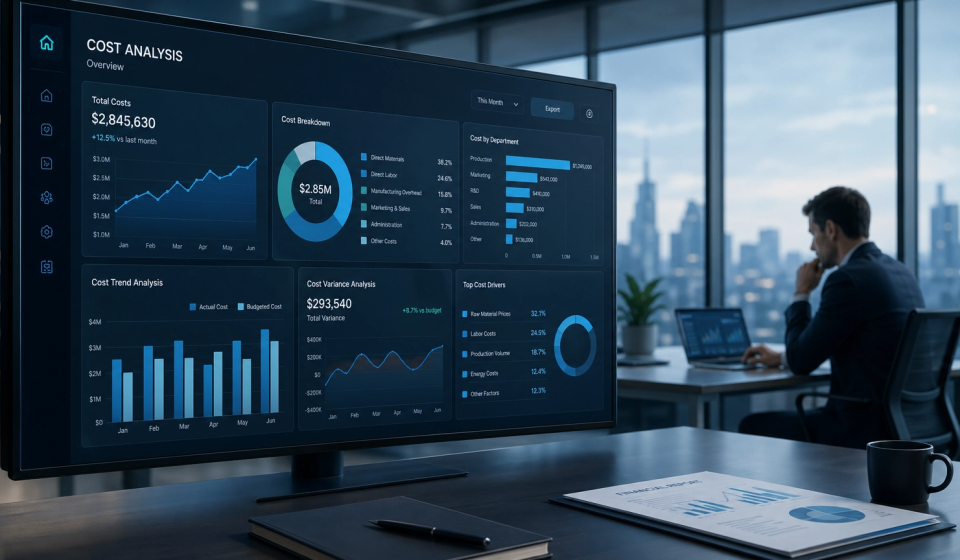
Managerial Accounting and Cost Analysis: 17 Powerful Insights to Boost Business Decisions

Managerial Accounting and Cost Analysis
Introduction to Managerial Accounting and Cost Analysis
Managerial accounting and cost analysis are essential tools that help organizations make informed decisions. Unlike financial accounting, which focuses on external reporting, managerial accounting is designed for internal use. It provides managers with data to plan, control, and evaluate business operations.
According to Managerial Accounting Training Course, managerial accounting equips professionals with skills to analyze cost behaviors, apply costing systems, and improve profitability.
In today’s competitive business environment, understanding costs is not optional—it’s critical. Companies rely on cost analysis to determine pricing, control expenses, and maximize profits.
Role of Managerial Accounting in Organizations
Managerial accounting plays a central role in organizational success. It supports three key functions:
Planning
Managers use accounting data to set goals and create budgets. This helps businesses prepare for future challenges.
Control
Through monitoring and evaluation, organizations ensure that actual performance aligns with plans.
Decision-Making
Managerial accounting provides relevant information for decisions such as pricing, investment, and cost reduction.
Programs like Cost Behavior and Systems Training emphasize practical decision-making skills using real-world scenarios.
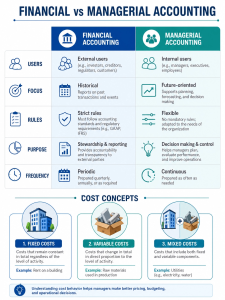
Key Differences Between Financial and Managerial Accounting
| Feature | Financial Accounting | Managerial Accounting |
|---|---|---|
| Audience | External users | Internal managers |
| Focus | Historical data | Future planning |
| Rules | Strict standards | Flexible |
| Reports | Standardized | Customized |
Managerial accounting is more flexible and tailored to specific business needs.
Understanding Cost Concepts
Cost analysis begins with understanding different types of costs:
Fixed Costs
These remain constant regardless of production levels (e.g., rent).
Variable Costs
These change with production volume (e.g., raw materials).
Mixed Costs
These contain both fixed and variable components.
Direct vs Indirect Costs
- Direct costs: Easily traced to a product
- Indirect costs: Shared across departments
Understanding these concepts helps managers allocate resources efficiently.
Cost Behavior and Estimation
Cost behavior refers to how costs change with activity levels. Accurate estimation is crucial for budgeting and forecasting.
High-Low Method
A simple technique that uses highest and lowest activity levels to estimate costs.
Regression Analysis
A more advanced method that provides precise cost predictions.
Courses like Budgeting and Forecasting Training teach these estimation techniques in detail.
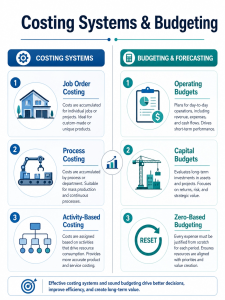
Costing Systems in Managerial Accounting
Different costing systems are used depending on the business type:
Job Order Costing
Used for customized products (e.g., construction projects).
Process Costing
Applied in mass production industries.
Activity-Based Costing (ABC)
Allocates overhead based on activities, improving accuracy.
As highlighted in Activity-Based Costing Course, ABC is particularly useful in complex organizations.
Budgeting and Forecasting
Budgeting is a key component of managerial accounting.
Types of Budgets
- Operating budgets
- Capital budgets
Flexible vs Static Budgets
Flexible budgets adjust to activity levels, while static budgets remain fixed.
Zero-Based Budgeting
Requires justification for all expenses, promoting efficiency.
Training programs like Advanced Budgeting Techniques provide hands-on experience in financial planning.
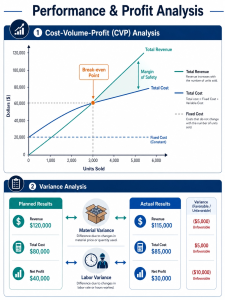
Variance Analysis and Performance Measurement
Variance analysis compares actual performance with planned results.
Types of Variances
- Material variance
- Labor variance
Importance
It helps identify inefficiencies and improve performance.
According to Variance Analysis Training, this process is essential for cost control and strategic adjustments.
Cost-Volume-Profit (CVP) Analysis
CVP analysis examines the relationship between costs, volume, and profit.
Break-even Analysis
Determines the level of sales needed to cover costs.
Margin of Safety
Measures how much sales can drop before losses occur.
These tools are widely used in financial planning and decision-making.
Strategic Decision-Making Using Cost Data
Managerial accounting supports strategic decisions such as:
- Make-or-buy decisions
- Pricing strategies
- Investment analysis
Businesses that leverage cost data effectively gain a competitive advantage.
Technology in Managerial Accounting
Modern tools like AI and automation are transforming managerial accounting. They improve accuracy, speed, and data analysis capabilities.
Real-World Applications
Managerial accounting is used across industries:
- Manufacturing: Cost control and efficiency
- Services: Pricing and budgeting
- Retail: Inventory management
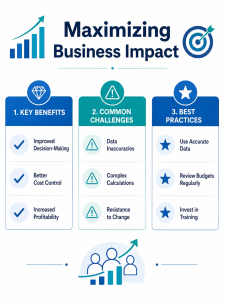
Benefits of Managerial Accounting and Cost Analysis
- Improved decision-making
- Better cost control
- Increased profitability
- Enhanced efficiency
Challenges and Limitations
- Data inaccuracies
- Complex calculations
- Resistance to change
Best Practices for Effective Cost Analysis
- Use accurate data
- Apply appropriate costing methods
- Regularly review budgets
- Invest in training
FAQs
1. What is managerial accounting and cost analysis?
It involves analyzing financial data to support internal decision-making.
2. Why is cost analysis important?
It helps businesses control expenses and improve profitability.
3. What are the main costing methods?
Job order costing, process costing, and activity-based costing.
4. What is variance analysis?
A method of comparing actual results with planned performance.
5. How does budgeting help businesses?
It allows planning and resource allocation.
6. Who should learn managerial accounting?
Managers, accountants, entrepreneurs, and analysts.
Conclusion
Managerial accounting and cost analysis are powerful tools that drive business success. By understanding cost behavior, applying effective costing systems, and using data for decision-making, organizations can improve efficiency and profitability.
If you want to deepen your expertise, consider professional training such as Managerial Accounting Course by Forelite Training to gain practical, real-world skills.
Reference
https://www.linkedin.com/pulse/managerial-accounting-cost-analysis-17-powerful-micbf