
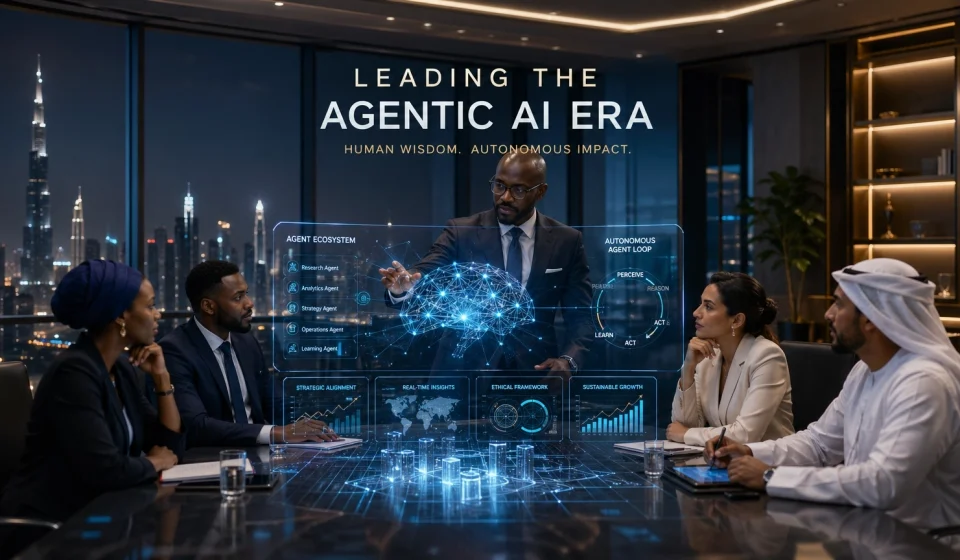

Autonomous agents are no longer a pilot project. They are reshaping procurement, compliance, and talent strategy across East Africa and global markets simultaneously. Here is how to lead, not just react.
In 2026, Agentic AI, systems capable of independent goal-setting, multi-step reasoning, and self-correction; represents the single most consequential shift in organizational design since the arrival of enterprise software. For corporate leaders, HR directors, and public sector decision-makers across Africa and MENA, the strategic imperative is no longer whether to adopt Agentic AI but how to govern, train for, and scale it responsibly. Organizations that build internal capability now, rather than outsourcing comprehension to vendors, will set the competitive and regulatory standard for their sectors through the decade ahead.
What exactly is Agentic AI, and why does it matter now?
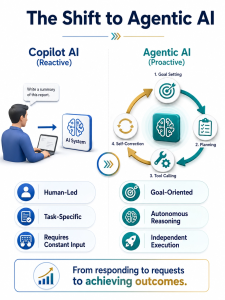
Most executives have grown comfortable with AI such as a copilot, a system that responds when prompted. Agentic AI changes the architecture entirely. An agentic system sets sub-goals, calls external tools, monitors its own outputs, and iterates without waiting for a human at each step.
Think of it less as a smarter chatbot and more as a junior analyst who can run a full due-diligence sweep, draft the memo, flag the anomalies, and escalate only the decisions that genuinely require you. The leverage is extraordinary and so is the governance burden if your organisation is not prepared.
The What — Technical Skill
Agentic Architecture
Understanding planning loops, tool-calling, memory retrieval, and multi-agent orchestration is the new baseline literacy for technology leaders.
The Why – Leadership Strategy
Competitive Governance
Firms that govern agentic systems proactively will set the sector standard. Those who do not will be regulated into compliance at far greater cost.
The How – Human Centricity
Workforce Wellbeing
Role redesign must accompany deployment. Teams need structured transition support, not just retraining modules, to sustain performance and morale.
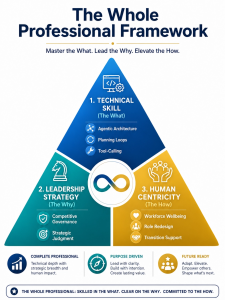
At ForElite, we call this the Whole Professional Framework and it is the lens through which we design every programme in our AI Leadership and Digital Transformation suite. Technical fluency alone is insufficient. Strategic judgment and human-centred transition management must advance together.
Why should Africa and MENA firms prioritise Agentic AI strategy right now?
The honest answer is that the window for setting institutional norms is narrow. When a transformative capability arrives, the organisations that build internal understanding first get to shape policy, procurement standards, and talent benchmarks. Those that wait inherit frameworks designed by others.
The African Continental Free Trade Area (AfCFTA) and the African Union’s Agenda 2063 both identify digital infrastructure and knowledge economies as primary growth levers. Agentic AI sits at the intersection of both. For Nairobi, Lagos, Riyadh, and Dubai alike, the question is not capability, it is readiness at the leadership level.
“The organisations that will thrive in the agentic era are not those with the largest AI budgets. They are those whose leaders understand what to delegate, what to govern, and what to keep profoundly human.”
In Kenya, the Data Protection (General) Regulations 2023 (POLD) require that automated decision-making systems affecting individuals include human oversight provisions and auditability trails. Any agentic deployment touching HR, lending, or public service delivery must be stress-tested against these obligations before go-live. Similarly, the UAE’s AI Governance Framework (2024) and Saudi Arabia’s emerging National AI Ethics Guidelines set analogous expectations for MENA deployments. Compliance is not a constraint on strategy, it is competitive differentiation when done well.
How can African and MENA firms scale Agentic AI responsibly?
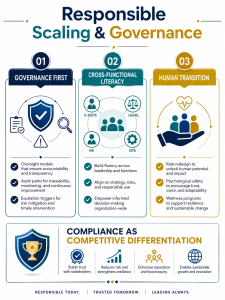
Responsible scaling is not a slower form of scaling. It is a more durable one. Three principles guide the organisations we work with at ForElite:
Start with governance architecture, not use cases
The temptation is to begin with the most exciting application, autonomous procurement agents, AI-driven performance reviews, predictive policy modelling. Resist it. Begin instead by defining your organisation’s oversight model: who approves agentic scope, who audits decisions, and what the escalation path looks like when an agent behaves unexpectedly. This governance layer is the foundation every use case will rest on.
Build cross-functional AI literacy, not just technical teams
Agentic systems surface in legal contracts, HR workflows, financial models, and communications strategy simultaneously. If only your IT department understands them, your risk exposure is significant. Our corporate training programmes are designed specifically to build AI fluency across the C-suite, legal teams, HR directors, and operations managers, because the decisions that shape agentic deployments are rarely made by engineers.
Invest in human transition, not just tool adoption
Every agentic deployment displaces or reshapes roles. The organisations that navigate this well treat workforce transition as a strategic function, not an afterthought. This means proactive role redesign, psychological safety frameworks for teams whose work is being automated adjacent to, and leadership communication that is honest about timelines and scope. Wellness and productivity are not competing priorities — in the agentic transition, they are the same priority.
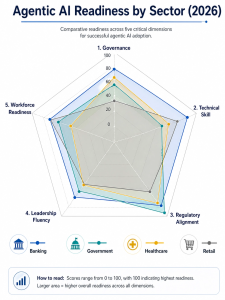
What does Agentic AI business strategy look like in practice across key sectors?
Public sector and government agencies
The highest-leverage agentic applications in government involve regulatory compliance monitoring, citizen service routing, and procurement optimisation. Kenya’s ongoing public sector digital transformation under the Bottom-Up Economic Transformation Agenda (BETA) creates natural alignment points for responsible AI deployment, particularly where agentic tools can reduce processing time in revenue collection and service delivery without eliminating the human accountability that public trust requires.
Our public sector leadership programmes are specifically designed to help government directors and permanent secretaries understand which decisions agentic systems can support and which must remain with elected or appointed human officials.
Financial services and banking
Agentic AI in financial services is already operating at the workflow level, loan underwriting assistants, AML monitoring agents, and customer onboarding systems that run multi-step verification autonomously. The 2026 challenge for CROs and compliance officers is not deployment but explainability: can your institution demonstrate to a regulator exactly which inputs led an agentic system to a decision? If not, the regulatory risk is systemic.
HR and people strategy
For HR directors, the 2026 question is a dual mandate: deploying agentic tools that improve recruitment, performance management, and learning while simultaneously designing the workforce strategy that accounts for the roles those same tools will transform. The leaders who navigate this well will define the employer brand premium of their organisations for the next decade.
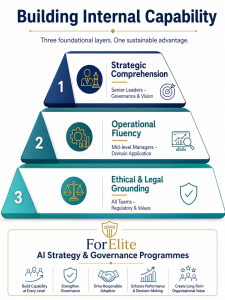
How do organisations build the internal capability to lead, not just use, Agentic AI?
The organisations that will set the standard are investing in three capability layers simultaneously:
- Strategic comprehension — senior leaders who understand agentic architecture well enough to govern it, even if they will never build it
- Operational fluency — mid-level managers who can identify where agentic tools should and should not be applied in their domain
- Ethical and legal grounding — teams who can stress-test deployments against regulatory requirements, institutional values, and stakeholder expectations before they go live
This is precisely the capability architecture that ForElite’s AI Strategy and Governance programmes are designed to build not in six-month academic cycles, but in intensive, executive-relevant formats that fit the rhythms of organisations already under operational pressure.
“The capability gap in 2026 is not technical. It is strategic. Most organisations have access to powerful agentic tools. Very few have leaders who know how to govern them.”
What is the first practical step for a corporate leader or HR director in Nairobi today?
Conduct an honest audit of your organisation’s AI literacy baseline not your tools inventory, but your human comprehension inventory. Ask: if our most significant agentic deployment encountered an unexpected outcome today, who in our leadership team could diagnose it, communicate it to the board, and redesign the governance response?
If the honest answer is “very few people,” that is the strategic gap to close first. Everything else; the tools, the use cases, the vendor relationships, builds on that foundation.
ForElite’s diagnostic workshops and executive briefings are designed to run that audit and produce a clear, prioritised capability roadmap in less than two days. The organisations we work with consistently report that this structured starting point rather than jumping directly to tool selection is what enables them to move with both speed and confidence.
Ready to build your Agentic AI leadership capability?
ForElite Training Institute delivers executive programmes in Nairobi and globally. Speak with our strategy team about a tailored cohort for your organisation.
References & Regulatory Sources: Kenya Data Protection (General) Regulations 2023 (POLD); African Union Agenda 2063 Digital Integration Framework; UAE AI Governance Framework 2024; AfCFTA Digital Trade Protocol 2025; Kenya Bottom-Up Economic Transformation Agenda (BETA). Statistics cited are indicative of industry analyst consensus ranges and should be verified against primary sources for formal citation.