


For decades, success was measured by simple numbers: how many products were sold, how many customers were served, or how many services were delivered. That approach worked in an era where demand often exceeded supply and competition was relatively limited. Today, organizations operate in a completely different environment. Customers expect personalized experiences, governments demand accountability, technology enables real-time performance measurement, and businesses face constant pressure to improve outcomes while controlling costs. This transformation has given rise to what experts call the shift to value, a strategic move away from measuring success purely by output toward evaluating meaningful outcomes and long-term impact.
The shift to value is no longer confined to healthcare. Businesses across manufacturing, education, finance, government, and technology are embracing value-driven strategies to improve efficiency, customer satisfaction, and sustainable growth. International organizations such as the World Health Organization (WHO) describe value as a holistic concept that prioritizes outcomes, integrated services, and strategic decision-making rather than simply minimizing costs.
Meanwhile, organizations investing in workforce development are discovering that professional training plays a critical role in creating long-term value. Companies increasingly partner with providers offering specialized programs in leadership, digital transformation, project management, monitoring and evaluation, and data analytics. Platforms like ForElite Institute have expanded access to industry-focused professional development that helps organizations strengthen employee capabilities while improving business outcomes.
The journey toward value is not a temporary trend. It represents a permanent transformation in how organizations define excellence, allocate resources, measure performance, and deliver meaningful results.
Understanding the Shift to Value
What Does “Shift to Value” Mean?
The shift to value represents a fundamental change in how organizations define success. Instead of focusing primarily on activities, transactions, or production volume, businesses are increasingly concentrating on the actual benefits created for customers, employees, communities, and stakeholders. In simple terms, it means asking a more important question: “What difference are we making?” rather than only asking “How much are we producing?” A company can manufacture millions of products, complete thousands of transactions, or serve countless customers, but if those activities do not create meaningful outcomes, the organization may struggle to achieve sustainable growth. Value-focused organizations recognize that quantity alone does not guarantee success.
Traditionally, businesses operated under a volume-driven mindset. More sales meant more revenue, more customers meant more success, and faster production meant greater efficiency. However, this approach often overlooked important factors such as customer loyalty, service quality, employee experience, innovation, and long-term sustainability. A shift to value requires organizations to look deeper into their operations and identify where real impact is created. This involves understanding customer needs, improving processes, investing in people, and using technology to make smarter decisions.
For example, a training organization that focuses only on the number of courses delivered may celebrate completing hundreds of sessions every year. However, a value-driven training provider evaluates whether participants gained practical skills, improved workplace performance, achieved career growth, and contributed to organizational improvement. This explains why modern professional development providers emphasize outcome-based learning approaches. Organizations seeking to strengthen workforce capabilities can explore specialized programs such as leadership development training, management skills development, and technical competency programs offered through platforms like ForElite Training that focus on creating measurable professional impact.
The shift to value also changes how leaders think about investment. Instead of viewing employees, technology, and training as expenses, organizations begin to see them as strategic assets that generate future returns. A company investing in employee skills, for instance, may experience improved productivity, better innovation, stronger retention, and increased customer satisfaction. Value creation becomes a continuous process where every decision is evaluated based on its contribution to broader organizational goals.
Why the Concept Matters More Than Ever
The importance of shifting to value has grown because the modern business environment has become more complex and competitive. Customers today have access to unlimited information and multiple alternatives. They no longer choose products and services based only on price. They consider quality, convenience, trust, ethical practices, customer experience, and the overall value they receive. Organizations that fail to understand this changing behavior risk losing relevance.
Additionally, economic uncertainty has forced businesses to become more strategic with their resources. Organizations cannot afford to invest heavily in activities that produce little measurable impact. Leaders are now expected to demonstrate clear returns from technology investments, employee development initiatives, marketing campaigns, and operational improvements. The shift to value helps organizations prioritize initiatives that deliver meaningful outcomes rather than simply increasing activity levels.
Digital transformation has accelerated this movement. Modern technologies provide organizations with access to enormous amounts of data, allowing leaders to understand performance patterns, customer behaviors, and operational challenges. Through analytics, businesses can identify what works, what needs improvement, and where resources should be directed. This data-driven approach allows organizations to move away from assumptions and make decisions based on evidence.
Professional skills development has become one of the strongest examples of value-based thinking. Organizations are realizing that training is not valuable because employees attend sessions; it is valuable because employees apply knowledge to solve problems and improve performance. Programs covering areas such as data analytics, monitoring and evaluation, project management, and digital skills help professionals transform knowledge into workplace results. Resources such as data management and analytics training programs demonstrate how skill development is becoming closely connected to organizational value creation.
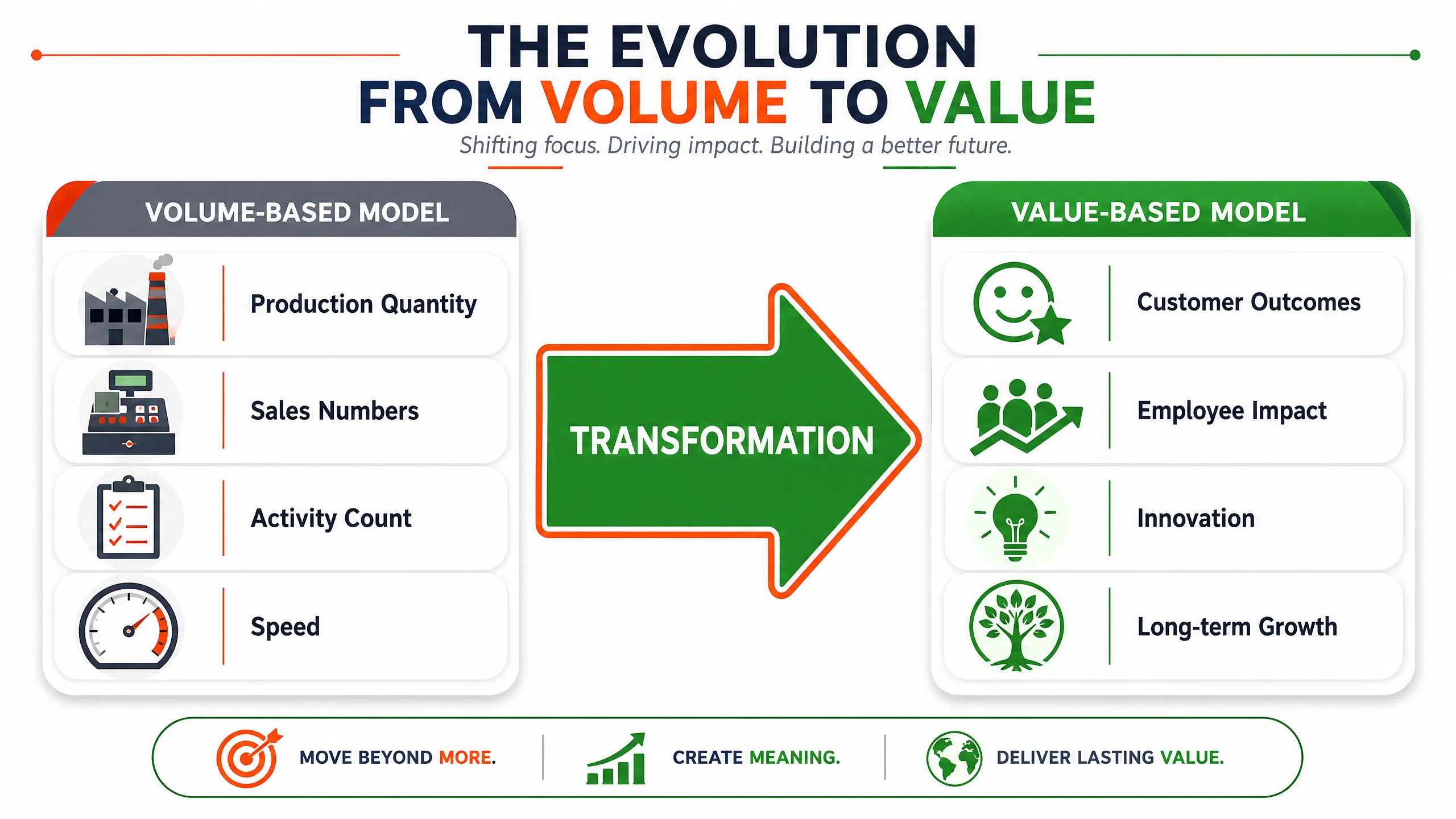
The Evolution from Volume to Value
Traditional Volume-Based Models
For many years, businesses operated using a volume-based model where growth was associated with increasing output. Manufacturers focused on producing more units at lower costs. Retailers concentrated on increasing sales numbers. Service providers measured success through the number of clients served or transactions completed. These measurements were easy to track and provided a straightforward picture of business performance.
However, volume-based models have significant limitations. They often encourage organizations to prioritize speed and quantity over quality and impact. A company may achieve impressive sales figures while experiencing declining customer satisfaction. A service provider may handle thousands of clients while failing to deliver meaningful experiences. A training institution may conduct many sessions but struggle to prove whether participants achieved measurable improvements after completing the programs.
The problem with volume-focused thinking is that it views organizations like machines where more output automatically creates more success. In reality, sustainable growth depends on multiple interconnected factors. Customer relationships, employee capabilities, innovation, operational efficiency, and social responsibility all contribute to long-term performance.
The limitations of volume-based strategies became increasingly visible during periods of rapid technological change. Digital platforms gave customers more choices, making loyalty harder to maintain. Global competition increased pressure on businesses to differentiate themselves. Organizations could no longer rely only on producing more; they needed to create better experiences and stronger outcomes.
Therefore, successful organizations began redefining performance measurement. Instead of focusing only on how many products were sold or services delivered, leaders started examining deeper indicators such as customer lifetime value, employee engagement, productivity improvements, and return on investment. This transformation marked the beginning of the shift toward value.
The Rise of Value-Based Thinking
Value-based thinking places outcomes at the center of organizational decision-making. It encourages leaders to understand what customers truly need and design solutions that create meaningful benefits. This approach requires organizations to move beyond short-term achievements and consider long-term impact.
A value-focused organization asks questions such as:
- How does our product improve customers’ lives?
- How does our service solve real problems?
- How do our employees contribute to innovation?
- How can technology improve efficiency and decision-making?
- What measurable outcomes demonstrate our success?
These questions help organizations develop strategies that create stronger connections between activities and results.
For example, consider a company investing in employee training. A volume-based approach might measure success by counting how many employees attended workshops. A value-based approach examines whether employees improved their skills, became more productive, solved workplace challenges, and contributed to organizational goals.
This approach has transformed professional learning. Modern organizations increasingly prefer customized training solutions aligned with their strategic objectives. Programs such as Monitoring and Evaluation training help professionals understand how to measure outcomes, assess performance, and demonstrate the impact of projects and initiatives.
Similarly, organizations undergoing digital transformation require employees who can adapt to new technologies and use information effectively. Digital competency programs, including those covering data analysis, automation, and technology adoption, support businesses in creating measurable value from digital investments.
Companies also recognize that achieving value requires strong communication and visibility. A well-designed digital strategy helps organizations communicate their impact, reach relevant audiences, and build stronger relationships. Digital agencies such as Nexera Digital Solutions support businesses by developing digital solutions that improve online presence, customer engagement, and strategic growth.
The transition from volume to value is ultimately a mindset change. It requires organizations to stop viewing success as a race for more and start focusing on becoming better, smarter, and more impactful. Businesses that embrace this philosophy position themselves to thrive in an environment where meaningful outcomes matter more than simple numbers.
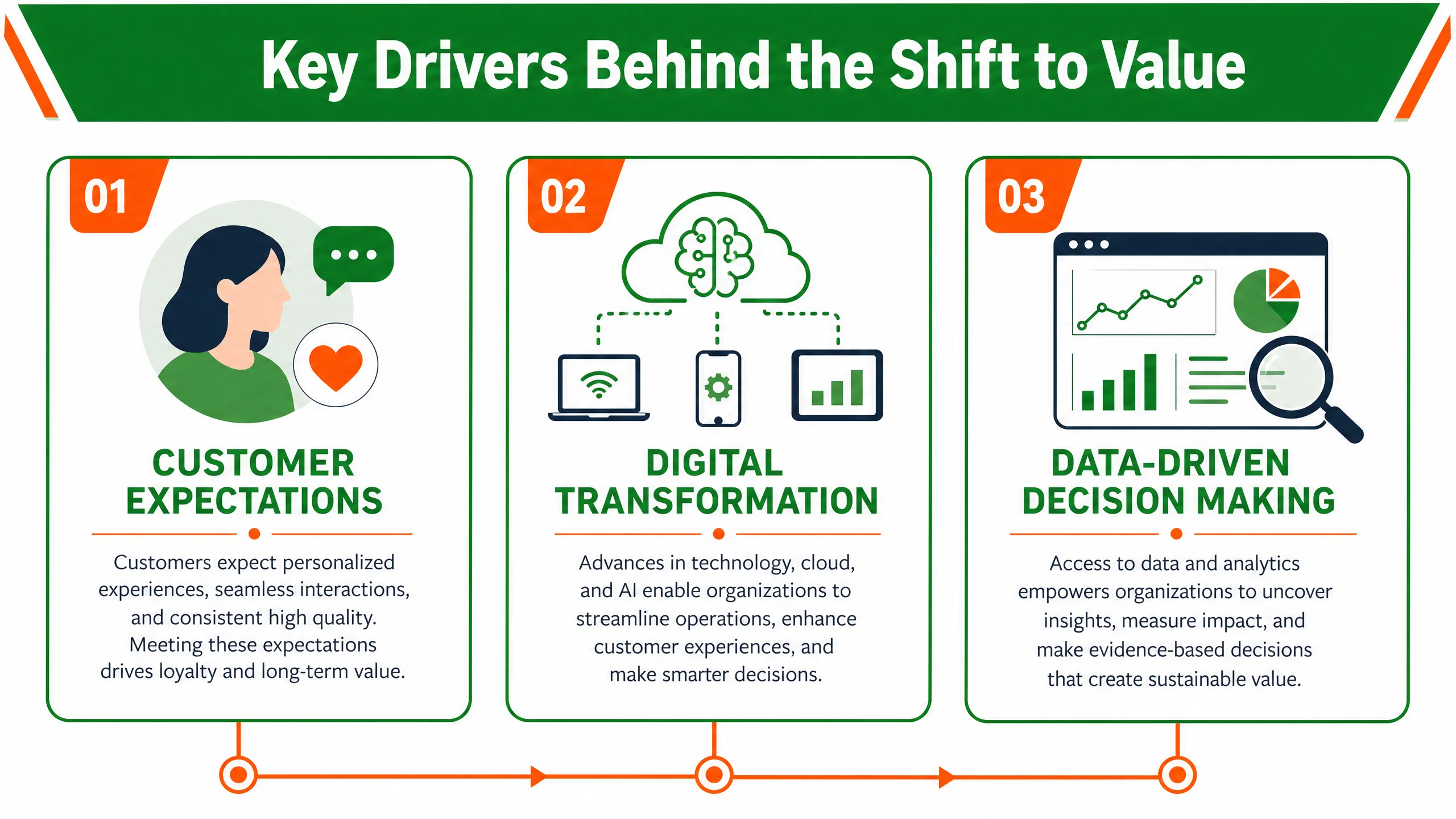
Key Drivers Behind the Shift to Value
Customer Expectations
One of the strongest forces behind the shift to value is the changing expectations of customers. In previous decades, customers often had limited choices, making availability and affordability the primary factors influencing purchasing decisions. Today, customers are more informed, connected, and selective. They compare options instantly, read reviews, seek recommendations online, and expect organizations to provide experiences that match their personal needs. This change has forced businesses to rethink how they create and deliver value.
Modern customers are not only interested in what they buy; they are interested in the impact and experience associated with their purchase. They want solutions that solve their problems efficiently, provide convenience, and create lasting benefits. A company that only focuses on selling more products without understanding customer outcomes may achieve short-term success but struggle to build loyalty. Organizations that embrace value-based thinking instead focus on creating meaningful relationships and delivering solutions that improve customers’ lives.
For instance, a software company is no longer judged only by the number of subscriptions it sells. Customers evaluate whether the software improves productivity, reduces operational challenges, and helps them achieve business objectives. Similarly, a professional training provider is not measured only by the number of participants attending courses but by whether learners gain practical skills that improve workplace performance.
This customer-centered approach has become essential across industries. Organizations are investing in customer research, data analytics, feedback systems, and personalized experiences to understand what creates real value. By collecting and analyzing customer insights, businesses can identify gaps, improve services, and develop solutions that respond to actual needs.
The professional training industry provides a clear example of this transformation. Companies are increasingly looking for learning solutions that align with organizational challenges rather than generic courses. They want programs that develop leadership abilities, technical expertise, digital skills, and strategic thinking. Platforms such as ForElite Training support this value-driven approach by providing professional development programs designed to help individuals and organizations achieve measurable growth.
Ultimately, customer expectations have moved the business conversation from “How much can we deliver?” to “How much value can we create?” Organizations that understand this shift are better positioned to develop trust, maintain customer relationships, and achieve sustainable success.
Digital Transformation
Digital transformation is another major factor accelerating the movement toward value-based strategies. Technology has changed how organizations operate, communicate, and measure performance. Businesses now have access to advanced tools that allow them to collect data, automate processes, improve decision-making, and create personalized customer experiences.
Previously, many organizations relied on historical information and manual processes to make decisions. Leaders often depended on assumptions, experience, or limited reports. However, digital technologies have created opportunities for real-time insights. Through analytics platforms, artificial intelligence, cloud computing, and automation, organizations can understand performance patterns and identify opportunities for improvement.
This technological evolution has changed the definition of efficiency. In the past, efficiency was often associated with producing more output using fewer resources. Today, efficiency is about creating better outcomes through smarter processes. A digitally transformed organization does not simply automate existing activities; it redesigns operations to create greater value.
For example, a healthcare organization implementing digital records is not only reducing paperwork. The real value comes from improving patient experiences, enabling faster access to information, reducing errors, and supporting better medical decisions. Similarly, a financial institution using artificial intelligence is not only processing transactions faster; it is improving customer security, personalization, and accessibility.
Organizations must also ensure that employees have the skills required to benefit from digital transformation. Technology investments often fail when teams lack the knowledge needed to use new systems effectively. This has increased demand for training programs focused on digital literacy, data management, automation, and technology adoption.
Professional learning providers are helping organizations bridge this skills gap through targeted programs. Courses covering areas such as Business Analytics with Excel Training, data visualization, digital transformation, and information management enable professionals to convert technology investments into measurable business value.
Therefore, digital transformation is not simply about adopting new technologies. It is about using technology strategically to improve outcomes, solve problems, and create sustainable advantages.
Data-Driven Decision Making
Data has become one of the most valuable resources in modern organizations. The shift to value depends heavily on the ability to measure performance, understand trends, and make informed decisions. Without reliable data, organizations may invest resources in activities that appear successful but produce limited impact.
A value-driven organization uses data to answer important questions: What outcomes are we achieving? Are our customers satisfied? Are our employees becoming more productive? Are our investments generating meaningful returns? These questions help leaders move beyond assumptions and focus on evidence-based strategies.
However, having data alone is not enough. Organizations must develop the ability to interpret information and convert insights into action. This requires skilled professionals who understand analytics, reporting, visualization, and performance measurement. As a result, data literacy has become one of the most important capabilities in the modern workplace.
For example, a nonprofit organization implementing a community development project may collect thousands of data points. The true value comes from analyzing that information to determine whether the project improved lives, achieved objectives, and used resources effectively. Similarly, a business may track sales data, but the real value comes from understanding customer behavior, identifying opportunities, and improving strategies.
This explains why fields such as Monitoring and Evaluation (M&E) have become increasingly important. Organizations need professionals who can measure results, assess effectiveness, and demonstrate impact. Training programs such as Monitoring and Evaluation courses help professionals develop skills required to design indicators, analyze performance, and communicate results.
Additionally, data-driven thinking supports continuous improvement. Organizations can identify weaknesses, test new approaches, and make adjustments based on measurable evidence. Instead of waiting for problems to become serious, leaders can use data to predict challenges and take proactive action.
The future belongs to organizations that can transform information into intelligence. Data is not valuable simply because it exists; it becomes valuable when it helps organizations make better decisions and create stronger outcomes.
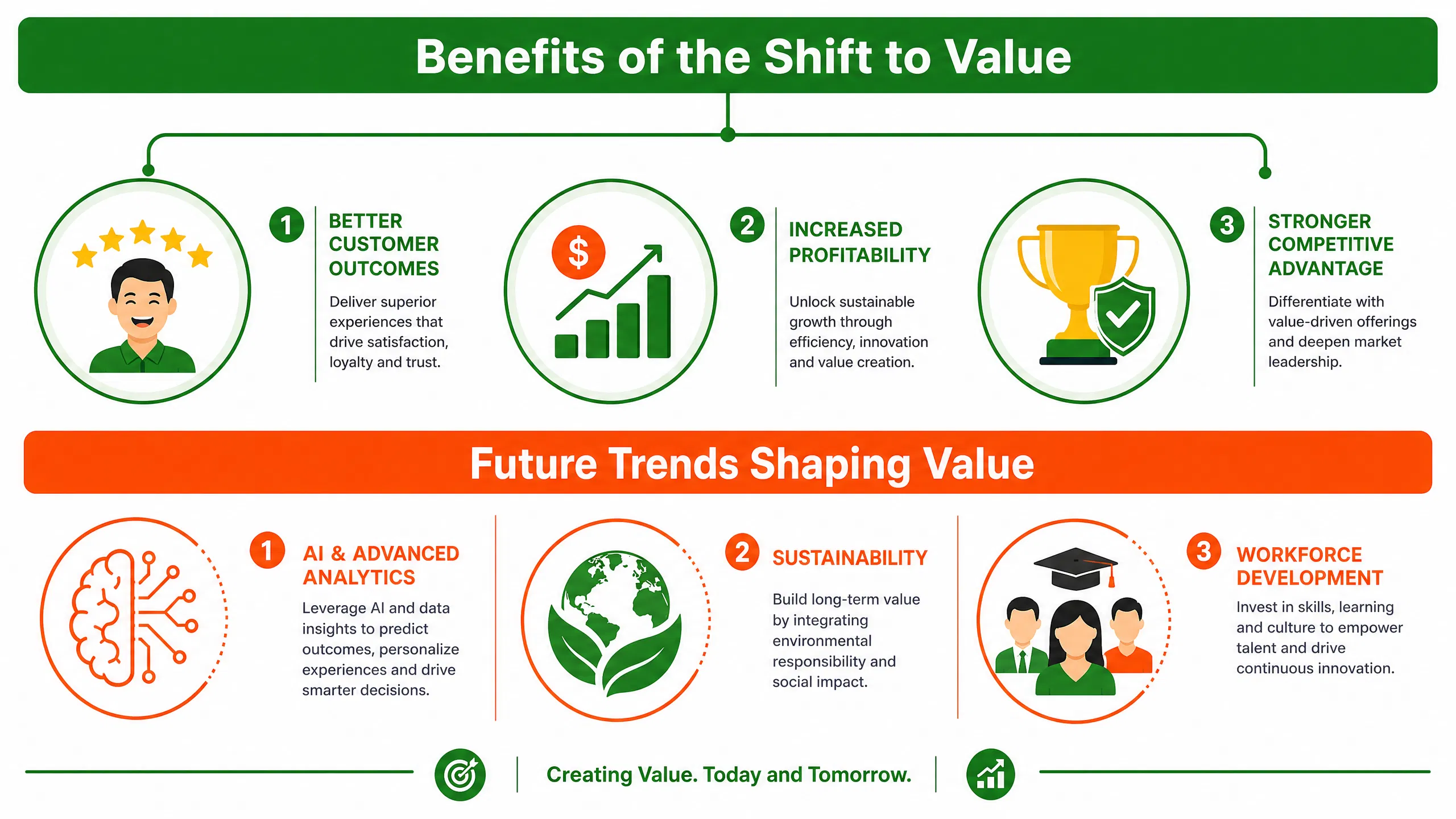
Benefits of Adopting a Value-Based Approach
Better Customer Outcomes
One of the biggest benefits of shifting to value is improved customer outcomes. When organizations focus on creating meaningful results rather than simply increasing sales or production, they naturally become more customer-focused.
A value-based approach encourages businesses to understand customer challenges deeply. Instead of offering standard solutions, organizations develop products and services designed to solve specific problems. This creates stronger relationships because customers recognize that the organization understands their needs.
For example, a professional training provider following a value-based model does not simply offer courses because they are popular. Instead, it identifies skill gaps within industries and develops learning solutions that address real workplace challenges. A course in project management, leadership, GIS, financial management, or digital skills becomes valuable when participants can apply knowledge to improve performance.
This approach also improves customer loyalty. Customers are more likely to continue working with organizations that consistently deliver meaningful benefits. Trust grows when businesses demonstrate that they are focused on helping customers succeed rather than only increasing revenue.
Organizations that prioritize value also receive better feedback. Customers become partners in improvement, providing insights that help businesses refine their products and services. This creates a continuous cycle where better understanding leads to better solutions, which leads to stronger customer relationships.
Increased Profitability
A common misconception is that focusing on value means sacrificing profitability. In reality, value-based strategies often improve financial performance because they help organizations use resources more effectively.
When businesses understand what creates value, they can invest in activities that produce the greatest impact. They avoid wasting resources on unnecessary processes, ineffective marketing campaigns, or products that fail to meet customer needs.
For example, a company that analyzes customer data may discover that certain services generate higher satisfaction and stronger returns. Instead of spreading resources across every activity equally, the organization can focus investment on areas with the greatest potential.
Value-driven organizations also benefit from stronger customer retention. Acquiring new customers is often more expensive than maintaining existing relationships. By consistently delivering meaningful outcomes, businesses can increase loyalty and create long-term revenue opportunities.
Employee development also contributes to profitability. Skilled employees are more productive, innovative, and capable of solving complex problems. Organizations investing in workforce development through programs such as leadership and management training often experience improved performance and stronger organizational capability.
In the long run, profitability becomes a result of creating genuine value rather than simply pursuing short-term financial gains.
Stronger Competitive Advantage Through Value Creation
In an increasingly competitive global marketplace, organizations can no longer depend only on price, size, or availability to differentiate themselves.Today, businesses must demonstrate why customers, employees, and partners should choose them over alternatives. This is where the shift to value creates a powerful competitive advantage. Organizations that understand how to deliver meaningful outcomes are better positioned to build stronger brands, attract loyal customers, and respond quickly to changing market conditions.
A value-driven organization competes differently from a volume-focused organization. Instead of asking, “How can we sell more?” it asks, “How can we solve bigger problems and create better experiences?” This mindset encourages innovation because teams are constantly searching for ways to improve products, services, and processes. As a result, organizations become more adaptable and resilient.
For example, two companies may offer similar consulting services, but the one focused on value will stand out by demonstrating measurable improvements achieved by previous clients. Customers increasingly want evidence of impact, not just promises. They want to understand how a service will help them reduce costs, improve efficiency, increase revenue, manage risks, or achieve strategic goals.
The same principle applies to employee development. Organizations that invest in meaningful learning opportunities create a workforce capable of innovation and problem-solving. Training is no longer viewed as a one-time event but as a continuous strategy for improving organizational capability. Professional development programs such as Human Resource Management Training help organizations strengthen their people strategies, improve employee performance, and create workplace cultures that support growth.
Additionally, value creation improves organizational reputation. Companies that consistently deliver positive outcomes build credibility among customers and stakeholders. A strong reputation becomes an important asset because trust influences purchasing decisions, partnerships, and long-term relationships.
In the digital age, competitive advantage also depends on visibility and communication. Organizations must effectively communicate their value through digital platforms, content marketing, and customer engagement strategies. Digital solutions providers such as Nexera Digital Solutions help businesses strengthen their online presence, improve customer engagement, and develop digital strategies that support long-term growth.
The organizations that succeed in the future will not necessarily be those that produce the most. They will be those that create the greatest value.
Industries Leading the Shift to Value
The movement toward value-based thinking is happening across almost every sector. While each industry applies the concept differently, the common goal remains the same: improving outcomes while using resources more effectively.
Healthcare Industry
Healthcare has been one of the strongest examples of the transition from volume to value. Traditionally, healthcare systems often measured performance based on the number of procedures performed, hospital visits completed, or services delivered. However, this approach did not always reflect whether patients actually achieved better health outcomes.
The value-based healthcare model focuses on improving patient results while controlling costs. Healthcare providers are increasingly evaluated based on factors such as patient recovery, quality of care, prevention, accessibility, and overall patient experience.
For instance, a hospital performing more surgeries is not automatically providing better healthcare. A value-based approach examines whether those procedures improved patients’ quality of life, reduced complications, and provided long-term benefits.
Data plays a critical role in this transformation. Healthcare organizations use analytics to identify health trends, improve decision-making, and personalize patient care. Professionals working in healthcare programs increasingly require skills in research, data analysis, monitoring, and evaluation.
Training programs focused on healthcare data management, research methods, and analytical skills help professionals contribute to this evolving environment. Organizations seeking to strengthen technical capabilities can explore specialized learning opportunities through platforms such as ForElite Training that support workforce development across multiple sectors.
Manufacturing Industry
Manufacturing has historically been associated with volume-based thinking. The goal was often to produce more goods faster and at lower costs. While production efficiency remains important, modern manufacturers are shifting toward value creation through quality, innovation, sustainability, and customer experience.
Today’s manufacturers are using advanced technologies such as automation, artificial intelligence, Internet of Things (IoT), and predictive analytics to create smarter production systems. These technologies help companies reduce waste, improve product quality, and respond faster to customer needs.
However, technology alone does not create value. Organizations must also develop employees who can operate, manage, and improve these systems. This has increased demand for technical training, digital skills development, and continuous professional learning.
A manufacturing company that invests in employee capability creates a workforce that can identify problems, improve processes, and contribute innovative ideas. This demonstrates an important principle of the value shift: people remain central to organizational success.
Financial Services Industry
The financial services sector has experienced a major transformation due to changing customer expectations and digital innovation. Banks and financial institutions are moving beyond traditional transaction-based models and focusing on creating personalized financial experiences.
Customers now expect faster services, digital accessibility, improved security, and solutions that help them achieve financial goals. A financial institution that only processes transactions may struggle to compete with organizations that provide broader value through financial guidance, convenience, and personalized solutions.
Digital transformation has become a major driver in this industry. Mobile banking, artificial intelligence, data analytics, and automated systems allow financial institutions to understand customer needs and provide more effective services.
Employees within financial organizations also require new capabilities. Skills in data analysis, cybersecurity, digital platforms, and customer experience management have become essential. Professional development initiatives help organizations prepare their workforce for this rapidly changing environment.
Education and Professional Training Industry
The education and training sector is experiencing one of the most significant shifts toward value-based models. In the past, educational success was often measured through enrollment numbers, attendance rates, or completion statistics. While these indicators remain useful, they do not fully demonstrate whether learners achieved meaningful outcomes.
The modern approach focuses on learner impact. Are participants gaining practical skills? Are they improving workplace performance? Are organizations benefiting from improved employee capability?
As a result, professional training providers are increasingly designing programs around real-world application. Organizations want training that directly addresses business challenges and produces measurable improvements.
For example, leadership training is valuable when managers become better decision-makers. Data analytics training is valuable when professionals use insights to improve operations. Project management training is valuable when teams deliver projects more effectively.
This outcome-focused approach is reflected in specialized programs covering areas such as:
- Leadership and management development
- Monitoring and evaluation
- Data analytics and digital skills
- Project management
- GIS and technical competencies
Organizations looking to strengthen workforce capabilities can access professional learning solutions through platforms such as ForElite Training that provide industry-oriented courses designed around practical application.
Practical Strategies for Implementing a Shift to Value
Building a Value-Centric Culture
The transition toward value begins with organizational culture. Technology, systems, and processes are important, but lasting change happens when employees understand and embrace the importance of creating meaningful outcomes.
A value-centric culture encourages employees to think beyond completing tasks. Instead of focusing only on activities, teams consider the purpose behind their work and how their contributions affect customers, stakeholders, and organizational goals.
Leaders play a critical role in this transformation. They must communicate a clear vision, demonstrate value-based decision-making, and encourage employees to identify opportunities for improvement. When leadership prioritizes value creation, employees are more likely to adopt the same mindset.
Organizations can strengthen this culture through continuous learning and professional development. Employees need the skills required to analyze challenges, innovate solutions, and measure results. Training programs in areas such as leadership, strategic management, communication, and problem-solving can help create teams that are focused on impact.
Measuring Success with the Right KPIs
A shift to value requires organizations to rethink how they measure success. Traditional metrics such as sales volume, production numbers, and customer counts remain important, but they should be combined with indicators that demonstrate deeper impact.
Value-based organizations track metrics such as:
- Customer satisfaction and retention
- Employee engagement and productivity
- Quality improvement
- Return on investment
- Innovation performance
- Social and environmental impact
- Long-term business growth
The key difference is that these measurements focus on outcomes rather than activities. They help leaders understand whether their efforts are creating meaningful improvements.
For example, an organization providing employee training should not only measure the number of employees trained. It should also evaluate skill improvement, workplace application, productivity changes, and organizational benefits.
Monitoring and evaluation frameworks are particularly useful for measuring value. Professionals trained in evaluation methods can help organizations design effective indicators, collect relevant data, and communicate results. Programs focusing on Monitoring and Evaluation Skills Development support professionals in building these important capabilities.
A successful shift to value requires patience, commitment, and continuous improvement. It is not achieved through a single project or technology investment. It is a long-term transformation that changes how organizations think, operate, and measure success.
Future Trends Shaping the Shift to Value
The movement toward value creation is expected to accelerate as organizations face increasing pressure to become more efficient, innovative, and responsible. In the coming years, businesses will continue moving away from traditional measures of success and adopt broader approaches that consider customer impact, employee experience, sustainability, and long-term organizational performance.
One major trend influencing this transformation is the growing use of artificial intelligence and advanced analytics. Organizations are discovering that technology is most valuable when it helps them make better decisions, understand customers, and improve operations. Artificial intelligence is not simply being adopted to automate tasks; it is increasingly being used to create personalized experiences, predict future needs, and identify opportunities for improvement.
For example, a company using artificial intelligence to analyze customer behavior can identify emerging trends before competitors do. A healthcare organization can use predictive analytics to improve patient outcomes. A government agency can analyze data to improve public service delivery. In each case, the technology creates value because it produces better results, not because it exists.
Another important trend is the increased focus on sustainability and responsible business practices. Modern organizations are recognizing that value extends beyond financial performance. Customers, investors, and employees increasingly expect companies to demonstrate social responsibility, environmental awareness, and ethical leadership.
Businesses are therefore evaluating their impact on communities and the environment. Sustainable practices such as reducing waste, improving energy efficiency, supporting employee well-being, and promoting responsible supply chains are becoming important indicators of organizational value.
The workforce itself is also changing. Employees now expect organizations to provide opportunities for learning, career development, and personal growth. Companies that invest in continuous professional development are more likely to attract and retain talented professionals.
This explains why workplace learning has become a strategic priority rather than a simple human resource activity. Organizations are investing in programs that strengthen leadership, technical expertise, digital skills, and strategic capabilities. Professional development platforms such as ForElite Training provide opportunities for organizations and professionals to build skills aligned with modern workplace demands.
Additionally, remote and hybrid work models are changing how organizations define productivity. In the past, productivity was often associated with physical presence and hours worked. Today, value-based organizations focus more on results, collaboration, innovation, and employee contribution.
This change requires new leadership approaches. Managers must learn how to measure performance based on outcomes rather than supervision. They need skills in communication, digital collaboration, team management, and strategic decision-making.
Organizations that successfully adapt to these trends will be better prepared for the future because they understand one important principle: sustainable success comes from creating meaningful value for all stakeholders.
How Leaders Can Accelerate the Shift to Value
Leadership is one of the most important factors determining whether an organization successfully moves from volume-based thinking to value-based performance. Without strong leadership commitment, transformation efforts often become isolated projects rather than lasting organizational changes.
Effective leaders begin by redefining organizational goals. Instead of focusing only on revenue targets, production numbers, or short-term achievements, they establish objectives that reflect broader value creation. These objectives may include improving customer experiences, developing employees, increasing innovation, strengthening operational efficiency, and creating positive social impact.
A value-focused leader also encourages collaboration across departments. Traditional organizations often operate in separate units where teams focus only on their own responsibilities. However, creating value usually requires cooperation between different functions.
For instance, improving customer satisfaction may require collaboration between marketing teams, technology specialists, customer support professionals, and product developers. When teams work together toward shared outcomes, organizations become more effective at solving complex challenges.
Leadership development is therefore essential in the modern workplace. Managers need skills beyond technical expertise. They require emotional intelligence, strategic thinking, communication abilities, change management skills, and the ability to inspire teams.
Organizations can strengthen leadership capability through structured development initiatives. Training programs focusing on leadership and management help professionals transition from task supervisors into strategic value creators. Learning opportunities offered through platforms such as ForElite Training support professionals in developing the competencies required for modern leadership.
Leaders must also create environments where innovation is encouraged. Employees closest to customers and daily operations often have valuable insights into improvement opportunities. Organizations that listen to employees and encourage creative thinking can discover new ways to create value.
Ultimately, leadership determines whether the shift to value becomes a genuine transformation or simply a temporary business initiative.
The Role of Digital Strategy in Value Creation
Digital strategy has become a critical component of value creation in almost every industry. Organizations can no longer separate business strategy from digital strategy because technology influences how companies operate, communicate, and compete.
A strong digital strategy helps organizations understand customers, improve processes, and create better experiences. However, successful digital transformation requires more than adopting software or creating online platforms. It requires a clear understanding of how technology supports organizational goals.
For example, creating a mobile application does not automatically create value. The application becomes valuable when it solves customer problems, improves accessibility, saves time, or provides better services.
Organizations must also consider their online visibility and communication strategies. In a competitive digital environment, businesses need effective ways to demonstrate their value to potential customers and stakeholders.
Digital marketing, search engine optimization, content strategy, and online engagement all contribute to value creation by helping organizations connect with the right audiences. Companies that communicate their expertise effectively can build trust and establish stronger market positions.
Digital agencies such as Nexera Digital Solutions help organizations develop digital strategies that improve visibility, customer engagement, and online performance. Through effective digital solutions, businesses can transform their online presence into a valuable business asset.
However, digital success depends on people as much as technology. Employees must understand how to use digital tools effectively and apply insights strategically. This reinforces the importance of continuous learning and workforce development.
The organizations that achieve the greatest value from digital transformation will be those that combine technology, skilled people, and clear strategic objectives.
Preparing Organizations for a Value-Driven Future
The future belongs to organizations that can adapt quickly and consistently create meaningful outcomes. The shift to value is not simply a business strategy; it is a new way of thinking about success.
Organizations must recognize that customers, employees, communities, and stakeholders are looking for more than basic transactions. They want meaningful experiences, reliable solutions, and measurable impact.
Therefore, businesses must continuously evaluate how they create value. They need to ask:
- Are we solving real problems?
- Are our customers achieving better outcomes?
- Are our employees equipped with the right skills?
- Are our investments producing measurable impact?
- Are we prepared for future challenges?
These questions help organizations remain focused on what truly matters.
Professional development will continue to play a central role in this transformation. As industries evolve, employees must continuously upgrade their skills to remain effective. Organizations that prioritize learning create adaptable teams capable of driving innovation and improvement.
Programs in areas such as digital transformation, leadership, data analytics, project management, and technical competencies enable professionals to contribute more effectively to organizational goals. Through structured learning opportunities from providers such as ForElite Training, organizations can strengthen their workforce and prepare for future demands.
The shift to value represents a movement toward smarter, more responsible, and more impactful organizations. It challenges businesses to look beyond immediate numbers and focus on lasting contributions.
Companies that embrace this approach will not only survive changing markets; they will become leaders in creating meaningful progress.
Conclusion
The shift to value represents one of the most important transformations shaping modern organizations. As competition increases and customer expectations continue to evolve, businesses can no longer rely only on volume, speed, or short-term performance indicators. Sustainable success requires organizations to focus on outcomes, impact, relationships, and continuous improvement.
Moving from volume to value requires a change in mindset. Organizations must understand that growth is not only about producing more; it is about creating better results. Customers want solutions that address their challenges. Employees want opportunities to develop and contribute. Stakeholders want organizations that operate responsibly and create lasting benefits.
Throughout this transformation, technology, data, and professional development will remain essential drivers. Digital tools help organizations understand performance and improve decision-making, while skilled employees turn strategies into real-world results.
The future will belong to organizations that can combine innovation, human capability, and strategic thinking. Those that embrace value-based approaches will be better equipped to build stronger relationships, improve efficiency, and achieve sustainable growth.
The question for every organization is no longer simply, “How much are we doing?” The more important question is, “How much value are we creating?”
Frequently Asked Questions (FAQs)
1. What does the shift to value mean for businesses?
The shift to value means organizations focus on creating meaningful outcomes rather than measuring success only through volume or activity. Instead of concentrating only on sales numbers, production levels, or service quantities, businesses evaluate customer satisfaction, employee performance, innovation, and long-term impact.
2. Why are organizations moving from volume-based models to value-based models?
Organizations are making this transition because customers have become more demanding, competition has increased, and technology has changed how businesses operate. Companies must now demonstrate real impact and provide experiences that create lasting value.
3. How does digital transformation support the shift to value?
Digital transformation supports value creation by helping organizations collect data, improve decision-making, automate processes, and deliver better customer experiences. Technology creates value when it helps organizations achieve better outcomes rather than simply increasing efficiency.
4. What skills do employees need in a value-driven organization?
Employees need a combination of technical and interpersonal skills, including data literacy, digital skills, leadership ability, communication, problem-solving, adaptability, and strategic thinking. Continuous professional development helps employees remain effective in changing environments.
5. How can organizations measure value creation?
Organizations can measure value creation through indicators such as customer satisfaction, employee engagement, productivity improvement, innovation outcomes, financial performance, and social impact. The right measurements depend on the organization’s goals and stakeholders.