

How Corporate Leaders, HR Directors, and Public Sector Decision-Makers Can Build Future-Ready Organisations
Professional development training in 2026 is the single most strategic lever available to organisations across Africa and the Middle East and North Africa (MENA) region seeking sustainable competitive advantage in an era of rapid AI adoption, evolving public sector regulation, and demographic transformation. Organisations that align their workforce learning strategy with frameworks such as the African Union Agenda 2063 and Kenya’s Public Officers and Leadership Development (POLD) Regulations 2023 report measurably higher retention, faster innovation cycles, and board-level confidence. ForElite Training Institute delivers accredited, context-specific programmes that close the gap between global best practice and on-the-ground African and MENA operational reality.
Why Is 2026 a Turning Point for Professional Development?
The pace of change has always been fast. But 2026 feels different. Three forces have converged to make strategic workforce development not optional but existential.
First, artificial intelligence is restructuring roles at every level. According to the World Economic Forum’s Future of Jobs report, more than 40% of core skills required across industries will shift by 2027. Many roles will not disappear. They will transform. Leaders who invest in reskilling now will lead the organisations others watch from behind.
Second, regulatory pressure is intensifying. In Kenya, the POLD Regulations 2023 set clear expectations for competency standards among public officers. Across the Gulf Cooperation Council, new Emiratisation and Saudization mandates are reshaping talent pipelines. Organisations that treat training as compliance box-ticking will fall behind those that treat it as institutional capital.
Third, the talent market has globalised. A mid-career professional in Nairobi or Riyadh now compares their growth trajectory not only against local peers but against global benchmarks. Organisations that do not invest in people lose them. It is that direct.
What Is the ‘Whole Professional’ Framework and Why Does It Matter?
Most training providers address one dimension of professional growth. They teach the technical skill. They stop there.
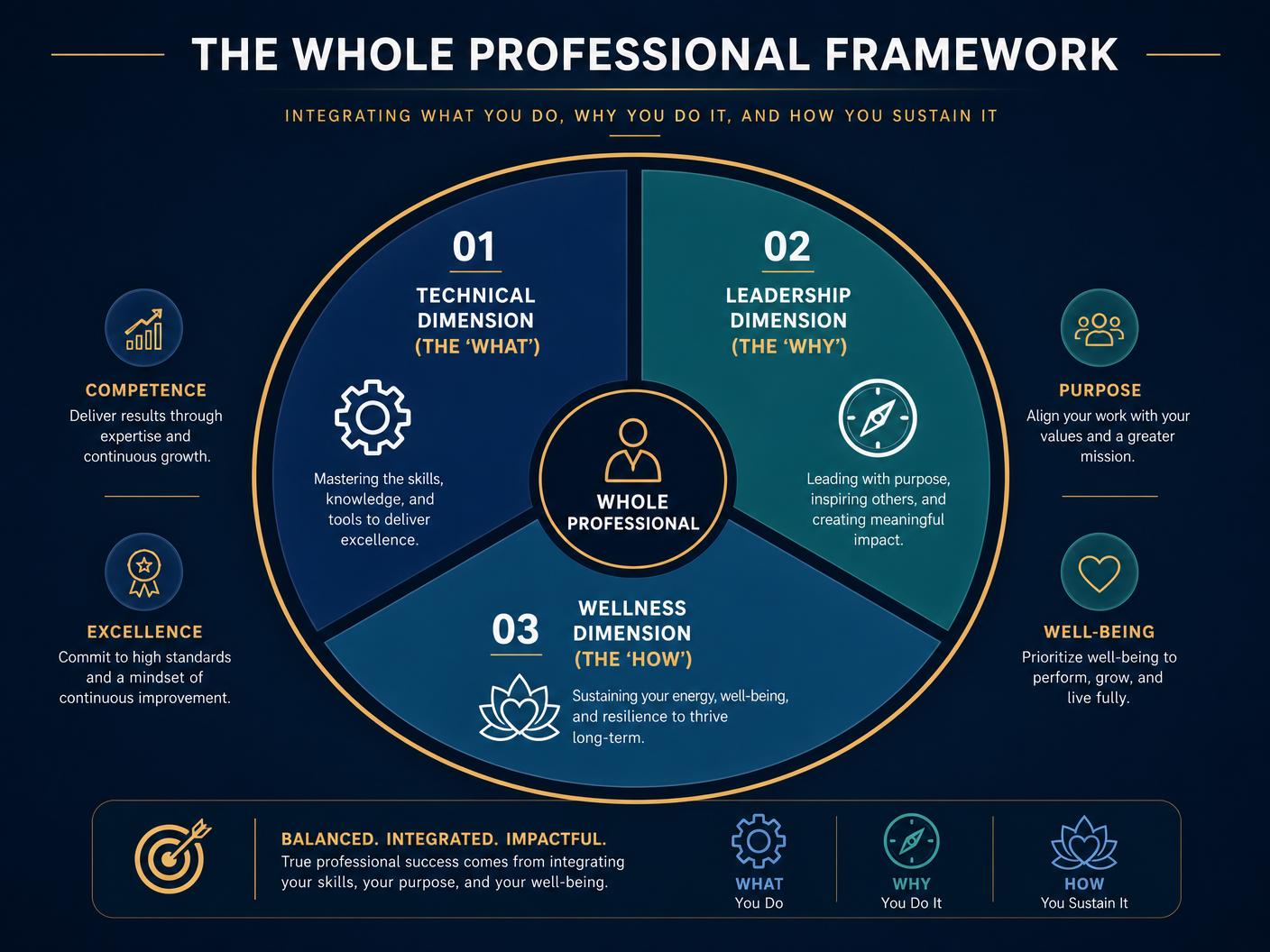
At ForElite Training Institute, we design every programme around what we call the Whole Professional Framework. It addresses three inseparable dimensions of lasting performance.
1. The Technical Dimension: The ‘What’
This is where most training begins and ends. Project management certifications. Data analytics tools. Financial modelling. Supply chain optimisation. These skills matter enormously. But technical competence without strategic context is a tool without a hand to hold it.
ForElite courses are built to global accreditation standards while being adapted for the operational realities of Nairobi, Lagos, Dubai, and Riyadh. Participants leave not just knowing a framework but knowing how to apply it in their specific institutional environment.
2. The Leadership Dimension: The ‘Why’
Skills without direction are wasted. The second dimension of the Whole Professional Framework addresses leadership strategy: the ability to think systemically, communicate vision compellingly, and make sound decisions under pressure.
This is where the deepest ROI lives. Research consistently shows that organisations with strong middle and senior leadership outperform peers across every key performance indicator, from employee engagement to revenue growth.
Our leadership development programmes are designed for decision-makers who need to lead through complexity, not around it.
3. The Wellness Dimension: The ‘How’
This is the dimension most organisations leave on the table. A technically brilliant leader who operates from burnout, poor boundaries, or unresolved emotional patterns will underperform. Always.
In 2026, forward-thinking HR directors are recognising that psychological safety, resilience, and wellbeing are not soft topics. They are productivity infrastructure. Our programmes integrate evidence-based wellness practices into every cohort, ensuring participants can sustain their performance long after the training room closes.
How Do Africa’s 2026 Regulatory Standards Shape Training Strategy?
Regulatory alignment is no longer a compliance checkbox. It is a competitive signal. When your organisation can demonstrate that its training investments align with frameworks that governments and development partners already trust, procurement and partnership doors open faster.
The POLD Regulations 2023: Kenya’s Blueprint for Public Sector Excellence
Kenya’s Public Officers Leadership and Delivery (POLD) Regulations 2023 mandate structured competency development for public servants across all government levels. The regulations create a formal expectation that public officers at senior and middle management levels demonstrate measurable leadership and professional competencies.
For HR directors in both public institutions and private organisations that supply to government, this creates a clear imperative. Training must produce verifiable outcomes, not just attendance certificates. ForElite’s accredited programmes are designed with this accountability architecture built in from day one.
Agenda 2063: The African Continental Vision
The African Union’s Agenda 2063 frames Africa’s long-term development around seven aspirations. Aspiration 6 specifically calls for ‘people-driven development relying on the potential of African people, especially its women and youth.’ This means human capital development is not peripheral to Africa’s continental strategy. It is central.
Organisations that position their professional development investments within this framework attract donor partnership, development finance institution interest, and government procurement preference. The language of Agenda 2063 belongs in your talent strategy board presentation, not just in government policy documents.
Explore how our programmes align with these frameworks at forelitetraining.com.
How Can Africa and MENA Firms Scale Agentic AI Responsibly?
Agentic AI refers to AI systems that do not merely answer questions but take actions, execute workflows, and make sequenced decisions with minimal human intervention. In 2026, early adopters in banking, logistics, healthcare, and government are already deploying these systems.
The challenge is not the technology. The challenge is the human capacity to govern, interrogate, and work alongside it.
Three capabilities separate organisations that scale AI responsibly from those that create costly failures:
- Critical AI literacy: The ability to evaluate AI outputs, identify bias, and understand system limitations.
- Ethical decision frameworks: Structured approaches to resolving AI-generated recommendations that conflict with organisational values or regulatory requirements.
- Human-centred workflow redesign: The skills to restructure teams and processes around human-AI collaboration rather than simply automating existing broken processes.
ForElite’s digital transformation and AI governance programmes address all three. Leaders who complete these programmes return to their organisations able to brief boards, evaluate vendors, and protect institutional integrity in the age of autonomous systems.
Browse our current digital and AI-aligned programme catalogue here.
What Is the Real ROI of Professional Development Training in 2026?
Decision-makers in 2026 face tighter budgets and more rigorous accountability frameworks. The question ‘what is the return on this training investment?’ is no longer a polite soft challenge. It is a prerequisite for budget approval.
The evidence is encouraging. Research cited in the 2026 LinkedIn Workplace Learning Report confirms that 67% of L&D leaders struggle to demonstrate training impact to executives. The gap is not in the value of training. It is in the measurement architecture.
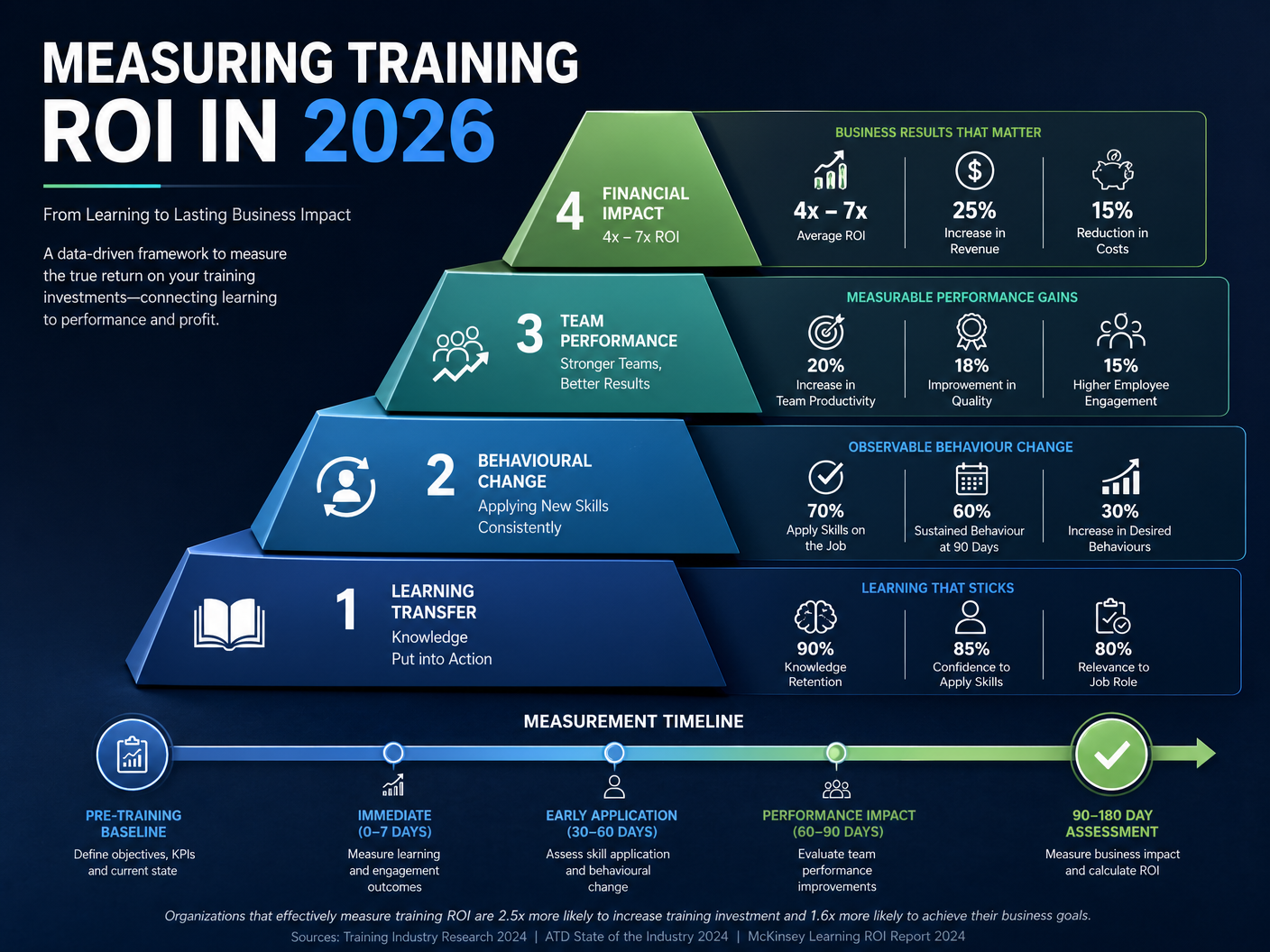
Well-designed, strategy-linked leadership development programmes consistently deliver returns of 4x to 7x the investment when four outcome layers are tracked: learning transfer, behavioural change, team performance improvement, and financial impact.
How to Measure Training ROI in Your Organisation
Start with a pre-training baseline. Measure what you want to improve before the programme begins. Set specific, measurable targets. Assess participants 90 days and 180 days after completion, not just at the end of the course. Link outcomes to business metrics your CFO already tracks.
The organisations making the strongest ROI case in 2026 are not the ones with the most sophisticated learning platforms. They are the ones that connected learning to performance outcomes from the start.
ForElite’s programme consultants work with HR directors to build this measurement architecture into every engagement. Learn more about our impact evaluation methodology at ForElite Institute.
Who Should Be Investing in Professional Development Training Right Now?
The short answer: anyone whose organisation depends on human judgment, which is every organisation worth leading.
But let us be specific about the profiles where the return is most immediate and measurable in 2026.
Corporate Leaders and C-Suite Executives
Senior leaders face a paradox. They are often the people with the least time and the greatest need for structured reflection and learning. The organisations that solve this paradox by creating protected time for executive development consistently outperform their peers on innovation and crisis resilience metrics.
HR Directors and Talent Strategists
HR is no longer a support function. It is a strategic function. HR directors who can design learning ecosystems, build skills taxonomies aligned to business strategy, and speak the language of workforce ROI have become indispensable to boards and executive committees.
Public Sector Decision-Makers
Government departments and public agencies face unique pressures in 2026: decentralisation mandates, digital service transformation expectations, and citizen-facing accountability demands. Professional development for public sector leaders is not bureaucratic box-ticking. It is how governments build the institutional capacity to actually deliver.
What Training Formats Work Best for Busy Senior Professionals in 2026?
The era of the five-day residential programme as the default format is over. Not because it does not work. It does, profoundly. But because 2026 learners demand formats that respect the complexity of their schedules and the diversity of their learning preferences.
The most effective professional development strategies in 2026 combine three modalities:
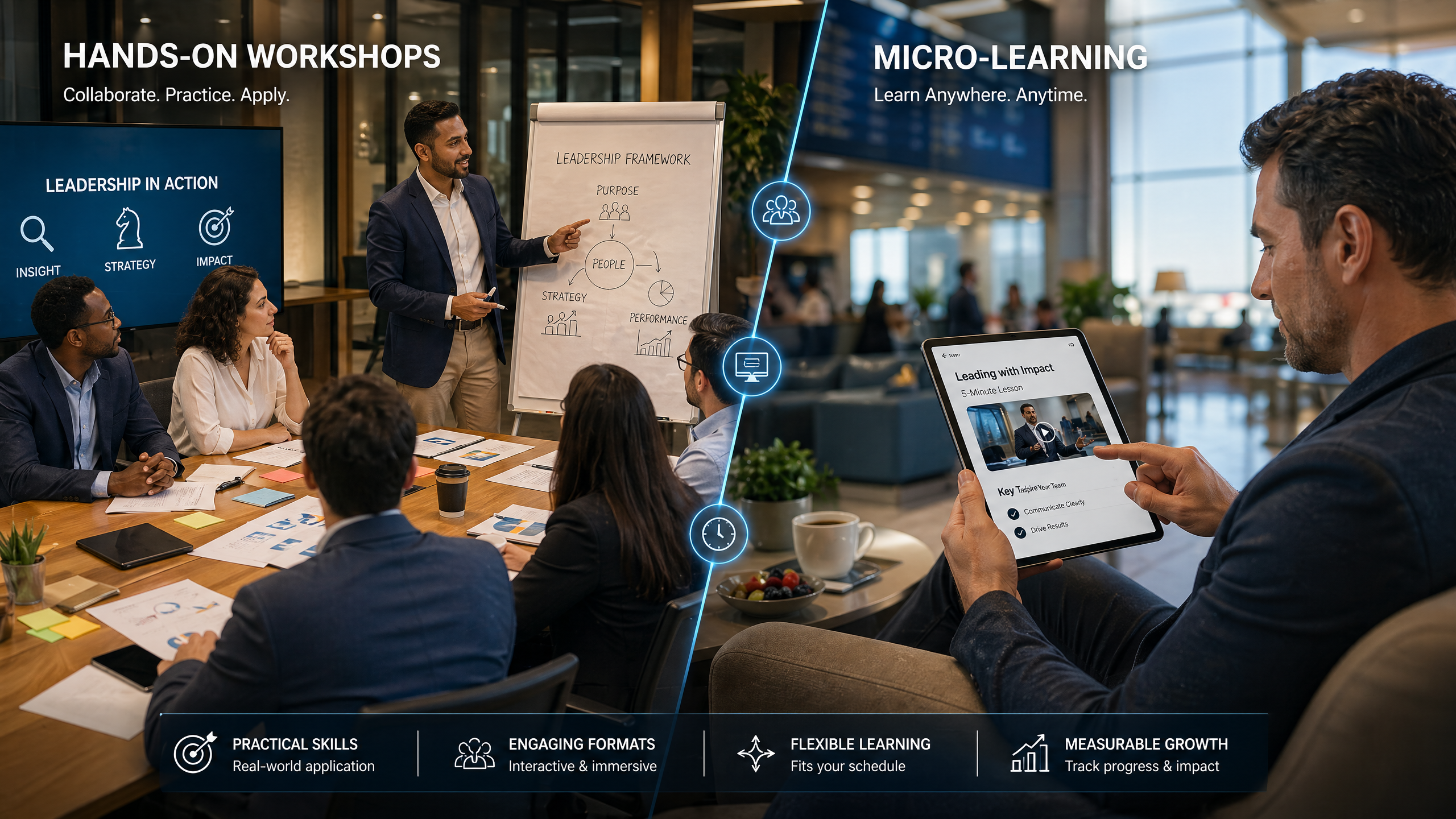
- Intensive residential or hybrid cohort experiences that build peer networks and create psychological depth of learning.
- Modular micro-learning sequences that reinforce key concepts in 15 to 20 minute doses between intensive sessions.
- Coaching integration where participants apply concepts to live challenges in their organisations with expert support.
This architecture respects the learner’s existing commitments while ensuring that knowledge is genuinely transferred to behaviour rather than remaining trapped in notebooks.
All ForElite programmes are designed with this three-layer architecture. Explore our programme formats at forelitetraining.com
Why Is Leader Wellbeing the Hidden Variable in Organisational Performance?
There is a stubborn myth in professional circles that wellbeing is a personal matter. Leaders manage their energy on their own time. The organisation provides the work. The individual provides the resilience.
This model is breaking down. Publicly and measurably.

Burnout at senior levels is now one of the top three causes of unexpected executive departure across the continent. When a leader leaves, they take institutional memory, stakeholder relationships, and strategic momentum with them. The replacement cost, both financial and organisational, is enormous.
The Whole Professional Framework addresses this directly. Every ForElite cohort includes structured sessions on sustainable performance: stress regulation, boundary-setting, energy management, and the psychological dimensions of leadership under pressure. These are not optional wellness extras. They are core curriculum.
| Calm Leadership Principle: The most powerful leaders we have worked with are not those who never feel the pressure. They are those who have developed the internal infrastructure to perform consistently despite it. This is teachable. It is also measurable. |
Frequently Asked Questions About Professional Development Training
Q: What is professional development training and why does it matter in 2026?
Professional development training is a structured investment in expanding the knowledge, skills, and leadership capacity of working professionals. In 2026, it matters because AI is restructuring roles faster than most organisations can adapt organically, regulatory frameworks are raising the bar for demonstrated competency, and the talent market has become genuinely global. Organisations that do not build structured development pathways lose their best people to those that do.
Q: How long does a professional development programme typically take?
Programme length varies significantly by objective and format. Intensive leadership cohorts typically run from two to five days in residential or hybrid format. Modular certificate programmes spread learning over six to twelve weeks. Full executive development engagements, including coaching, can extend across six to twelve months. The right duration is not the shortest possible. It is the minimum needed to ensure genuine behavioural transfer, not just knowledge acquisition.
Q: How do I measure the return on investment of professional development training?
Start by establishing a pre-training baseline against the specific outcomes you want to improve: team engagement scores, decision-making speed, project completion rates, staff retention figures. Assess these same metrics at 90 days and 180 days post-training. Compare the cost of the programme against the quantifiable improvement in these business metrics. The strongest ROI cases in 2026 link training outcomes directly to financial measures your CFO already tracks, such as revenue per employee, cost of turnover, or cost of error and rework.
Q: What is the difference between training and professional development?
Training typically refers to skill-specific instruction aimed at a defined task or process. Professional development is broader. It encompasses not just skill acquisition but the development of judgment, leadership capacity, strategic thinking, and the professional identity needed to grow into roles of greater complexity and responsibility. Both matter. But professional development has a longer shelf life and a deeper organisational impact.
Q: Can professional development training be done online or does it need to be in-person?
Both formats deliver strong outcomes when designed correctly. In-person and hybrid cohort programmes tend to produce deeper peer networks and more sustained behavioural change because of the relational intensity they create. Online modular programmes are superior for reaching distributed teams, reinforcing concepts between intensive sessions, and accommodating senior professionals whose travel schedules are unpredictable. The most effective 2026 programmes combine both modalities intentionally rather than treating one as a substitute for the other.
Q: Who should attend professional development training: individuals or entire teams?
Both approaches have proven value, and the choice depends on your organisational objective. Individual development builds specific leadership capacity and creates internal champions for change. Team-based development accelerates cultural alignment, builds shared language around performance, and produces faster organisational impact. For senior leadership cohorts, the most powerful model is a mixed approach: individuals from different organisations learning together, then returning to apply insights within their own team contexts.
Q: How do I choose the right professional development training provider?
Evaluate five things. First, does the provider understand your sector, region, and regulatory context? Generic content rarely transfers. Second, is the programme accredited by a recognised body? Accreditation signals quality assurance and is increasingly required for public sector procurement. Third, does the provider have a clear methodology for measuring outcomes, not just satisfaction? Fourth, do the facilitators have practitioner experience, not only academic credentials? Fifth, does the provider offer post-programme support: coaching, peer networks, or follow-up learning? Providers who say yes to all five are rare and worth investing in.
Q: Is professional development training tax deductible or eligible for funding support?
In many African and MENA jurisdictions, employer-funded professional development qualifies for tax deduction as a business expense. In Kenya, organisations can access training levy rebates through the National Industrial Training Authority (NITA). In South Africa, training aligned with B-BBEE Skills Development criteria qualifies for scorecard recognition. In the Gulf states, nationalisation-aligned training programmes may attract government subsidy. Always verify current regulations with your tax and legal advisors, as these provisions evolve. ForElite’s programme team can connect you with the relevant frameworks for your jurisdiction.
Q: How does professional development training support succession planning?
Succession planning without development is a list of names. Development without succession planning is investment without strategy. The two must be integrated. Professional development training, particularly leadership development at middle and senior levels, builds the bench strength that allows organisations to promote from within confidently. It also signals to high-potential employees that the organisation is invested in their long-term trajectory, which is one of the most effective retention tools available.
Q: What skills are most in demand for professional development training in 2026?
Based on current demand across the ForElite client base and global workforce intelligence, the highest-priority development areas in 2026 are: AI literacy and governance, strategic communication and stakeholder influence, data-informed decision-making, change leadership and organisational resilience, ethical leadership and institutional integrity, and cross-cultural team management. The common thread is that these are all fundamentally human skills, made more important, not less, by the rise of automation.
The ForElite Commitment: Training for the Leaders Africa and MENA Need
ForElite Training Institute was built on a single conviction: that the leaders Africa and the MENA region need already exist. They simply need the right environment, the right challenge, and the right support to become who their organisations require them to be.
We do not deliver generic global content with a local coat of paint. We design programmes that respect the complexity of operating in high-growth, high-complexity markets where regulatory frameworks are evolving, institutional trust is being built in real time, and the stakes of leadership failure are borne by communities, not just shareholders.
Whether you are an HR director designing your organisation’s 2026 learning strategy, a corporate leader looking to invest in your own growth, or a public sector institution building the capacity to deliver on national mandates, ForElite has a programme pathway designed for you.
| Ready to invest in your organisation’s most important asset? Visit forelitetraining.com to explore our full programme catalogue, speak with a learning advisor, and request a customised proposal for your team. |
Explore All Programmes | Leadership Development | Contact Us
About ForElite Training Institute
ForElite Training Institute is a leading professional development and leadership training provider serving corporate, public sector, and NGO clients across Africa and the Middle East and North Africa region. Our programmes are accredited, context-specific, and designed to deliver measurable organisational impact. Headquartered in Nairobi, Kenya, with programme delivery capacity across Africa and MENA, ForElite is the partner of choice for organisations serious about building the leaders their futures require.