


What is Integrated Project Delivery (IPD)?
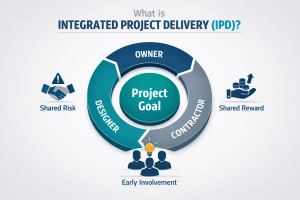
Integrated Project Delivery (IPD) is a modern project management approach that brings together all key stakeholders; owners, designers, and contractors from the very beginning of a project. Unlike traditional methods, IPD emphasizes collaboration, shared goals, and collective accountability.
In IPD, all parties work as a unified team, sharing risks and rewards while aligning their efforts toward a common objective. This approach reduces inefficiencies and improves overall project outcomes.
Definition and Core Concept
IPD is defined as a collaborative project delivery method where all major participants are involved early, enabling better decision-making and innovation. According to industry practices, IPD ensures shared responsibility across the project lifecycle, leading to improved efficiency and reduced conflicts.
Evolution of Project Delivery Methods
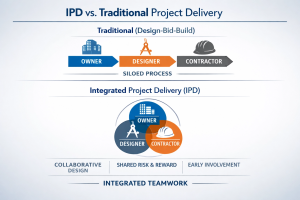
Traditional project delivery models, such as Design-Bid-Build, follow a linear approach where each phase is handled separately. IPD evolved to address inefficiencies in these models by integrating processes and teams into a cohesive structure.
Key Principles of Integrated Project Delivery
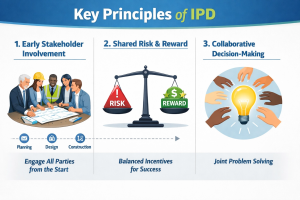
Early Stakeholder Involvement
One of the core principles of IPD is involving all stakeholders from the start. This ensures that decisions are informed by diverse expertise, reducing costly changes later in the project.
Shared Risk and Reward
IPD contracts are structured so that all parties share both risks and rewards. This encourages collaboration and discourages blame-shifting.
Collaborative Decision-Making
Decisions are made collectively, ensuring transparency and alignment across all participants.
How Integrated Project Delivery Works
Project Lifecycle in IPD
IPD integrates all phases of a project into a seamless process:
Planning Phase
Stakeholders define project goals, scope, and expectations collaboratively.
Design Phase
Designers and contractors work together to optimize solutions and reduce rework.
Construction Phase
Execution is streamlined due to prior alignment, reducing delays and cost overruns.
Benefits of Integrated Project Delivery
Improved Collaboration
IPD fosters a culture of teamwork, ensuring that all participants contribute to project success.
Cost Efficiency
By reducing duplication and errors, IPD significantly lowers project costs.
Risk Reduction
Shared responsibility minimizes disputes and enhances accountability.
Challenges of Implementing IPD
Cultural Resistance
Organizations accustomed to traditional methods may resist adopting IPD due to its collaborative nature.
Contractual Complexity
IPD requires specialized contracts that define shared risks and responsibilities.
Integrated Project Delivery vs Traditional Methods
IPD vs Design-Bid-Build
In traditional models, processes are sequential and siloed. IPD, on the other hand, integrates all phases and stakeholders.
IPD vs Design-Build
While Design-Build combines design and construction, IPD goes further by integrating all stakeholders and aligning incentives.
Role of Technology in IPD
BIM and Digital Tools
Technologies like Building Information Modeling (BIM) enhance collaboration and visualization.
AI in Project Delivery
AI tools improve decision-making, automate tasks, and increase efficiency in project delivery.
Training and Skills for IPD Success
To successfully implement Integrated Project Delivery, organizations must invest in training and skill development.
Project Management Training
Courses like Introduction to Project Management Course provide a solid foundation in project lifecycle management, stakeholder engagement, and risk control. These skills are essential for IPD success.
Additionally, advanced programs such as Advanced Project Management Techniques Training equip professionals with tools for managing complex projects and collaborative environments.
You can also explore the broader Project Management Training Programs offered by Forelite Training, which cover Agile, risk management, and stakeholder communication—key competencies in IPD.
Strategic Planning Skills
Strategic alignment is critical in IPD. Programs like Strategic Project Planning and Implementation Training help professionals develop planning and execution strategies that align with organizational goals.
For performance tracking and evaluation, courses such as Monitoring and Evaluation (M&E) Training provide valuable insights into measuring project success and outcomes.
Case Study of Integrated Project Delivery
A real-world example shows how IPD can scale operations effectively. In one case, a company expanded its team significantly while maintaining quality and transparency by adopting IPD principles.
This demonstrates how IPD supports growth, innovation, and operational efficiency.
Future Trends in Integrated Project Delivery
Digital Transformation
Organizations are increasingly integrating digital tools into IPD frameworks to enhance efficiency and scalability.
For example, Digital Strategy and Web Solutions offered by Nexera Digital Solutions help businesses build scalable digital infrastructures that align with modern project delivery models.
Smart Project Ecosystems
The future of IPD lies in creating intelligent ecosystems where data, technology, and collaboration converge to drive success.
FAQs on Integrated Project Delivery
What is Integrated Project Delivery?
It is a collaborative project management approach where all stakeholders work together from the start, sharing risks and rewards.
What are the main benefits of IPD?
Improved collaboration, cost savings, and reduced risks are the key benefits.
How does IPD differ from traditional methods?
Unlike traditional methods, IPD integrates all stakeholders and phases into a unified process.
What skills are needed for IPD?
Project management, communication, strategic planning, and collaboration skills are essential.
Is training necessary for IPD implementation?
Yes, training programs such as those offered by Forelite Training help build the necessary competencies.
What role does technology play in IPD?
Technology enhances collaboration, improves efficiency, and supports data-driven decision-making.
Conclusion
Integrated Project Delivery is transforming how projects are executed by fostering collaboration, improving efficiency, and reducing risks. While it requires a shift in mindset and processes, the benefits far outweigh the challenges.
Organizations that invest in training—such as those offered by Forelite Training—and leverage digital solutions from platforms like Nexera Digital Solutions are better positioned to succeed in today’s competitive landscape.