
Adaptive Leadership and “Unpredictability Skills”: 9 Powerful Ways Leaders Can Thrive Through Uncertainty in 2026

Introduction: Leadership in an Age of Constant Uncertainty
Modern leadership is changing rapidly. Organizations around the world are facing economic instability, artificial intelligence disruption, cybersecurity threats, climate-related risks, remote work challenges, and changing workforce expectations. Because of this, leaders can no longer depend entirely on traditional “predict and control” management systems.
For decades, businesses relied on stability. Leaders created long-term plans, established fixed hierarchies, and expected predictable results. However, today’s environment is far more dynamic. A sudden technological breakthrough can disrupt an industry overnight. Global events can reshape supply chains within weeks. Customer expectations shift faster than ever before.
As a result, adaptive leadership frameworks are becoming the new standard for effective management. Instead of trying to control every outcome, adaptive leaders focus on flexibility, resilience, collaboration, and continuous learning.
Importantly, adaptive leadership does not mean abandoning structure or discipline. Rather, it means balancing stability with agility. Leaders still need clear goals and accountability. Yet they must also prepare teams to adapt quickly when conditions change.
Organizations increasingly recognize this need. Leadership development providers such as Forelite Training are helping professionals build strategic thinking, communication, and organizational adaptability skills required for modern business environments.
In 2026, leadership success will depend less on predicting the future perfectly and more on responding effectively to uncertainty.
Why Traditional “Predict and Control” Leadership Is Failing
Traditional management systems were designed for relatively stable business environments. Leaders created annual plans, controlled operations through hierarchy, and focused heavily on minimizing uncertainty.
However, the business world has changed dramatically.
Today’s organizations operate in environments where disruption is constant. Technology evolves rapidly. Consumer behavior changes frequently. Global markets shift unexpectedly. Consequently, rigid leadership models often fail to respond effectively.
The Problem With Fixed Planning
Traditional leadership assumes that future conditions can be predicted accurately. Yet uncertainty makes forecasting increasingly difficult.
For example, many companies created long-term growth strategies before global disruptions forced sudden operational changes. Businesses that adapted quickly survived. Those that resisted struggled significantly.
This is why leading through uncertainty 2026 requires a more flexible leadership mindset.
Why Organizations Need Adaptability
Modern organizations need leaders who can:
- Respond quickly to changing conditions
- Encourage innovation
- Manage complexity effectively
- Build resilient teams
- Support continuous learning
- Navigate uncertainty confidently
Because industries evolve rapidly, adaptive leadership frameworks are replacing rigid management systems across many sectors.
Technical Fixes vs Adaptive Challenges
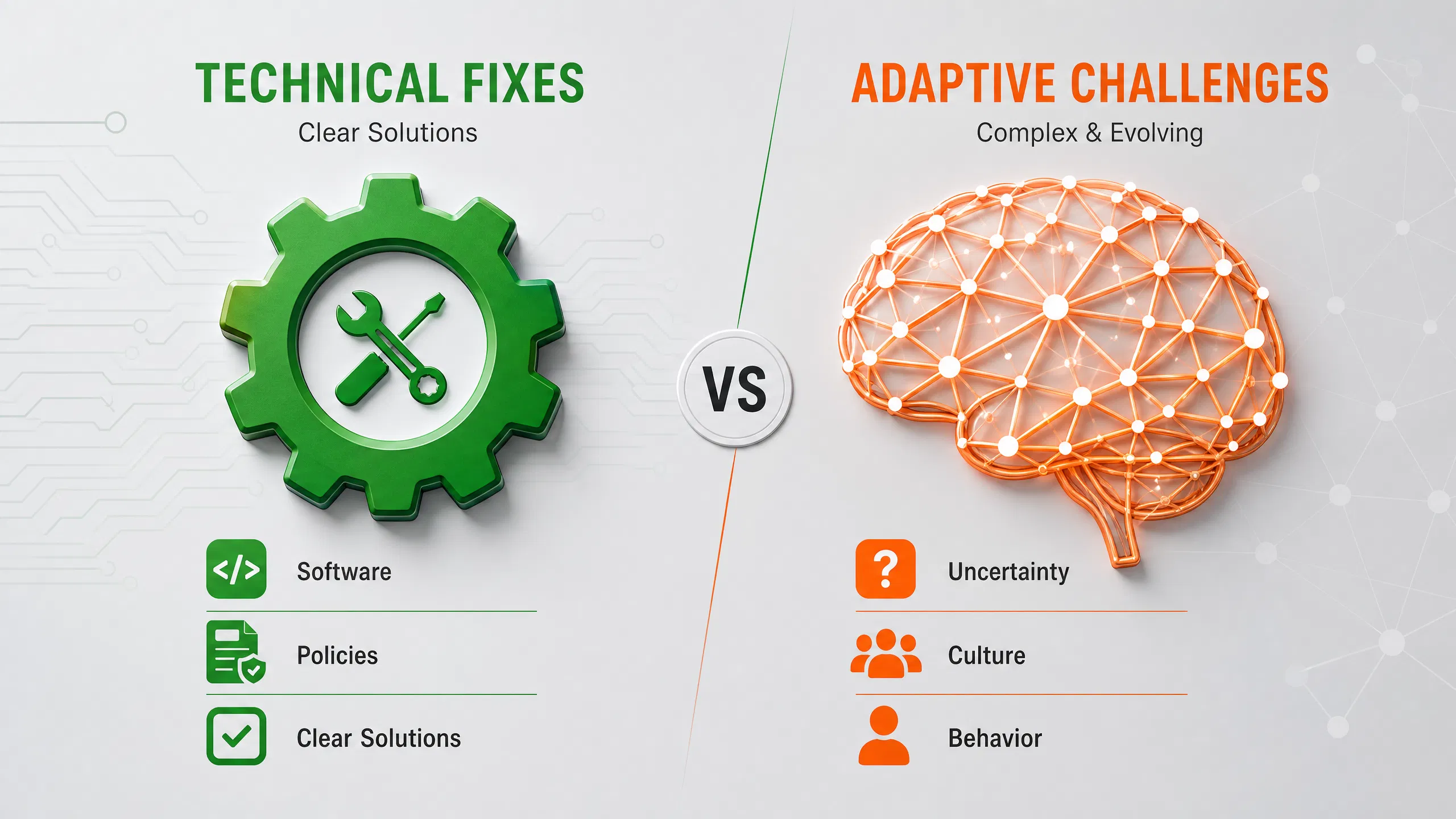
One of the most important concepts in adaptive leadership is understanding the difference between technical fixes and adaptive challenges.
What Are Technical Fixes?
Technical problems usually have clear solutions. Organizations already possess the expertise needed to resolve them.
Examples include:
- Repairing software systems
- Updating workplace policies
- Fixing operational errors
- Installing new equipment
- Improving reporting processes
Technical fixes are generally straightforward and predictable.
What Are Adaptive Challenges?
Adaptive challenges are far more complex. They involve uncertainty, behavioral change, culture transformation, and evolving conditions.
Examples include:
- Leading digital transformation
- Rebuilding employee trust
- Managing hybrid workforces
- Responding to market disruption
- Improving organizational culture
- Navigating economic uncertainty
Unlike technical problems, adaptive challenges do not have simple solutions.
Why This Difference Matters
Many organizations fail because they apply technical solutions to adaptive challenges.
For instance, low employee engagement cannot always be solved with new software tools. The deeper issue may involve communication problems, leadership trust, or organizational culture.
Adaptive leaders understand that uncertainty often requires cultural transformation rather than quick operational fixes.
Organizations investing in modern leadership capability often pursue programs such as Leadership and Management Training Programs by Forelite Training to strengthen adaptability and strategic thinking.
Why Unpredictability Skills Matter in 2026
The modern workplace rewards leaders who can operate effectively in uncertain environments.
As a result, unpredictability skills are becoming essential leadership capabilities.
Core Unpredictability Skills
1. Agility
Agile leaders adjust quickly without losing strategic direction.
2. Emotional Intelligence
Leaders must communicate empathetically and manage relationships effectively during stressful periods.
3. Strategic Curiosity
Adaptive leaders continuously ask questions and explore possibilities.
4. Collaborative Thinking
Complex problems require teamwork across departments and industries.
5. Learning Agility
Modern leaders must learn continuously because knowledge evolves rapidly.
Why These Skills Are Growing in Importance
Technology increasingly automates technical tasks. Consequently, human-centered leadership abilities are becoming more valuable.
Organizations now prioritize adaptability, communication, and resilience over rigid expertise alone.
Because of this trend, many professionals are pursuing continuous development opportunities through Forelite Training Courses to strengthen adaptability and workplace resilience.
The Evolution of Adaptive Leadership Frameworks
Adaptive leadership frameworks help organizations respond effectively to uncertainty and complexity.
These frameworks encourage flexibility, collaboration, innovation, and organizational learning.
The Heifetz Adaptive Leadership Model
Ronald Heifetz developed one of the most influential adaptive leadership frameworks.
Key principles include:
- Identifying adaptive challenges
- Managing organizational stress
- Encouraging shared responsibility
- Protecting diverse viewpoints
- Supporting continuous learning
This framework emphasizes organizational evolution rather than rigid control.
Agile Leadership Frameworks
Agile leadership focuses on rapid learning and iterative improvement.
Agile leaders:
- Test ideas quickly
- Encourage experimentation
- Gather feedback continuously
- Adapt strategies frequently
This approach works especially well in fast-changing industries.
Systems Thinking Leadership
Systems thinking helps leaders understand how organizational elements connect.
For example:
- Employee morale affects productivity
- Communication impacts trust
- Customer satisfaction influences revenue
- Organizational culture shapes innovation
Adaptive leaders examine root causes instead of reacting only to symptoms.
Learning Organization Models
Learning organizations prioritize continuous development and knowledge sharing.
These organizations encourage:
- Innovation
- Collaboration
- Skill development
- Open communication
- Experimentation
Organizations that learn faster often outperform competitors during uncertainty.
Resilient Organizational Design Explained
Resilient organizational design helps businesses survive and grow during disruption.
Resilience means organizations can absorb shocks, adapt quickly, and continue operating effectively.
Characteristics of Resilient Organizations
| Characteristic | Description |
|---|---|
| Flexibility | Ability to adjust processes quickly |
| Strong communication | Transparent information sharing |
| Distributed leadership | Shared decision-making authority |
| Continuous learning | Ongoing skill development |
| Psychological safety | Employees feel safe contributing ideas |
| Strategic adaptability | Ability to pivot during disruption |
Why Organizational Design Matters
Rigid structures slow decision-making. In contrast, adaptive organizations encourage faster collaboration and information flow.
Cross-functional teams often solve problems more efficiently because communication barriers are reduced.
The Role of Workplace Culture
Culture strongly influences adaptability.
Adaptive cultures encourage:
- Innovation
- Accountability
- Openness to change
- Collaboration
- Continuous learning
Meanwhile, rigid cultures often resist transformation.
Organizations seeking to strengthen resilience frequently explore workforce development programs like Corporate Training Solutions by Forelite Training to improve organizational effectiveness.
Scenario Planning for Managers
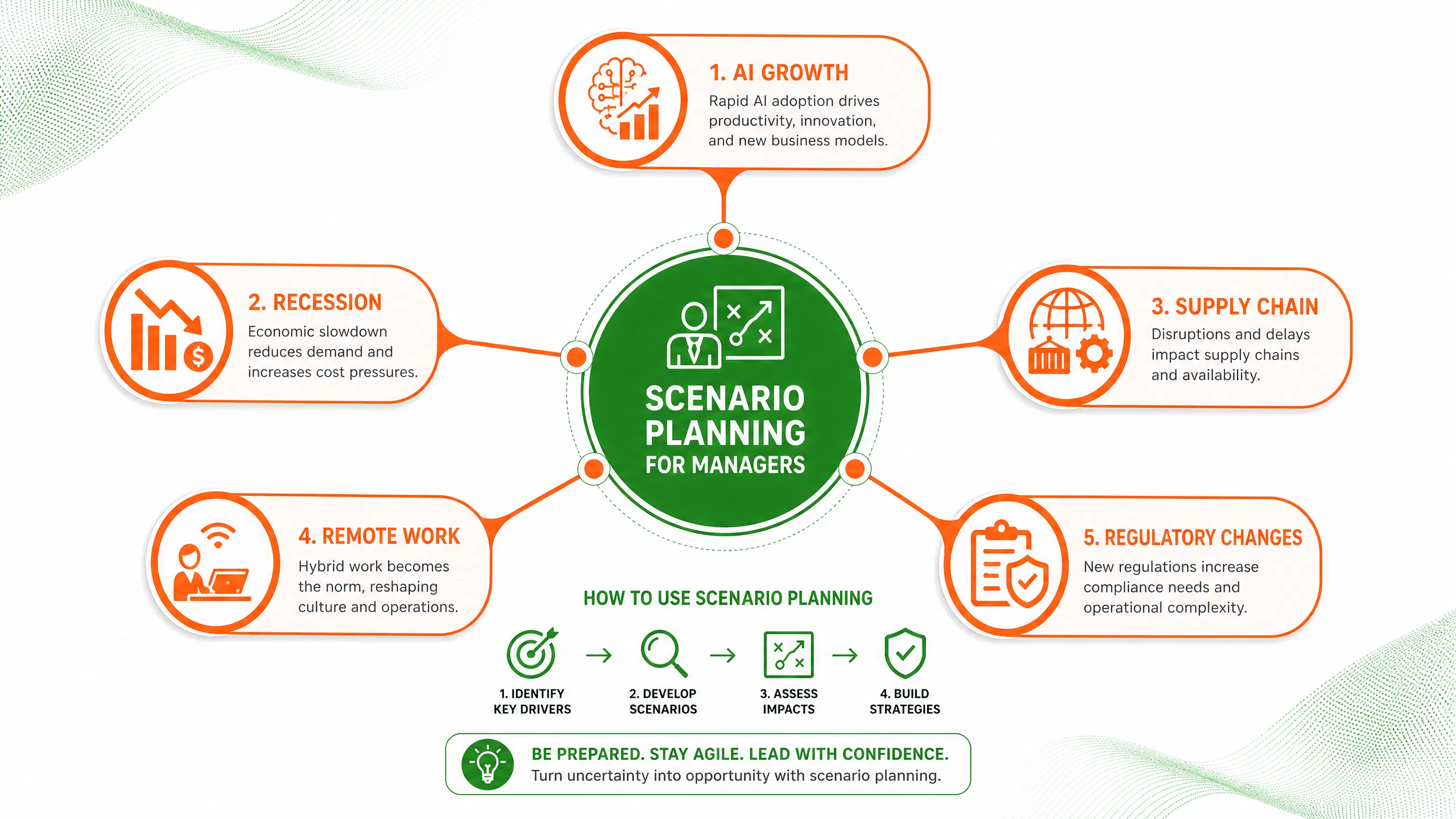
Scenario planning for managers has become one of the most valuable leadership practices in uncertain environments.
Instead of depending on one prediction, adaptive leaders prepare for multiple possible futures.
What Is Scenario Planning?
Scenario planning is a strategic process that helps organizations explore different future outcomes and prepare flexible responses.
Organizations may plan for:
- Economic recession
- AI disruption
- Cybersecurity threats
- Supply chain instability
- Regulatory changes
- Workforce shortages
Benefits of Scenario Planning
Scenario planning helps organizations:
- Improve strategic flexibility
- Reduce panic during crises
- Strengthen resilience
- Identify risks early
- Encourage innovation
Key Steps in Scenario Planning
Step 1: Identify Major Uncertainties
Leaders analyze trends and unpredictable factors affecting operations.
Step 2: Develop Multiple Scenarios
Organizations create realistic future possibilities.
| Scenario | Possible Outcome |
|---|---|
| Rapid AI growth | Workforce restructuring |
| Economic recession | Budget reductions |
| Supply chain disruption | Delayed production |
| Remote work expansion | Increased digital collaboration |
| Regulatory changes | Compliance adjustments |
Step 3: Evaluate Organizational Readiness
Leaders assess strengths, weaknesses, and vulnerabilities.
Step 4: Develop Flexible Strategies
Adaptive plans remain adjustable rather than rigid.
Step 5: Review Continuously
Scenario planning must evolve alongside changing conditions.
Organizations increasingly seek digital transformation expertise from companies such as Nexera Digital Solutions to improve strategic adaptability.
Emotional Intelligence in Uncertain Environments
Technology is transforming workplaces, but people remain central to organizational success.
Because of this, emotional intelligence has become one of the most important leadership skills in 2026.
Why Emotional Intelligence Matters
Employees experiencing uncertainty often feel stress and anxiety.
Leaders who communicate empathetically create stronger trust and engagement.
Emotional intelligence helps leaders:
- Build stronger relationships
- Improve collaboration
- Manage conflict effectively
- Support employee wellbeing
- Strengthen organizational culture
Core Emotional Intelligence Skills
Self-Awareness
Leaders must understand their own emotions and behaviors.
Empathy
Understanding employee perspectives improves communication.
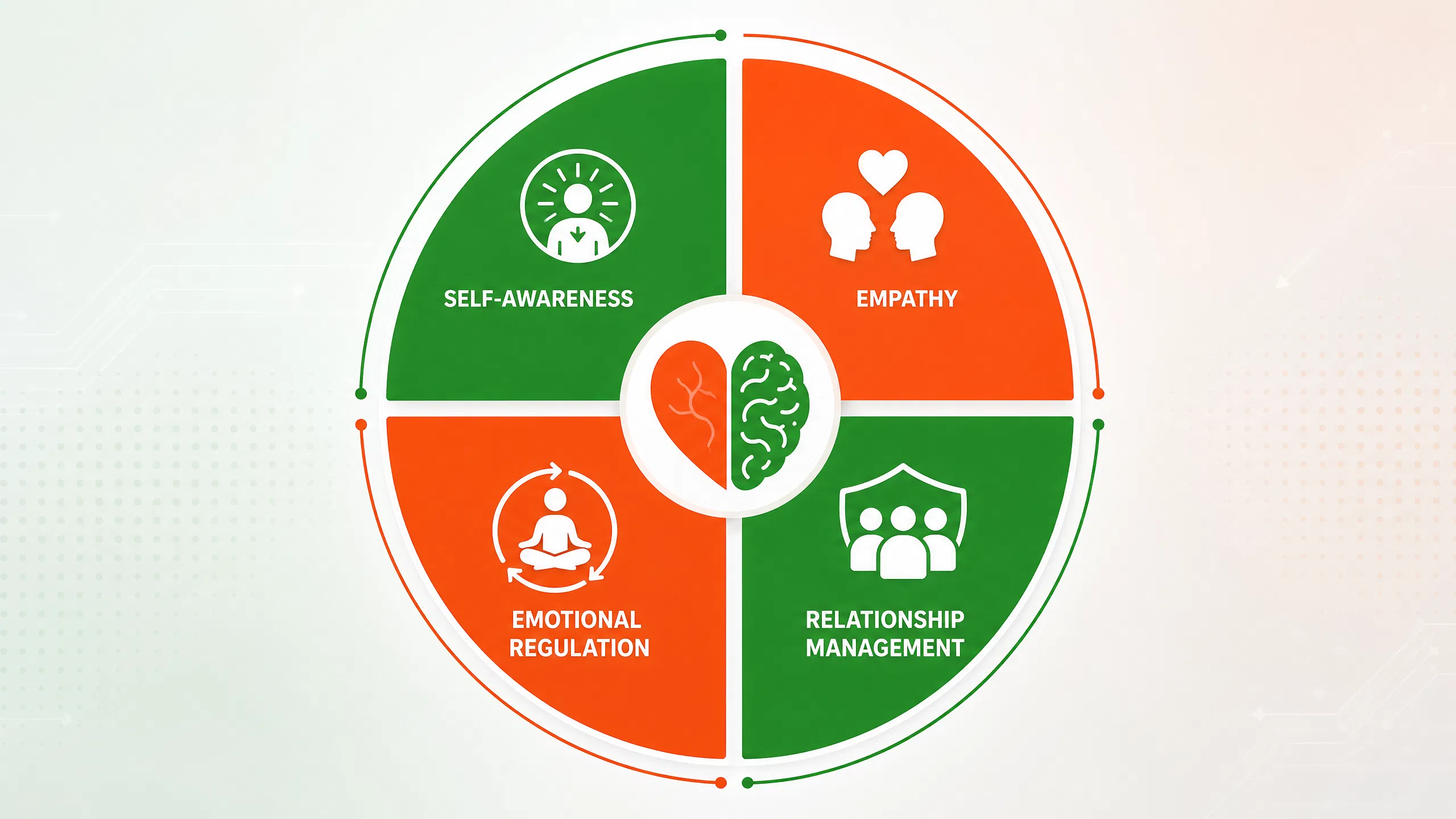
Emotional Regulation
Calm leadership supports better decision-making during crises.
Relationship Management
Strong relationships improve teamwork and resilience.
Human-centered leadership becomes especially important in hybrid and remote work environments.
Communication Strategies During Disruption
Communication becomes even more critical during uncertainty.
Employees need clarity, transparency, and reassurance from leadership.
Why Poor Communication Creates Problems
When communication fails:
- Rumors spread quickly
- Employee trust declines
- Anxiety increases
- Productivity suffers
Characteristics of Effective Leadership Communication
Adaptive leaders communicate with:
- Honesty
- Clarity
- Empathy
- Consistency
- Confidence
Practical Communication Strategies
Be Transparent
Employees appreciate honest communication about uncertainty.
Share Frequent Updates
Regular updates reduce confusion.
Encourage Two-Way Dialogue
Employees should feel heard and valued.
Reinforce Organizational Purpose
Strong purpose helps teams remain motivated during disruption.
Organizations often strengthen communication capability through Professional Workshops by Forelite Training focused on leadership and workplace collaboration.
Agile Leadership and Learning Cultures
Adaptive organizations depend on agile teams and continuous learning cultures.
What Makes Teams Agile?
Agile teams:
- Collaborate openly
- Learn continuously
- Adapt quickly
- Share knowledge freely
- Experiment with new ideas
Why Learning Cultures Matter
Skills become outdated quickly in modern industries.
Consequently, organizations must encourage ongoing development and professional learning.
Learning cultures improve:
- Innovation
- Employee retention
- Organizational resilience
- Strategic adaptability
Encouraging Innovation
Adaptive leaders create environments where employees feel safe exploring new ideas.
Innovation grows when organizations:
- Reward creativity
- Accept reasonable risk
- Encourage experimentation
- Learn from failure
Professional development programs such as Project Management Training Programs by Forelite Training help managers improve strategic execution and adaptability.
Technology and AI in Adaptive Leadership
Artificial intelligence is transforming leadership dramatically.
However, technology alone cannot solve adaptive challenges.
How AI Supports Organizations
AI helps organizations:
- Analyze data faster
- Improve forecasting
- Automate repetitive tasks
- Enhance customer service
- Support operational efficiency
The Human Side of Leadership
Despite technological advances, organizations still need leaders who can:
- Inspire teams
- Build trust
- Manage uncertainty
- Lead culture change
- Navigate ethical concerns
Ethical Leadership in the AI Era
Adaptive leaders must consider:
- Data privacy
- Bias in algorithms
- Responsible innovation
- Employee concerns about automation
Organizations that balance technology with human-centered leadership often achieve stronger long-term success.
Building Organizational Resilience
Leading through uncertainty 2026 requires strong organizational resilience.
Resilient organizations recover quickly from disruption while maintaining operational effectiveness.
Types of Organizational Risks
Modern businesses face:
- Cybersecurity risks
- Economic instability
- Operational disruption
- Reputational threats
- Talent shortages
- Climate-related challenges
Strategies for Building Resilience
Strengthen Communication Systems
Clear communication improves coordination during crises.
Invest in Employee Development
Training improves organizational adaptability.
Encourage Innovation
Innovation supports long-term resilience.
Diversify Operations
Diversification reduces dependence on single systems or markets.
Develop Crisis Response Plans
Prepared organizations respond more effectively during emergencies.
Organizations investing in workforce capability often explore Forelite Training Professional Development Programs to strengthen resilience and leadership effectiveness.
Common Leadership Mistakes During Uncertainty
Even experienced leaders make mistakes during disruption.
Mistake 1: Overcontrolling Teams
Micromanagement reduces creativity and slows decision-making.
Mistake 2: Ignoring Employee Concerns
Failure to listen weakens organizational trust.
Mistake 3: Resisting Change
Rigid thinking limits growth opportunities.
Mistake 4: Poor Communication
Silence increases confusion and anxiety.
Mistake 5: Treating Adaptive Challenges Like Technical Problems
Complex challenges require deeper transformation.
Adaptive leaders remain curious, flexible, and willing to learn continuously.
Practical Steps for Becoming an Adaptive Leader
Developing adaptive leadership skills requires intentional effort.
Step 1: Commit to Continuous Learning
Lifelong learning improves leadership adaptability.
Step 2: Strengthen Emotional Intelligence
Strong relationships improve organizational performance.
Step 3: Develop Strategic Thinking
Leaders should explore multiple future possibilities.
Step 4: Build Diverse Networks
Different perspectives encourage innovation.
Step 5: Encourage Experimentation
Organizations grow when teams can test ideas safely.
Step 6: Improve Communication Skills
Clear communication strengthens trust and alignment.
Step 7: Invest in Professional Development
Leadership training accelerates organizational growth and adaptability.
Future Leadership Trends Beyond 2026
Leadership will continue evolving rapidly.
Several important trends are likely to shape the future.
Human-Centered Leadership Will Expand
Organizations will prioritize employee wellbeing and workplace flexibility.
AI-Augmented Decision-Making Will Increase
Leaders will increasingly combine human judgment with AI insights.
Continuous Learning Will Become Essential
Professional development will remain critical for organizational competitiveness.
Decentralized Leadership Structures Will Grow
Organizations will empower teams to make decisions more independently.
Resilience Will Become a Core Competitive Advantage
Businesses capable of adapting quickly will outperform competitors consistently.
Frequently Asked Questions (FAQs)
1. What is adaptive leadership?
Adaptive leadership is a leadership approach that helps organizations respond effectively to uncertainty, complexity, and change.
2. Why are adaptive leadership frameworks important?
They improve organizational flexibility, resilience, innovation, and long-term sustainability.
3. What is the difference between technical fixes and adaptive challenges?
Technical fixes involve clear solutions, while adaptive challenges require behavioral and organizational transformation.
4. Why is scenario planning important for managers?
Scenario planning helps organizations prepare for multiple future possibilities and respond more effectively during disruption.
5. What are unpredictability skills?
These include agility, emotional intelligence, strategic curiosity, collaboration, and learning adaptability.
6. How can organizations build resilience?
Organizations strengthen resilience through communication, innovation, training, flexible systems, and adaptive leadership.
7. Why is emotional intelligence important in leadership?
It improves communication, trust, teamwork, and employee engagement during uncertainty.
8. How does AI affect leadership?
AI improves efficiency and data analysis, but leaders still need strong human-centered skills to guide organizations effectively.
Conclusion: Adaptive Leadership Is the Future
The future belongs to leaders who can adapt.
Traditional “predict and control” leadership models are becoming less effective in today’s unpredictable environment. Organizations now require leaders who can guide teams through uncertainty, encourage innovation, and build resilient organizational design.
Adaptive leadership frameworks help businesses move beyond rigid planning toward flexible, people-centered strategies.
At the same time, unpredictability skills such as emotional intelligence, agility, collaboration, and strategic thinking are becoming essential for long-term success.
Organizations that invest in resilience, continuous learning, and adaptive leadership capability will be better prepared for future disruption.
As industries continue evolving, leaders who embrace adaptability will create stronger organizations, healthier workplace cultures, and more sustainable long-term growth.
Thank you for reading this comprehensive guide on adaptive leadership and unpredictability skills. Organizations that invest in resilient leadership, strategic adaptability, and continuous learning are better prepared to succeed in uncertain times.