

Distributed Leadership and Self-Managed Teams: Why Managers Must Evolve from Directors to Catalysts

Organizations around the world are rethinking traditional management structures. As businesses strive to become more agile, innovative, and responsive, concepts such as distributed leadership, self-managed team structures, decentralized decision-making, and flattening the hierarchy are rapidly gaining traction.
With over 12,000 monthly searches around these topics, it is clear that business leaders are looking for ways to empower employees while reducing bureaucratic bottlenecks. However, one critical question continues to emerge:
If organizations are becoming “leaderless,” what happens to managers?
The answer is simple: managers are not disappearing. Instead, their role is evolving.
In modern organizations, managers are shifting from being directors who control every decision to catalysts who create the conditions for success. Rather than issuing instructions, they enable collaboration, remove barriers, and empower teams to take ownership of outcomes.
The Rise of Distributed Leadership
Distributed leadership is a management approach where leadership responsibilities are shared across multiple individuals instead of being concentrated in a single authority figure.
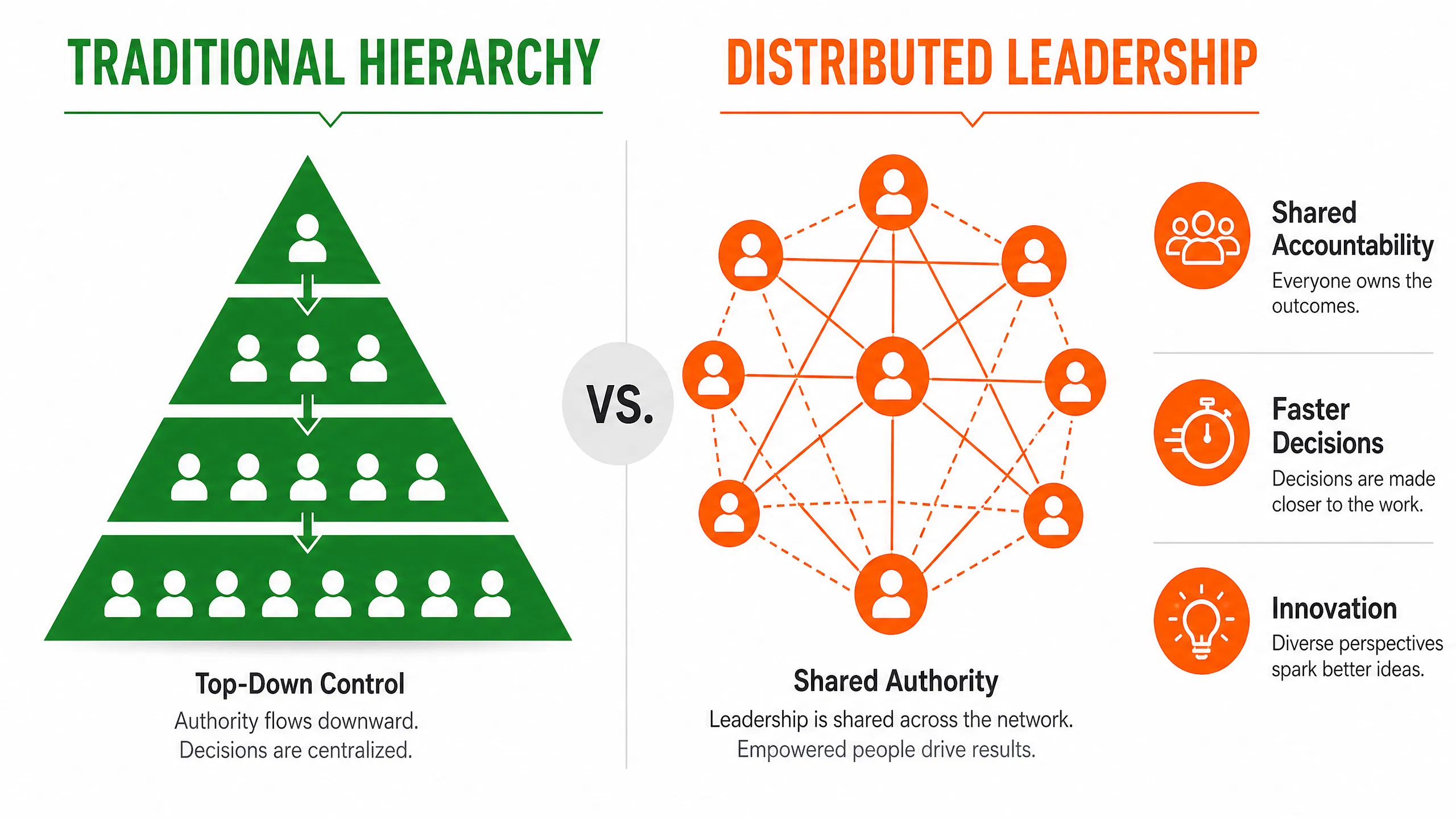
Traditionally, organizations relied on hierarchical chains of command. Employees reported to supervisors, supervisors reported to managers, and managers reported to executives. Decisions typically moved from the top down.
Today, however, business environments are changing too quickly for this model to remain effective.
As a result, organizations are distributing authority across teams, allowing employees closest to challenges and opportunities to make informed decisions. This approach creates greater flexibility and responsiveness.
Distributed leadership encourages:
- Shared accountability
- Faster decision-making
- Increased innovation
- Greater employee engagement
- Enhanced organizational resilience
Consequently, companies are discovering that leadership is no longer tied to a position. Instead, leadership becomes a capability that can emerge from any level of the organization.
Professionals seeking to build these capabilities can benefit from the leadership development programs offered by ForElite Training Institute’s Leadership and Management Skills for New Managers and Supervisors Course, which focuses on team leadership, communication, and performance management.
Understanding Self-Managed Team Structures
Self-managed teams operate with minimal direct supervision. Team members collectively organize their work, allocate responsibilities, solve problems, and make decisions.
Unlike traditional structures where managers oversee every task, self-managed teams are empowered to govern themselves.
Furthermore, these teams often demonstrate higher levels of accountability because employees feel a stronger sense of ownership over results.
Characteristics of self-managed teams include:
- Shared responsibility
- Collaborative decision-making
- High transparency
- Continuous learning
- Strong peer accountability
Organizations that successfully implement self-managed teams often experience improved productivity and faster innovation cycles.
Nevertheless, self-management does not mean an absence of leadership. Instead, leadership responsibilities become distributed among team members based on expertise and situational needs.
This shift requires organizations to invest heavily in leadership development and organizational capability building.
Why Decentralized Decision-Making Matters
One of the biggest obstacles in traditional organizations is decision-making bottlenecks.
Employees identify problems quickly, yet decisions often require multiple layers of approval. This slows execution and limits innovation.
Decentralized decision-making addresses this challenge by pushing authority closer to the people performing the work.
As a result, teams can:
- Respond faster to customer needs
- Solve operational issues more efficiently
- Adapt quickly to market changes
- Experiment and innovate without excessive bureaucracy
Research consistently shows that organizations with decentralized structures can adapt more effectively in uncertain environments.
Moreover, decentralization encourages employee engagement because people feel trusted to make meaningful contributions.
To successfully lead in increasingly decentralized environments, managers require advanced strategic leadership capabilities. The ForElite Training Institute Strategic Leadership and Future-Ready Management Course focuses on strategic thinking, organizational alignment, innovation leadership, and transformation management.
Flattening the Hierarchy: The Organizational Shift
Flattening the hierarchy involves reducing management layers and increasing direct communication between employees and decision-makers.
Traditional organizations often contain multiple supervisory levels. While these structures can provide control, they frequently slow communication and decision-making.
By contrast, flatter organizations promote:
- Faster information flow
- Increased collaboration
- Greater transparency
- Improved agility
- Stronger employee empowerment
Technology has accelerated this trend significantly.
Digital collaboration tools allow employees to communicate directly with colleagues, stakeholders, and executives without navigating multiple managerial layers.
Therefore, organizations are increasingly questioning whether extensive management hierarchies are still necessary.
However, flattening the hierarchy does not eliminate the need for management. Instead, it changes the nature of managerial work.
The Manager’s New Role: From Director to Catalyst
This is where many organizations struggle.
When leadership becomes distributed and teams become self-managed, some managers fear their roles are becoming obsolete.
The opposite is true.
Managers remain essential, but their focus shifts dramatically.
The Traditional Director
Historically, managers acted as directors.
Their responsibilities included:
- Assigning tasks
- Monitoring performance
- Approving decisions
- Controlling information
- Enforcing compliance
This model worked well in stable environments where predictability was valued.
However, today’s business landscape demands adaptability rather than rigid control.
The Modern Catalyst
Catalyst managers focus on enabling success rather than directing every action.
They:
- Create clarity
- Build trust
- Develop talent
- Facilitate collaboration
- Remove obstacles
- Encourage innovation
Rather than asking, “How can I control outcomes?” catalyst leaders ask, “How can I help my team succeed?”
This mindset shift is fundamental to modern leadership.
The leadership transition from control to empowerment is a key focus area in the ForElite Training Institute Middle Managers Leadership and Management Program, which helps managers strengthen strategic thinking, communication, and organizational alignment.
Five Critical Responsibilities of Catalyst Managers
1. Creating Strategic Clarity
Self-managed teams still need direction.
Catalyst managers ensure everyone understands:
- Organizational goals
- Strategic priorities
- Customer expectations
- Success metrics
Without clarity, empowerment can lead to confusion.
Therefore, managers become translators of strategy rather than enforcers of compliance.
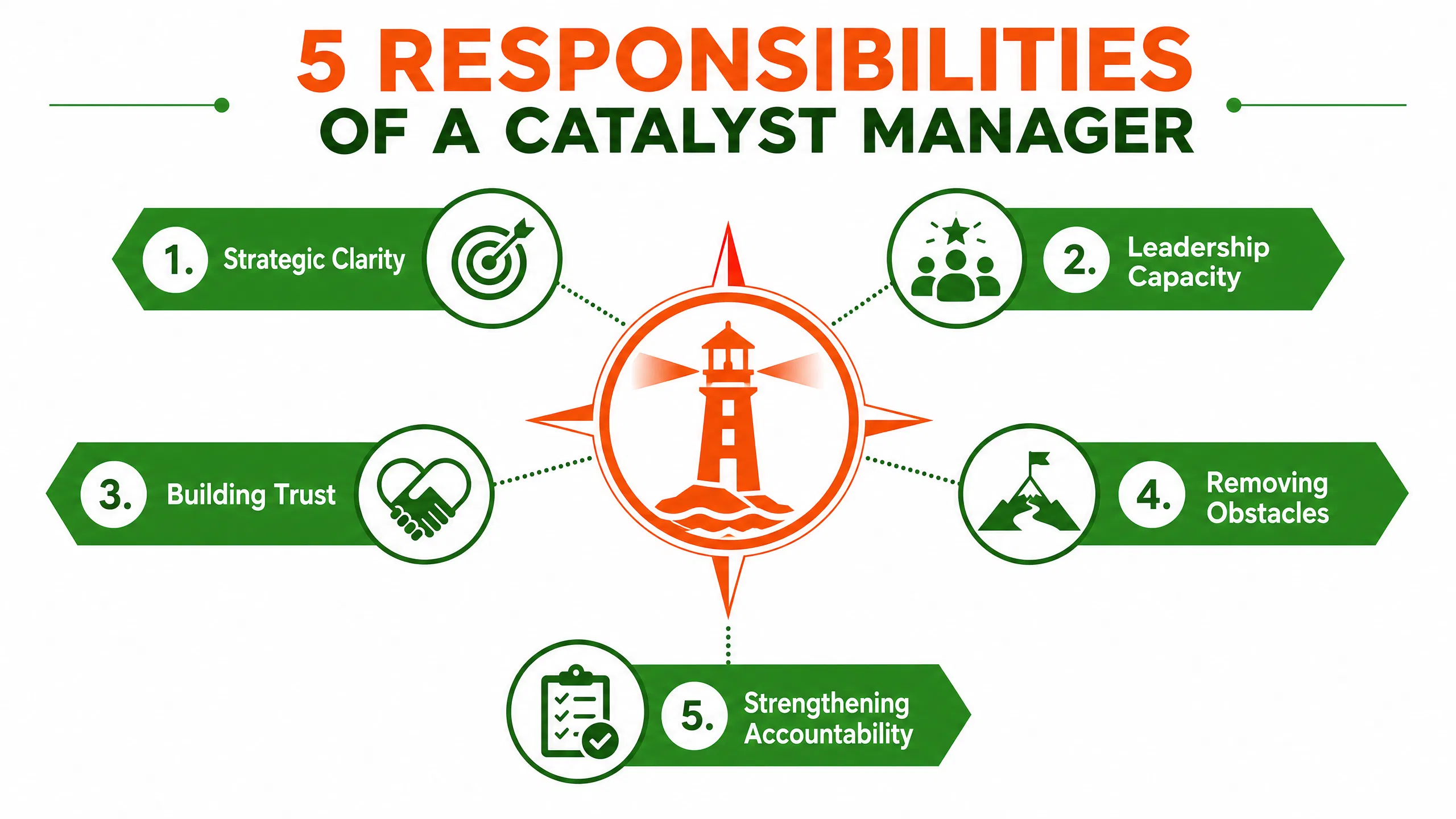
2. Developing Leadership Capacity
Distributed leadership requires more leaders throughout the organization.
Catalyst managers actively coach employees to:
- Improve decision-making
- Strengthen communication
- Build confidence
- Solve complex problems
Consequently, leadership becomes a shared organizational capability rather than an executive privilege.
The ForElite Training Institute Global Leadership Course provides practical frameworks for developing leadership capabilities across diverse and geographically distributed teams.
3. Building Trust
Trust is the foundation of decentralized organizations.
Employees cannot make independent decisions if they fear punishment for mistakes.
Catalyst managers foster environments where:
- Feedback is welcomed
- Experimentation is encouraged
- Learning is valued
- Accountability is shared
As trust grows, autonomy becomes possible.
4. Removing Obstacles
Traditional managers often become gatekeepers.
Catalyst managers become problem-solvers.
They identify and eliminate barriers such as:
- Resource shortages
- Process inefficiencies
- Communication gaps
- Organizational silos
As a result, teams can focus their energy on creating value rather than navigating bureaucracy.
5. Strengthening Accountability
Empowerment without accountability creates chaos.
Catalyst managers establish systems that ensure:
- Clear expectations
- Transparent performance measures
- Regular feedback loops
- Shared ownership of outcomes
Thus, autonomy and accountability work together rather than competing against one another.
For professionals seeking to strengthen personal responsibility in autonomous environments, the ForElite Training Institute Self-Leadership and Personal Accountability Course offers valuable frameworks for developing ownership and accountability.
Challenges Organizations Must Overcome
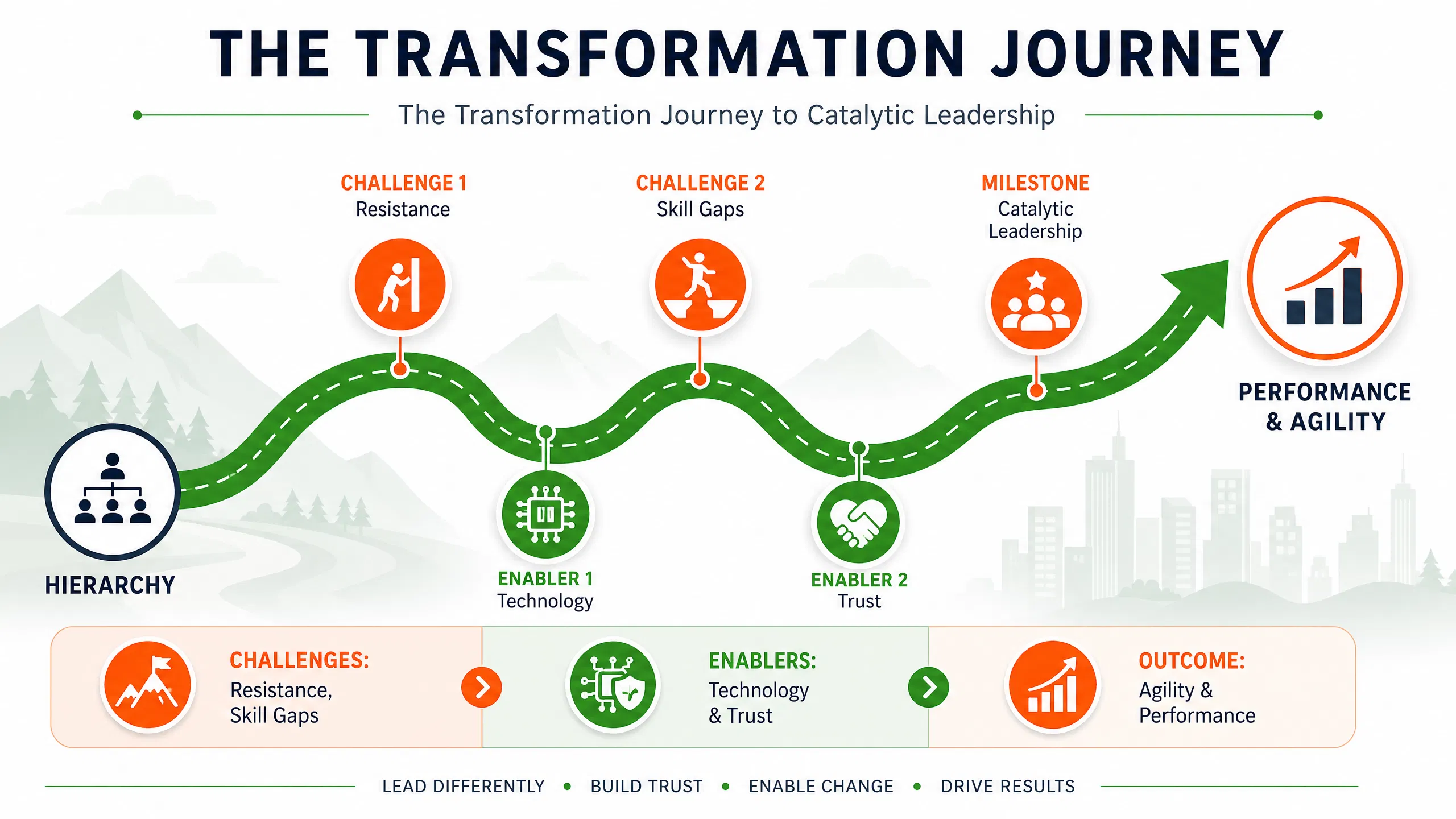
Despite its benefits, transitioning to distributed leadership is not easy.
Common challenges include:
Resistance to Change
Managers accustomed to authority may struggle to relinquish control.
Skill Gaps
Employees may lack the confidence or capabilities required for autonomous decision-making.
Cultural Barriers
Organizations with highly hierarchical cultures often find empowerment difficult to implement.
Ambiguity
Without clear structures, employees may become uncertain about roles and responsibilities.
Therefore, successful transformation requires intentional leadership development, continuous learning, and effective change management.
Organizations looking to build ethical, accountable leadership cultures can also benefit from the ForElite Training Institute Ethics, Integrity and Responsible Leadership Course.
The Technology Factor in Distributed Leadership
Technology plays a crucial role in enabling flatter, more decentralized organizations.
Digital platforms facilitate:
- Real-time collaboration
- Knowledge sharing
- Transparent communication
- Data-driven decision-making
Consequently, organizations can maintain alignment even when authority is distributed.
Digital transformation initiatives often complement leadership transformation efforts. Businesses seeking to modernize their digital infrastructure can explore the services offered by Nexera Digital Solutions, which specializes in digital strategy, web architecture, content intelligence, and performance-driven digital ecosystems.
The Future of Leadership Is Catalytic
The future of work is not leaderless.
Instead, it is characterized by leadership that is more distributed, collaborative, and adaptive.
Organizations will continue flattening hierarchies, empowering self-managed teams, and decentralizing decision-making because these structures provide the agility needed in rapidly changing markets.
Yet, success will depend on managers who can evolve.
The most effective leaders will not be those who control the most people.
Rather, they will be those who create the conditions where people can perform at their highest potential.
In this new era, the manager’s greatest contribution is not directing every action.
It is acting as a catalyst who unlocks leadership, innovation, accountability, and performance across the entire organization.