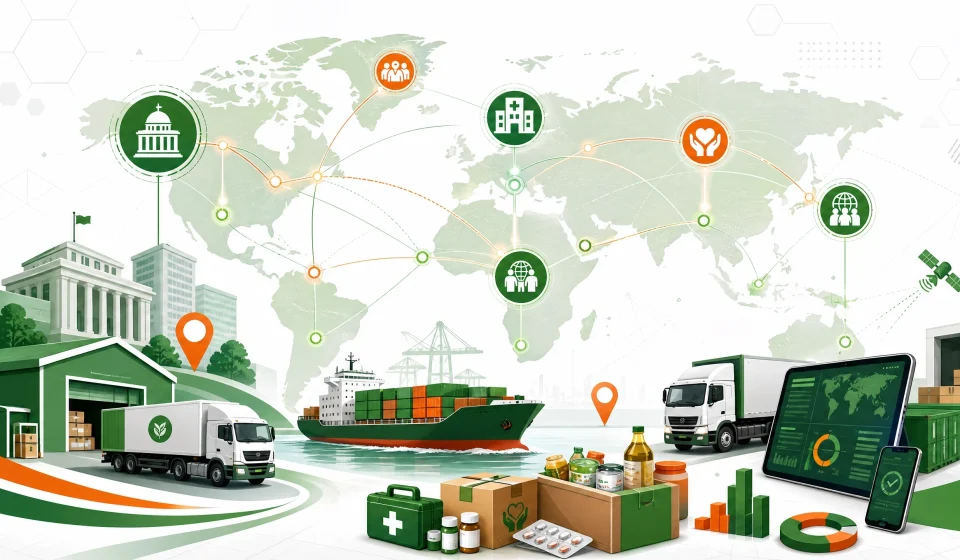
Government and Nonprofit Supply Chain: Building Resilient, Transparent, and Efficient Public Service Delivery

Government agencies and nonprofit organizations exist to create public value rather than maximize profits. Therefore, their supply chains are designed with a different mission in mind. Whether distributing medical supplies, delivering humanitarian aid, managing educational resources, or procuring infrastructure materials, every supply chain decision directly affects communities and citizens. A delayed shipment can interrupt healthcare services, while inefficient procurement can reduce the impact of donor funding or taxpayer resources.
Today, supply chains have become significantly more complex than they were a decade ago. Global disruptions, geopolitical tensions, climate-related disasters, cybersecurity threats, and increasing public expectations have forced governments and nonprofits to rethink how they source, transport, and distribute critical goods and services. Recent global research shows that resilience, digital transformation, AI adoption, cybersecurity, and supply chain visibility have become the highest priorities for public organizations seeking operational excellence.
Organizations seeking to strengthen procurement, logistics, and supply chain capabilities can benefit from specialized professional development such as the supply chain and procurement programs, alongside courses in project management, monitoring and evaluation, data analytics, public financial management, and leadership development that support stronger institutional performance.
Understanding Government and Nonprofit Supply Chains
Unlike private companies, government and nonprofit organizations must balance efficiency with accountability, transparency, fairness, and legal compliance. Consequently, procurement decisions are rarely based solely on price. They must also consider ethical sourcing, competitive bidding regulations, environmental sustainability, local economic development, and donor requirements.
Every stage of the supply chain, from planning and budgeting to procurement, warehousing, transportation, inventory management, and final distribution, must demonstrate accountability. Because these organizations manage public or donor funds, every expenditure is subject to scrutiny. This makes documentation, audit trails, and supplier transparency essential rather than optional.
What Makes Public Sector Supply Chains Different?
Government agencies often operate under procurement laws that require competitive bidding, supplier diversity, and public disclosure. Meanwhile, nonprofit organizations frequently work under donor-imposed procurement policies that emphasize value for money and measurable impact. These requirements create longer procurement cycles but also improve accountability and public trust.
Unlike commercial businesses, public organizations often prioritize social outcomes over financial returns. Emergency response agencies, humanitarian organizations, hospitals, and educational institutions may need to maintain strategic inventories even when doing so appears financially inefficient. After all, preparedness often saves lives.
| Private Sector | Government & Nonprofit |
|---|---|
| Profit-driven | Mission-driven |
| Faster purchasing | Regulated procurement |
| Competitive advantage | Public accountability |
| Customer satisfaction | Citizen and donor impact |
| Revenue growth | Social outcomes |
Why Supply Chain Management Matters More Than Ever
Recent studies indicate that supply chain resilience has become a strategic priority across governments worldwide. Organizations are investing in diversified sourcing, predictive analytics, cybersecurity, and AI-powered planning to prepare for disruptions rather than merely reacting to them. Experts increasingly argue that resilience now creates greater value than simply minimizing costs.
Similarly, nonprofit organizations responding to humanitarian crises must deliver supplies rapidly despite damaged infrastructure, political instability, or funding uncertainty. Building resilient supplier networks, maintaining emergency inventories, and collaborating with multiple partners significantly improve response capabilities.
Professionals looking to strengthen these competencies may also benefit from procurement, logistics, and humanitarian management training.
Key Components of Government and Nonprofit Supply Chains
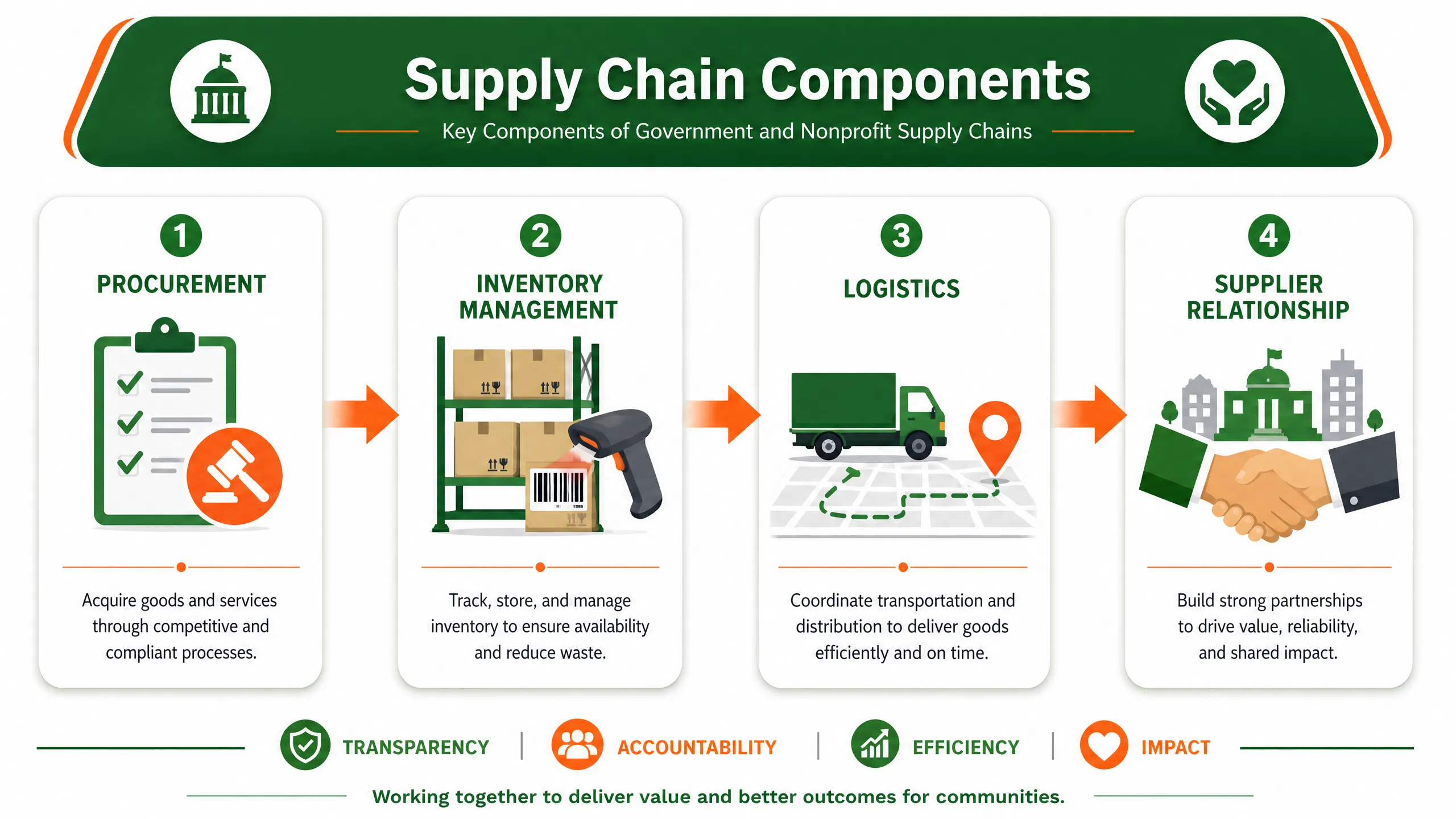
Effective public sector supply chains rely on several interconnected functions. First, procurement ensures that goods and services are acquired fairly, competitively, and transparently. Next, inventory management guarantees that essential supplies remain available without creating excessive stockholding costs. Then, logistics coordinates transportation, warehousing, customs clearance, and last-mile delivery. Finally, supplier relationship management ensures consistent quality and dependable service.
Modern organizations increasingly use integrated Enterprise Resource Planning (ERP) platforms, e-procurement systems, barcode technology, GPS tracking, and cloud-based inventory management to enhance visibility across their operations. AI-enabled forecasting is also helping organizations predict demand fluctuations, identify procurement risks, and optimize inventory levels.
Training in digital procurement systems, ERP implementation, business analytics, and data visualization helps procurement professionals adapt to these rapidly evolving technologies.
Major Challenges Facing Government and Nonprofit Supply Chains
Despite technological progress, public sector supply chains continue to face numerous obstacles. One of the biggest challenges is limited financial resources. Governments must balance competing priorities, while nonprofits often depend on uncertain donor funding. Budget reductions frequently delay procurement projects or restrict inventory investments.
Another significant challenge involves regulatory compliance. Procurement officers must navigate complex procurement legislation, anti-corruption requirements, environmental regulations, and donor guidelines. These processes, while necessary, often extend procurement timelines.
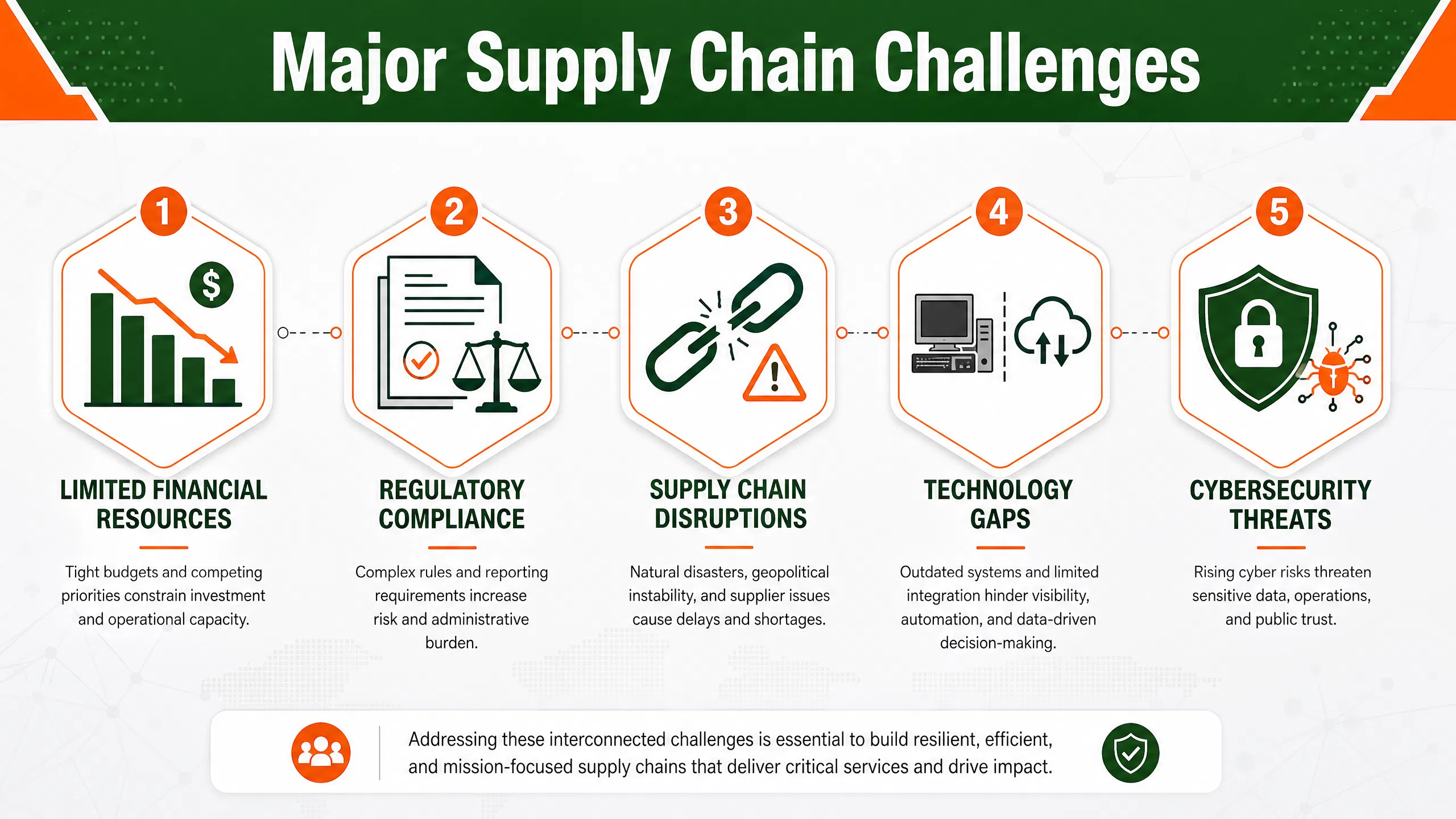
Supply chain disruptions have also become increasingly common. Geopolitical conflicts, transportation bottlenecks, pandemics, extreme weather events, and cybersecurity attacks continue to expose vulnerabilities across global supply networks. Governments are responding by strengthening domestic manufacturing, diversifying suppliers, and investing in resilient logistics infrastructure.
Technology gaps present an additional hurdle. Many public institutions still rely on fragmented spreadsheets and manual procurement systems that limit visibility and increase administrative costs.
Digital Transformation in Public Sector Supply Chains
Digital transformation is reshaping government procurement faster than ever before. Today, artificial intelligence supports demand forecasting, supplier risk assessment, automated document processing, and contract management. Cloud-based procurement platforms centralize purchasing data, while predictive analytics enables proactive decision-making instead of reactive crisis management.
Industry research suggests that AI delivers the greatest value when organizations redesign their business processes rather than simply adding technology to existing workflows. Successful digital transformation combines modern software with organizational change, workforce training, and strong governance.
Cybersecurity has become equally important. As procurement systems become increasingly interconnected, organizations must protect supplier data, financial records, and critical infrastructure against sophisticated cyber threats. Software supply chain security, vendor verification, and continuous monitoring now represent essential elements of public sector resilience.
Professionals seeking digital transformation expertise can expand their knowledge through technology, data analytics, cybersecurity, and digital governance programs available at ForElite Institute.
Best Practices for Strengthening Government and Nonprofit Supply Chains
Successful organizations rarely depend on a single strategy. Instead, they combine strong governance, modern technology, skilled personnel, supplier collaboration, and continuous improvement. Risk management begins with identifying critical suppliers, evaluating vulnerabilities, and developing contingency plans. Diversifying suppliers reduces dependence on single sources while strengthening resilience during disruptions.
Capacity building also plays a vital role. Procurement officers, logistics managers, finance professionals, and project managers require continuous professional development to remain effective in an increasingly digital environment. Investing in staff capabilities often produces returns that exceed investments in technology alone.
Sustainability has also become a strategic priority. Governments increasingly incorporate environmental, social, and governance (ESG) principles into procurement policies by evaluating suppliers based on carbon emissions, ethical labor practices, circular economy initiatives, and local economic impact. Recent international studies suggest that circular procurement strategies can improve resilience while generating broader economic and environmental benefits.
Organizations can strengthen broader institutional performance through complementary programs in leadership, project management, monitoring and evaluation, public financial management, and organizational development offered by ForElite Institute.
Digital communication also plays an important role in public procurement modernization. Organizations implementing supply chain technology, procurement portals, or digital transformation initiatives may benefit from specialized web development, SEO, and digital marketing expertise from Nexera Digital Solutions to improve stakeholder engagement and online service delivery.
Future Trends and Opportunities
The future of government and nonprofit supply chains will be shaped by resilience, intelligence, sustainability, and collaboration. Artificial intelligence will increasingly automate procurement analysis, demand forecasting, fraud detection, and supplier performance monitoring. Blockchain technologies may enhance transparency, while Internet of Things (IoT) devices will improve real-time asset tracking.
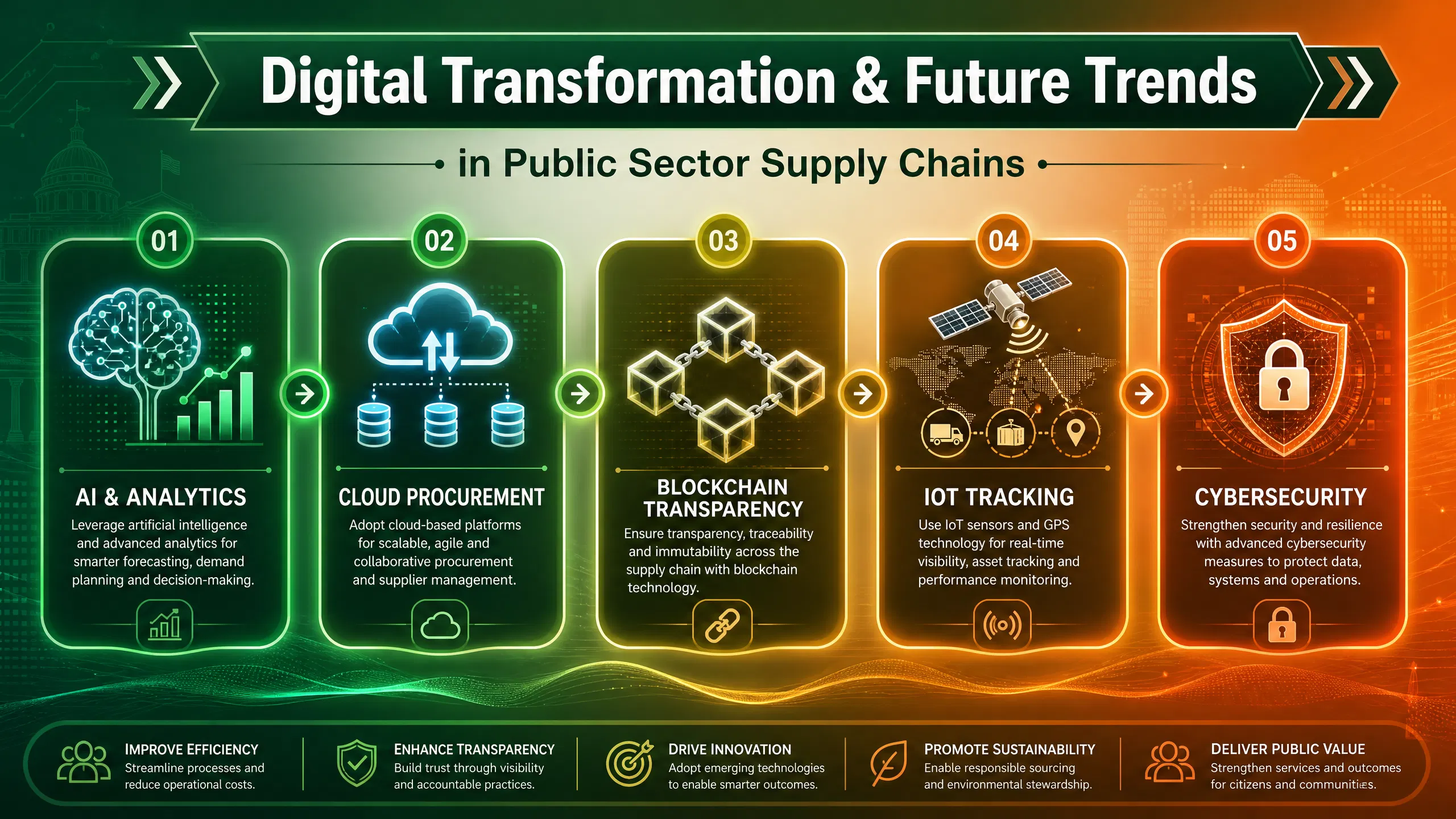
Governments are also placing greater emphasis on regional sourcing, strategic reserves, public-private partnerships, and resilient infrastructure to reduce dependence on fragile global supply networks. International organizations expect supply chains to become more interconnected, data-driven, and responsive to emerging risks over the coming years.
Organizations that embrace continuous learning, invest in workforce capabilities, modernize procurement systems, and strengthen supplier relationships will be better positioned to deliver essential public services efficiently while maintaining transparency and accountability.
Conclusion
Government and nonprofit supply chains have evolved from administrative support functions into strategic drivers of national resilience, humanitarian response, and sustainable development. Today, effective supply chain management requires much more than purchasing goods at competitive prices. It demands transparency, digital innovation, ethical procurement, resilient supplier networks, skilled professionals, and continuous improvement.
As technology continues transforming procurement and logistics, organizations that combine modern digital tools with strong governance and workforce development will be better equipped to serve citizens, donors, and communities. Investing in resilient supply chains ultimately strengthens public trust, improves operational efficiency, and enables governments and nonprofits to fulfill their missions even during periods of uncertainty.
Frequently Asked Questions
1. What is a government supply chain?
A government supply chain manages the procurement, storage, transportation, and distribution of goods and services needed to deliver public services efficiently and transparently.
2. How do nonprofit supply chains differ from private sector supply chains?
Nonprofits focus primarily on social impact, donor accountability, and mission achievement rather than maximizing profits.
3. Why is supply chain resilience important?
Resilience enables organizations to maintain operations during disruptions such as natural disasters, geopolitical conflicts, cyberattacks, or supplier failures.
4. How is AI transforming public sector supply chains?
AI improves demand forecasting, supplier risk assessment, procurement automation, inventory optimization, fraud detection, and decision-making through advanced analytics.
5. What skills are essential for government procurement professionals?
Key skills include strategic sourcing, contract management, logistics, financial management, risk analysis, digital procurement systems, negotiation, data analytics, and regulatory compliance.