


Managerial Skills: The Foundation of Successful Leadership
Modern workplaces are changing at lightning speed. Teams are becoming more digital, employees are demanding stronger leadership, and organizations are searching for managers who can inspire productivity while also supporting employee well-being. Because of this shift, managerial skills are no longer optional traits reserved for executives sitting in corner offices. They have become essential survival tools for every professional responsible for leading people, projects, and organizational goals.
A manager today wears many hats. One moment they are solving operational problems, and the next they are acting as mentors, strategists, communicators, and technology adopters. Companies now expect managers to balance productivity with empathy while adapting to constant market changes. Recent workplace reports show that only 44% of managers globally have received formal management training, even though poor leadership directly affects engagement and productivity. This gap explains why organizations are increasingly investing in leadership development and management courses.
Interestingly, the modern workforce no longer values authority alone. Employees want leaders who communicate clearly, support career growth, and encourage innovation. A manager who lacks emotional intelligence or communication skills can damage morale faster than a broken process or outdated technology. Think of managerial skills as the engine of a car. Without the engine, the vehicle may look impressive from the outside, but it simply will not move forward effectively.
Organizations seeking to strengthen leadership capabilities are increasingly turning to professional development institutions like ForElite Training Institute, which provides specialized programs focused on leadership, workplace productivity, and supervisory excellence. At the same time, businesses embracing digital transformation are also leveraging innovative companies like Nexera Digital Solutions to modernize operations and improve organizational performance.
Understanding Managerial Skills in Today’s Workplace
Managerial skills refer to the abilities managers use to coordinate people, resources, and processes efficiently. These skills help leaders guide teams toward organizational objectives while maintaining productivity and workplace harmony. Traditionally, management focused heavily on authority and supervision. Today, however, effective management revolves around communication, adaptability, collaboration, and innovation.
The workplace environment in 2026 looks very different from previous decades. Hybrid work models, artificial intelligence, automation, and digital collaboration tools have transformed the responsibilities of managers. According to recent workplace studies, leaders are increasingly overwhelmed by broader responsibilities, distributed teams, and technological disruption. Managers are now expected to understand employee well-being, workflow optimization, and digital systems all at once.
Why Managerial Skills Matter More Than Ever in 2026
Modern organizations operate in environments filled with uncertainty. Economic shifts, rapid technological advancement, and evolving employee expectations require leaders who can adapt quickly. Companies with strong managers experience higher employee retention, stronger productivity, and healthier workplace cultures.
Research also shows that leadership training improves communication, accountability, and team engagement. Employees are more likely to remain loyal to organizations where managers actively listen, provide feedback, and encourage professional growth. As a result, managerial skills directly influence organizational success.
The Difference Between Leadership and Management
People often confuse leadership with management, but the two concepts are slightly different. Management focuses on planning, organizing, and controlling operations. Leadership focuses on vision, influence, and inspiration. A truly successful manager combines both qualities.
Imagine a football coach. Management involves organizing training schedules, monitoring performance, and assigning roles. Leadership, on the other hand, involves motivating players to believe in the vision of winning together. The best managers know how to balance operational discipline with emotional inspiration.
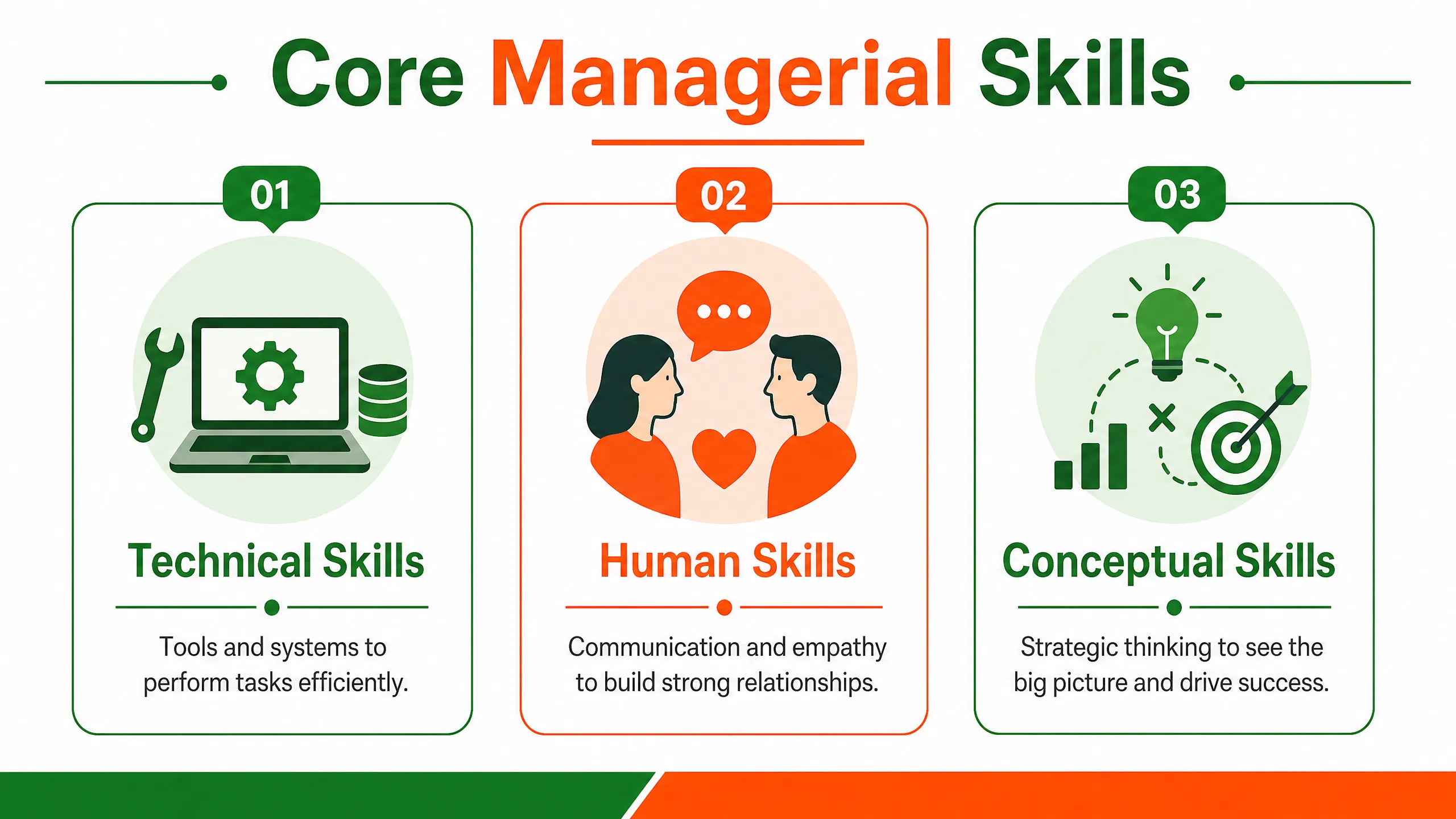
Core Types of Managerial Skills
Managers require multiple skill sets to perform effectively. These skills generally fall into three major categories: technical skills, human skills, and conceptual skills.
| Skill Type | Description | Importance |
|---|---|---|
| Technical Skills | Knowledge of tools, systems, and processes | Essential for operational efficiency |
| Human Skills | Communication and relationship-building abilities | Crucial for teamwork and motivation |
| Conceptual Skills | Strategic thinking and problem-solving | Helps managers make informed decisions |
Technical Skills
Technical skills involve understanding the practical aspects of work processes and systems. Managers in finance, engineering, marketing, or IT must understand the technical foundations of their industries. Without technical knowledge, managers struggle to guide teams effectively or evaluate performance accurately.
However, technical skills alone do not guarantee managerial success. A highly skilled engineer may fail as a manager if they cannot communicate with employees or delegate tasks properly. This is why leadership development programs are becoming increasingly important.
Organizations seeking structured managerial development often enroll employees in programs such as the Leadership and Management Skills Training Course for New Managers and Supervisors offered by ForElite Training Institute.
Human and Interpersonal Skills
Human skills involve communication, empathy, negotiation, collaboration, and relationship management. These abilities allow managers to work effectively with diverse teams. Managers who lack interpersonal skills often create toxic work environments filled with misunderstandings and mistrust.
Recent discussions among professionals highlight growing frustration with micromanagement and disconnected leadership styles in modern organizations. Employees increasingly value managers who encourage transparency, flexibility, and emotional support.
Conceptual and Strategic Thinking Skills
Conceptual skills allow managers to see the bigger picture. These abilities help leaders understand organizational goals, industry trends, and long-term strategies. Managers with strong conceptual thinking can connect daily operations to broader business objectives.
Strategic thinking is particularly important in industries experiencing digital transformation. Businesses adopting AI and automation need managers who can align technology with workforce productivity.
Communication as the Heart of Management
Communication is arguably the most important managerial skill. A manager may possess technical expertise and strategic intelligence, but poor communication can destroy team morale and operational efficiency.
Managers communicate constantly. They provide instructions, give feedback, resolve conflicts, present ideas, and motivate employees. Clear communication creates alignment, while poor communication creates confusion and frustration.
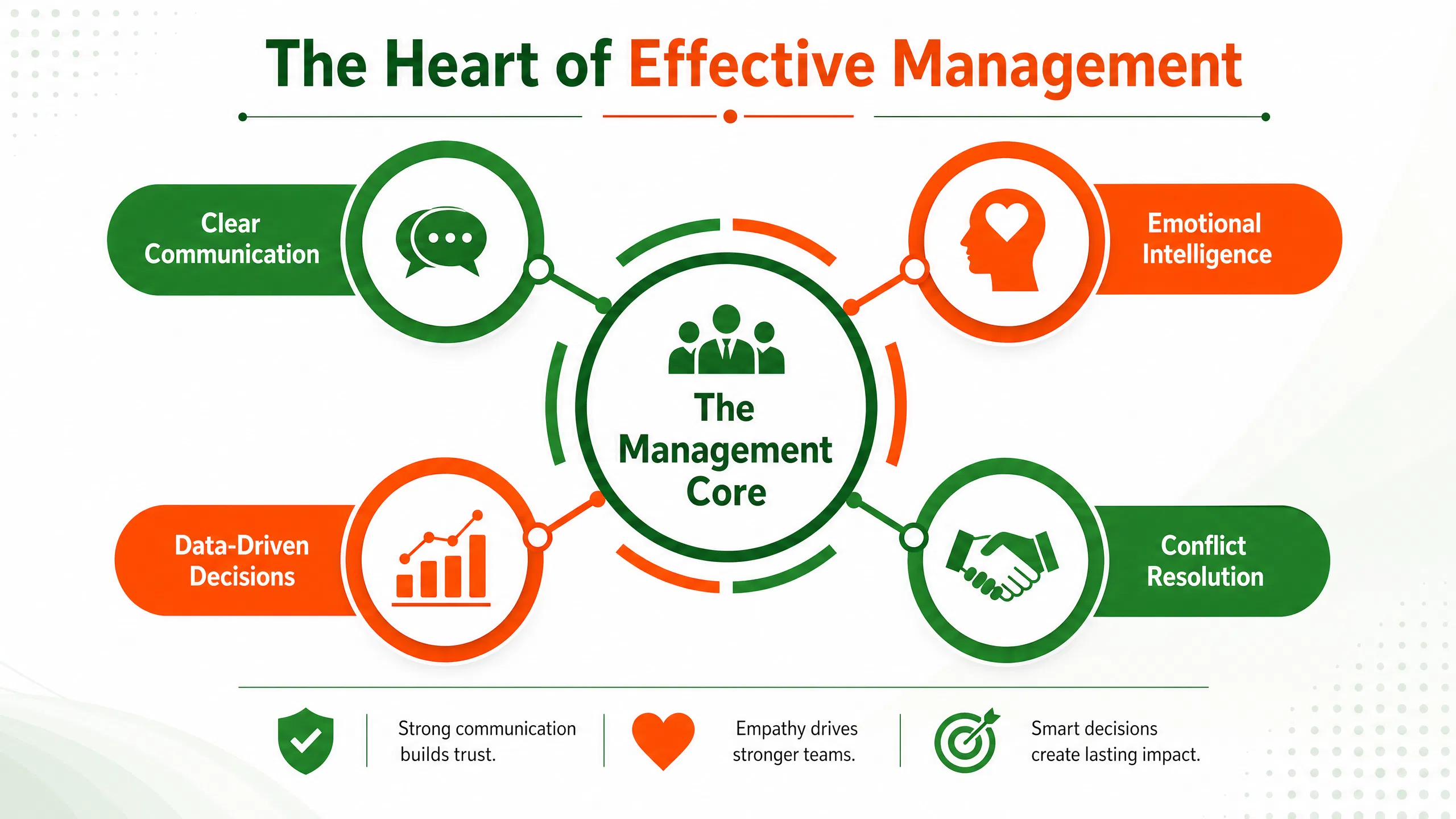
Active Listening and Workplace Transparency
Great managers do not simply talk; they listen actively. Employees want leaders who understand their concerns and acknowledge their contributions. Active listening builds trust and encourages collaboration.
Gallup workplace research emphasizes that regular conversations between managers and employees improve engagement significantly. Employees feel valued when managers genuinely pay attention to their perspectives.
Conflict Resolution and Team Collaboration
Conflict is inevitable in every workplace. Different personalities, goals, and communication styles naturally create tension. Skilled managers handle disagreements calmly and professionally instead of escalating problems emotionally.
Conflict resolution requires patience, emotional intelligence, and objectivity. Managers who address issues early prevent larger organizational problems later. Think of workplace conflict like a small leak in a roof. Ignore it long enough, and the damage spreads everywhere.
For organizations seeking stronger workplace communication and performance management capabilities, Performance Management and Talent Development Training Programs provide practical solutions for leadership growth.
Decision-Making and Problem-Solving Skills
Managers make decisions every single day. Some decisions involve routine operations, while others impact entire organizations. Strong decision-making skills allow leaders to evaluate information carefully, assess risks, and choose effective solutions.
Data-Driven Decision Making
Modern businesses rely heavily on analytics and data. Managers now use performance dashboards, AI systems, and digital tools to guide decision-making. Still, data alone cannot replace human judgment.
The best managers combine analytical thinking with emotional intelligence. They understand numbers, but they also recognize the human impact behind those numbers.
Managing Uncertainty in Modern Organizations
The business environment has become increasingly unpredictable. Managers must now navigate economic uncertainty, technological disruption, and changing employee expectations simultaneously.
Recent workplace studies suggest that leadership success depends heavily on adaptability and resilience. Managers who remain flexible during uncertainty help organizations maintain stability and productivity.
Emotional Intelligence and Employee Motivation
Emotional intelligence refers to the ability to understand emotions, manage relationships, and respond appropriately to workplace situations. This skill has become one of the defining qualities of successful modern managers.
Employees no longer want robotic supervisors who focus only on targets and deadlines. They want managers who recognize stress, appreciate contributions, and support personal growth.
Building Trust Within Teams
Trust acts as the glue that holds teams together. Without trust, employees hesitate to share ideas, collaborate openly, or take initiative. Managers build trust through consistency, honesty, and accountability.
Employees observe managerial behavior closely. If leaders fail to communicate transparently or constantly change expectations, trust erodes quickly.
The Role of Empathy in Leadership
Empathy allows managers to understand employee perspectives and workplace challenges. Empathetic leaders create supportive environments where employees feel respected and motivated.
Modern workplaces are becoming more complex, especially with hybrid work arrangements and digital collaboration systems. Managers who show empathy improve morale and reduce burnout risks.
Time Management and Delegation
Managers juggle meetings, projects, deadlines, employee concerns, and strategic planning simultaneously. Without strong time management skills, productivity quickly collapses.
Prioritization Strategies for Managers
Effective managers prioritize tasks based on urgency and organizational value. They focus energy on high-impact activities instead of wasting time on low-priority distractions.
Productivity studies reveal that employees spend large portions of their workdays handling fragmented communication and administrative overload. Managers who streamline workflows improve efficiency significantly.
Avoiding Micromanagement
Micromanagement is one of the fastest ways to damage team morale. Employees become frustrated when managers control every detail unnecessarily.
Delegation empowers employees while allowing managers to focus on strategic responsibilities. Successful managers trust their teams and encourage ownership of tasks.
Organizations seeking to strengthen delegation, productivity, and leadership capabilities often explore courses such as Human Capital and Institutional Development Courses to develop stronger workplace leadership frameworks.
Digital Transformation and Managerial Skills
Technology is reshaping every industry. Managers must now understand digital tools, automation systems, and AI-driven workflows to remain effective leaders.
Managing AI-Driven Workplaces
Artificial intelligence is changing how organizations operate. Managers increasingly oversee teams working alongside AI systems and automation technologies.
Research indicates that leadership now requires digital literacy, adaptability, and the ability to guide employees through technological transitions.
Why Digital Literacy Is Essential for Managers
Managers who resist technology risk becoming irrelevant. Digital literacy helps leaders analyze performance data, improve workflows, and communicate effectively within modern organizations.
Companies focusing on digital transformation frequently partner with innovative technology providers like Nexera Digital Solutions to enhance automation, SEO performance, analytics, and digital growth strategies.
Training and Professional Development for Managers
Managerial skills improve through continuous learning and practical experience. Even experienced leaders require ongoing development because workplace dynamics constantly evolve.
Best Leadership Training Programs
Professional management training programs help managers strengthen communication, strategic thinking, delegation, and employee engagement skills. Structured training also improves confidence among new supervisors and department leaders.
Programs such as the Leadership and Management Skills Training Course equip professionals with practical tools for handling real-world workplace challenges.
Benefits of Continuous Learning
Continuous learning keeps managers adaptable and competitive. Organizations investing in leadership development often experience stronger productivity, improved employee retention, and healthier workplace cultures.
Leadership development is similar to sharpening a knife. Even the sharpest blade becomes dull without regular maintenance.
Common Mistakes Managers Should Avoid
Even experienced managers make mistakes. Some of the most damaging leadership errors include:
- Poor communication
- Micromanagement
- Ignoring employee feedback
- Avoiding difficult conversations
- Failing to delegate
- Resisting technological change
- Lack of emotional intelligence
Managers who recognize these mistakes early can improve team performance significantly. Self-awareness remains one of the most underrated leadership qualities.
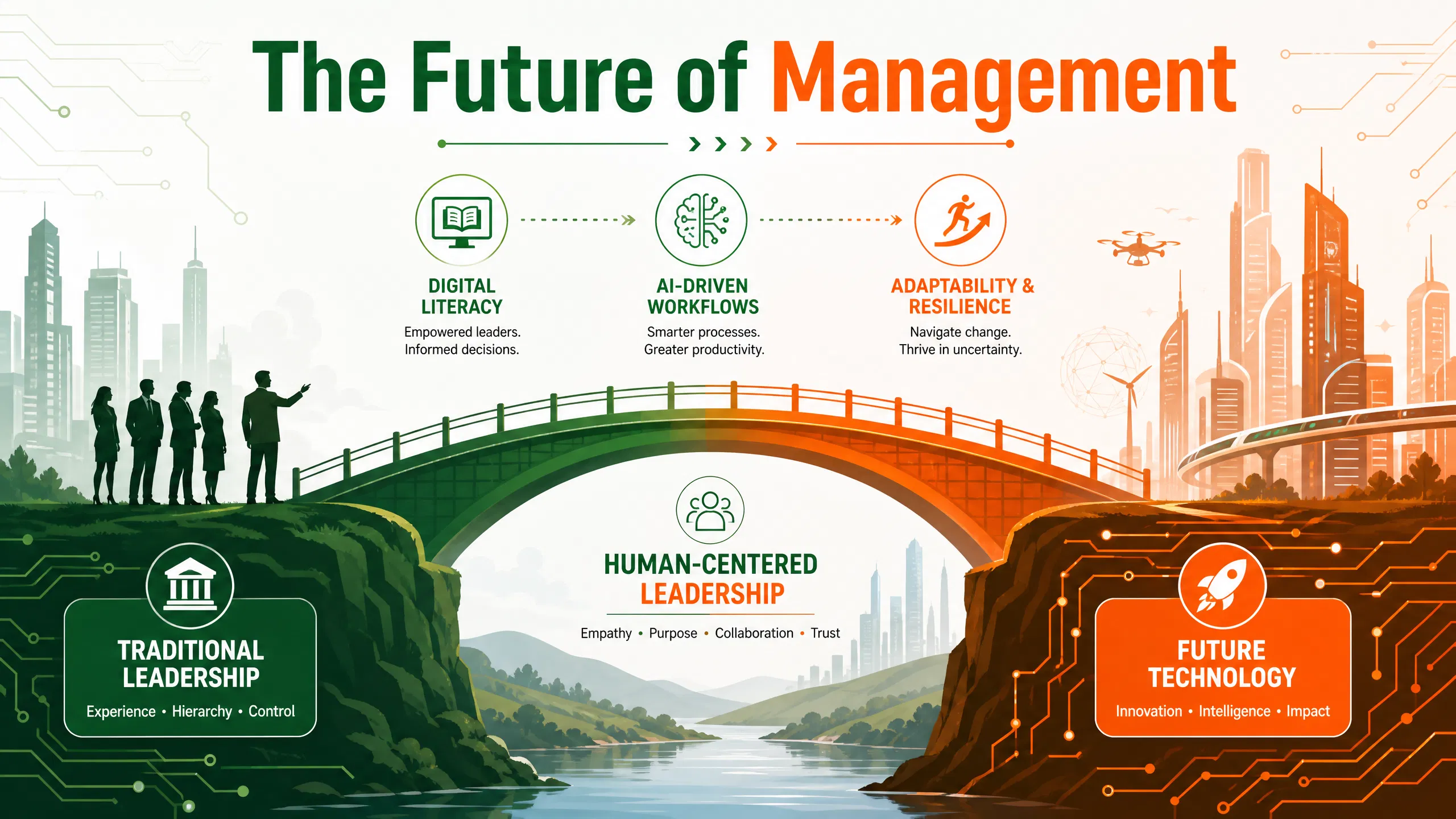
Future Trends Shaping Managerial Skills
The future of management will revolve around adaptability, digital intelligence, and human-centered leadership. AI systems will continue transforming workflows, but human skills such as empathy, creativity, and communication will remain irreplaceable.
Studies also suggest that organizations increasingly value hybrid leadership models combining technological understanding with interpersonal intelligence. Managers capable of balancing innovation with emotional intelligence will dominate future workplaces.
The manager of tomorrow will not simply supervise tasks. They will guide ecosystems of people, technology, and organizational culture simultaneously.
Conclusion
Managerial skills are no longer limited to planning schedules or supervising employees. They now represent the foundation of organizational success in a rapidly changing world. Strong managers communicate effectively, motivate teams, solve problems strategically, and adapt to technological change confidently.
Modern workplaces demand leaders who combine technical expertise with emotional intelligence and strategic thinking. Employees expect transparency, support, and meaningful collaboration from their managers. Organizations that invest in leadership development consistently outperform those that neglect managerial training.
The future belongs to managers who embrace learning, adapt to innovation, and prioritize human connection alongside productivity. Whether leading a small department or an international organization, mastering managerial skills remains one of the most valuable investments any professional can make.
FAQs
1. What are managerial skills?
Managerial skills are abilities that help managers lead teams, solve problems, communicate effectively, and achieve organizational goals efficiently.
2. Why are managerial skills important?
They improve productivity, employee engagement, teamwork, and organizational performance while helping managers handle workplace challenges effectively.
3. Which managerial skill is the most important?
Communication is often considered the most important managerial skill because it influences teamwork, motivation, problem-solving, and decision-making.
4. How can managers improve their leadership skills?
Managers can improve through professional training, mentorship, continuous learning, workplace experience, and leadership development programs.
5. What is the difference between technical skills and managerial skills?
Technical skills focus on performing specialized tasks, while managerial skills involve leading people, making decisions, and managing organizational processes.