
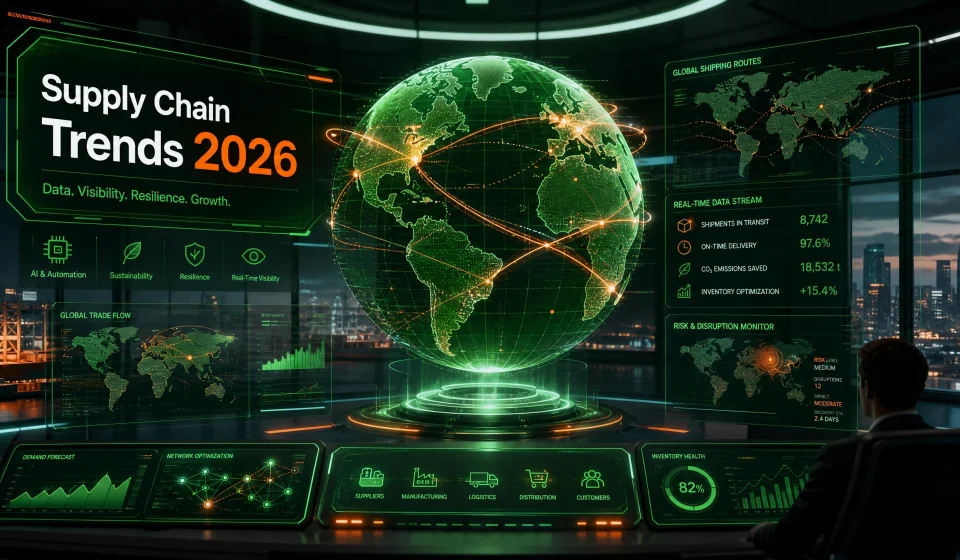
The 2026 Blueprint: Master Supply chain trends 2026 with Power, Speed, and Unshakable Resilience

The era of predictable commerce is officially dead and buried. If you are running an enterprise today, you already know that global instability is no longer a temporary hurdle, it is your everyday operating baseline. To survive and dominate this landscape, you must adapt to the defining macro shifts of the year. According to the World Economic Forum, more than 80% of global companies expect recurring, structural impacts on their logistics networks due to geopolitical conflicts, frantic regulatory shifts, and extreme climate disruptions.
Managing these challenges requires a total operational overhaul. We are witnessing a massive transition where passive visibility is replaced by immediate, automated execution. This comprehensive guide breaks down the core Supply chain trends 2026 that are shifting corporate priorities from simple cost-cutting to absolute, unyielding structural endurance.
1. The Dawn of Agentic AI: Moving Beyond Simple Predictive Analytics
The hype cycle surrounding basic generative artificial intelligence has finally passed. In its place, a much more powerful force has emerged at the center of Supply chain trends 2026: Agentic AI. For years, digital platforms simply served up alerts on pretty dashboards, leaving human planners to log into multiple systems to fix the mess.
Today, that old approach is a major bottleneck. Agentic systems do not just flag an exception; they reason through complex logic chains, query disparate enterprise resource planning (ERP) systems, and execute solutions autonomously.
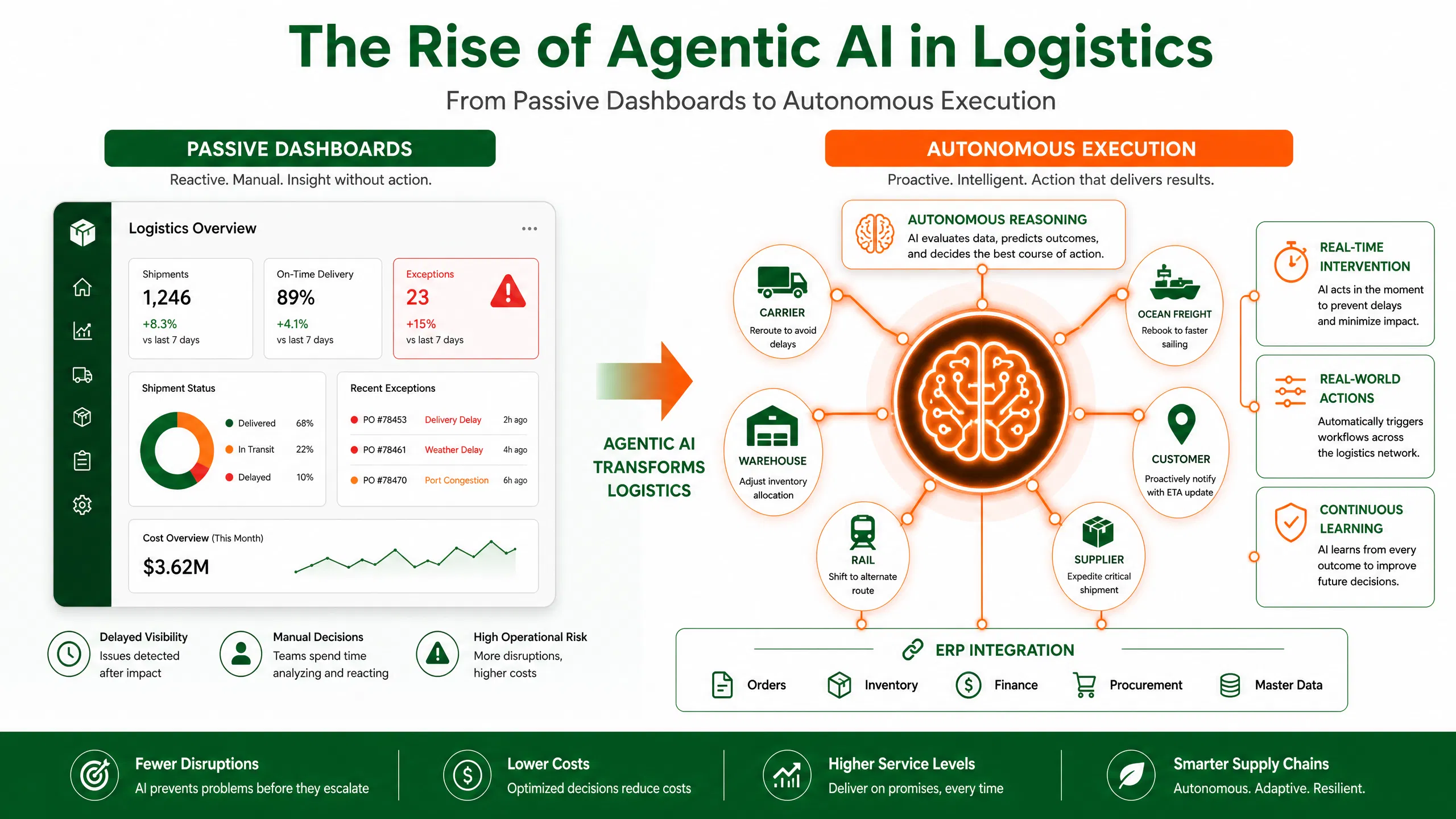
1.1 Shifting from Passive Visibility Dashboards to Autonomous Execution Systems
Boy, the days of staring helplessly at a red alert on a screen are long gone! Modern corporate networks leverage autonomous agents that actively intervene the exact second a disruption signal ripples through the logistics web. If a port strike or a sudden climate event shuts down a transit lane, the software does not wait for a morning meeting. It instantly recalculates transit times, checks alternative vendor availability, and modifies purchase orders on the fly.
Data from recent studies by Tradeverifyd shows that 72% of supply chain executives now consider automated mitigation capabilities mandatory for handling market volatility. By offloading these tedious data explorations and root-cause analyses to software agents, you reduce decision latency from days to mere fractions of a second. This operational speed is exactly what separates industry leaders from legacy operators who are still drowning in manual spreadsheets.
1.2 Tackling the Retirement Cliff: Preserving Deep Logistics Knowledge
There is a quiet crisis happening in back offices right now. Experienced planners are retiring in record numbers, taking decades of tribal knowledge right out the door with them. This “demographic retirement cliff” leaves younger, smaller workforces to manage wildly complex global networks.
Thankfully, agentic AI acts as the ultimate knowledge preservation engine. By observing historical workflows and training on deep transactional data, these intelligent systems effectively clone senior planners’ expertise. A fresh hire can step in and immediately coordinate complex category management because the AI guides their choices, ensures data quality, and validates quotes automatically.
2. Hyperautomation and Composable Architecture in Modern Warehousing
The old way of upgrading enterprise software, spending millions of dollars on a rigid, multi-year implementation project, is completely dead. In 2026, agility is the name of the game, and that requires a major shift toward modular tech stacks.
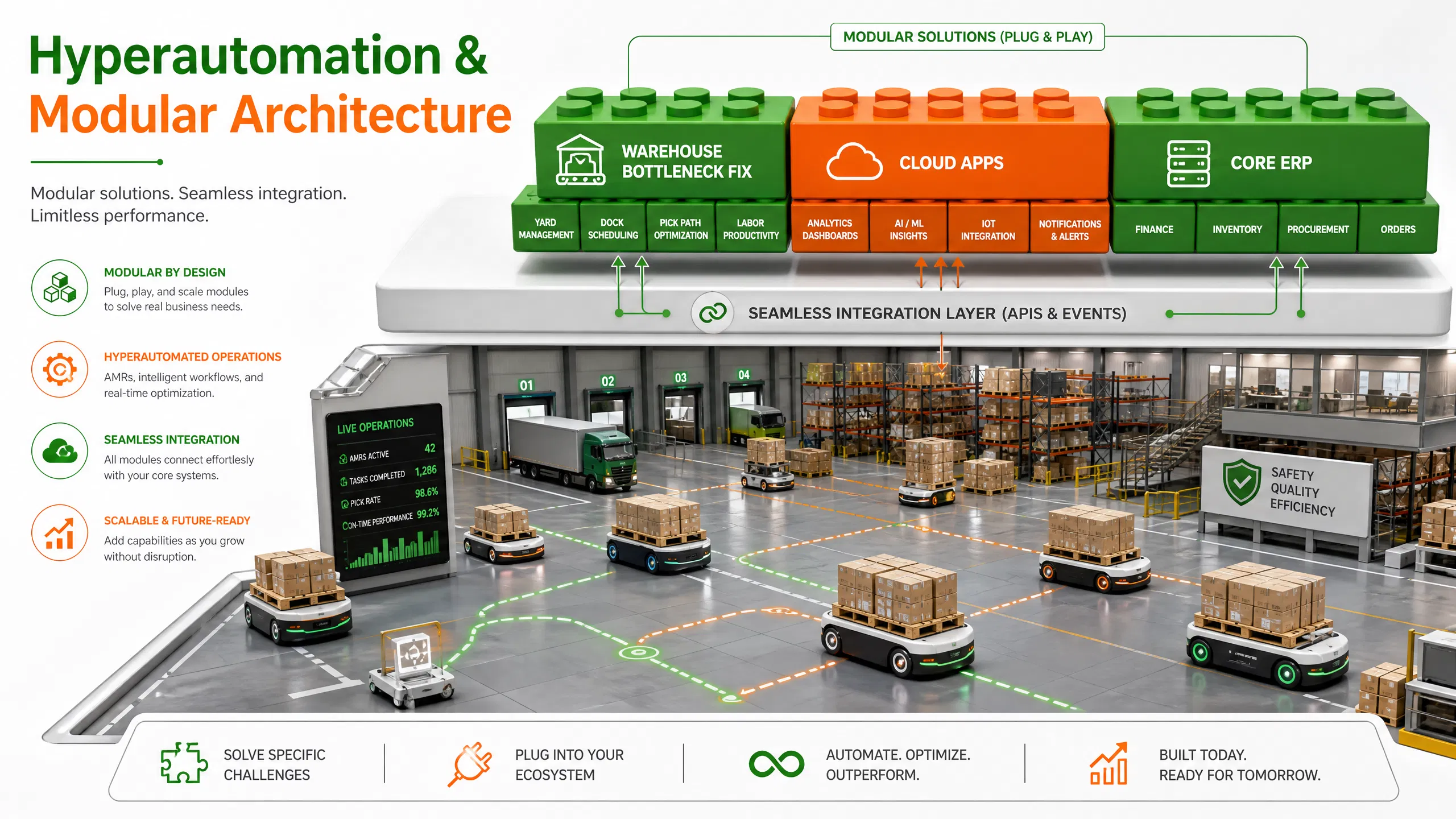
2.1 Smashing the Monolith: Why Modular Point Solutions are Winning
Let’s face it: nobody has the patience for a three-year software rollout anymore. Modern organizations are aggressively tearing down monolithic systems and replacing them with composable architectures. This means you can drop in a specialized cloud application to solve a specific warehouse bottleneck without touching your core ERP.
According to product experts, shifting to a modular structure delivers a rapid return on investment (ROI) and eliminates the curse of paid software sitting unused on a server. It allows your business to continuously evolve in a steady, ongoing rhythm rather than gambling on massive, high-risk IT overhauls.
2.2 Robotics and Smart Sensors Redefining Throughput on the Shop Floor
Physical automation is exploding across leading distribution centers. The combination of active IoT (Internet of Things) sensors and autonomous mobile robots (AMRs) has turned dark, dusty warehouses into highly synchronized execution engines.
These technologies pull real-time inventory counts and move goods directly to human pickers, completely eliminating wasted transit time on the shop floor. By pairing these hardware advancements with strong data foundations, fulfillment operations maintain a steady, unshakeable pace even during unpredictable peak seasons.
3. Redefining Resilience: Transitioning from Redundancy to Adaptability
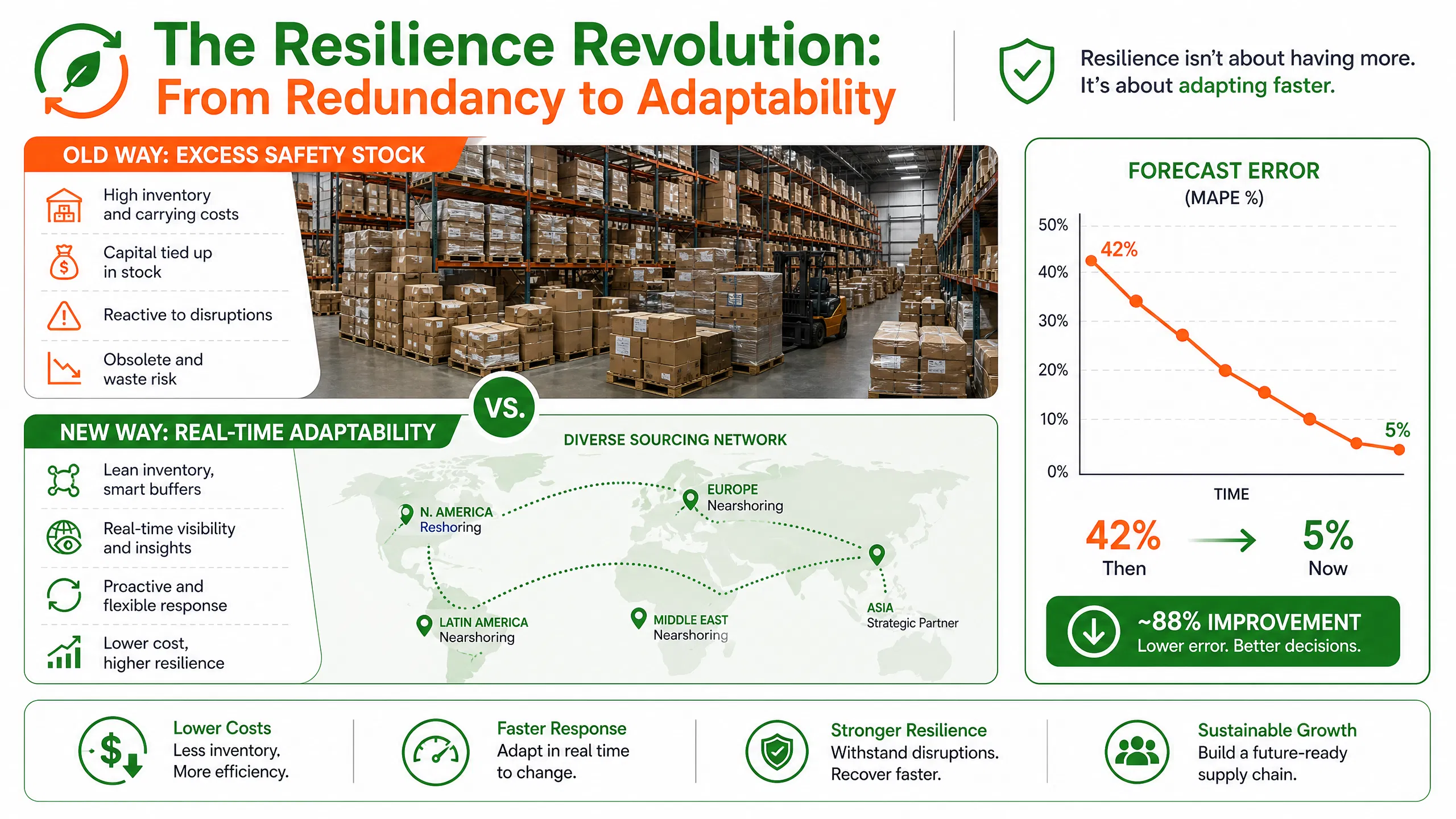
For a long time, companies thought the only way to protect against shortages was to hoard inventory. But holding heaps of safety stock paralyzes capital and spikes storage costs. The current environment demands that we redefine resilience entirely: it is no longer about redundancy; it is about pure, real-time adaptability.
3.1 Escaping the Trap of Costly Excess Inventory and Safety Stock
Tying up millions in emergency stock is a lazy strategy that backfires when demand shifts overnight. Top-performing operations are throwing away broad, blanket inventory policies and embracing granular, SKU-level metrics.
By applying advanced artificial intelligence to demand forecasting, you can slash forecast errors dramatically. This precision means you hold exactly what you need, where you need it, dropping safety stock levels without risking empty shelves. Agility beats volume every single day of the week.
3.2 Nearshoring, Reshoring, and the Dynamic Sourcing Revolution
Relying on a single factory half a world away is a recipe for disaster. To combat structural price volatility and political tariffs, Western firms are executing a massive geographical rewiring.
Whether you call it nearshoring, reshoring, or regionalized sourcing, the goal is exactly the same: shorten your transit lanes and bring production closer to your end customers. Building a diverse, flexible supplier network gives you the power to pivot instantly when a specific region experiences a sudden shock.
4. Connected Execution: Synthesizing Sourcing, Logistics, and Finance
Silos are the absolute enemy of a smooth operation. A late inbound container should never be a surprise to your warehouse crew, nor should it blindside your order management team. Connected execution brings all your separate systems together under a single, unified layer of live intelligence.
4.1 Breaking Down Operational Silos with Real-Time Digital Twins
Enter the digital twin: a complete virtual replica of your entire physical supply network. By continuously feeding live data from active sensors into these virtual models, planners can view their entire footprint instantly.
More importantly, it allows teams to run predictive stress-test simulations. You can virtually break a shipping lane or simulate a component shortage to see exactly how it impacts your cash flow and delivery promises before it actually happens. This foresight transforms your organization from a reactive firefighter into an intentional, proactive strategist.
4.2 Driving Strategic Value by Moving Logistics into Global Business Services
A highly sophisticated logistics setup handles millions of small transactions, regulatory filings, and complex reporting tasks every day. Because of this massive administrative footprint, leading global enterprises are centralizing their logistics functions into Global Business Services (GBS) units.
Bringing sourcing, customer service, and transportation management under one roof unlocks immense cost efficiencies. It builds a single, undeniable source of truth for your data, making it simple to scale automated processes, deploy predictive algorithms, and maintain tight corporate governance.
5. Essential Metrics and the New Baseline for Strategic Evaluation
You cannot manage what you do not accurately measure. The traditional metrics of the past like simple unit cost or generic lead times fail to capture the true health of a modern network operating in a permanent state of crisis.
5.1 Tracking Recovery Time and Decision Accuracy in an Era of Permacrisis
The boardroom conversation has completely shifted. Today, executives focus intensely on metrics like Time to Recover (TTR) and automated decision accuracy.
These modern performance indicators track exactly how long it takes your system to identify a disruption, pivot to an alternative plan, and return to normal service levels. Prioritizing these numbers ensures your operational ecosystem remains highly responsive, data-driven, and perfectly aligned with shifting market demands.
6. Frequently Asked Questions (FAQs)
What are the absolute biggest Supply chain trends 2026 has brought to light?
The most impactful developments center squarely on agentic AI systems, highly composable software architectures, and a complete shift from hoarding physical inventory to building real-time network adaptability.
How does agentic AI differ from the older generative AI models?
Older generative models were primarily used for creating content or displaying static charts. Agentic AI actively reasons, connects deeply with existing corporate systems, and takes direct, autonomous action to solve complex logistics problems without needing human intervention.
Why is modular software architecture replacing traditional legacy systems?
Traditional enterprise software requires years of expensive implementation and locks companies into rigid workflows. Composable, modular apps let you plug in quick solutions for specific operational bottlenecks, ensuring a fast return on investment.
What is driving the massive industry push toward nearshoring and reshoring?
Constant geopolitical friction, aggressive tariff changes, and severe climate disruptions have made long-distance, single-source travel lanes incredibly risky. Bringing production closer to home dramatically shortens transit times and builds an effective shield against global instability.
How do digital twins actually improve daily operational resilience?
A digital twin uses live data from active sensors to build a real-time virtual replica of your physical infrastructure. This lets your planners run advanced simulations, catch bottlenecks early, and fix logistics errors before they ripple downstream.
What specific skills does the modern workforce need to thrive right now?
Because automated tools handle the repetitive data tasks, human workers must pivot toward advanced data literacy, strategic scenario planning, and cross-functional system management. Up-skilling your team is crucial for maintaining data integrity.
Conclusion: Seize the Future of Logistics Today
The structural shifts reshaping global commerce demand bold, immediate action. Sticking to outdated strategies or relying on fragmented data spreadsheets will quickly leave your business exposed to costly errors and aggressive, tech-enabled competitors. Building an agile, automated network is no longer a future goal, it is a mandatory condition for survival.
To position your business for long-term success, your team must deeply understand these emerging systems. Check out professional industry resources and elevate your team’s operational capabilities by enrolling them in targeted logistics and supply chain short courses, training and seminars to master these critical modern strategies today.