

The modern workplace is changing faster than at any point in recent history. Artificial intelligence, hybrid work models, global competition, and shifting employee expectations are forcing leaders to rethink how organizations operate. Companies that once thrived through rigid hierarchies and top-down management are discovering that these structures often struggle to adapt to rapid change. As a result, a new organizational model is gaining attention: the self-optimizing organization.
A self-optimizing organization continuously improves its performance through decentralized decision-making, transparent information sharing, learning cultures, and empowered employees. Rather than waiting for executives to identify every problem and prescribe every solution, these organizations create systems where teams can recognize opportunities, solve challenges, and adapt in real time.
The urgency for this shift is supported by recent workplace research. According to Gallup’s 2026 State of the Global Workplace report, global employee engagement dropped to 20% in 2025, the lowest level since 2020, costing the world economy approximately $10 trillion in lost productivity. The decline was driven largely by falling manager engagement, highlighting the limitations of traditional leadership approaches.
Organizations that learn to self-optimize are better positioned to remain resilient, innovative, and competitive. They move faster because intelligence is distributed across the organization rather than concentrated at the top. They also attract and retain talent because employees feel trusted, valued, and empowered.
For leaders seeking to build future-ready businesses, designing self-optimizing organizations is no longer optional. It is becoming a strategic necessity.
Understanding Self-Optimizing Organizations
What Does Self-Optimization Mean in Modern Business?
A self-optimizing organization is not a leaderless organization. Instead, it is an organization where leadership is embedded throughout the system. Teams are equipped with the information, authority, and capabilities needed to improve processes and outcomes without waiting for approval at every step.
Think of a modern navigation app. It constantly collects data, analyzes traffic conditions, and adjusts routes automatically. A self-optimizing organization works in a similar way. Information flows freely, feedback loops are active, and employees continuously adapt based on real-time insights.
Meanwhile, self-optimization goes beyond efficiency. It also involves improving employee experience, customer satisfaction, innovation, and long-term resilience. The organization becomes capable of learning from both successes and failures.
This concept has become increasingly relevant as organizations navigate uncertainty. Traditional command-and-control systems often create bottlenecks because information must travel through multiple management layers before action occurs. In rapidly changing environments, that delay can be costly.
Why Traditional Hierarchies Are Losing Effectiveness
Traditional organizational structures were designed during an era when stability was the norm. Leaders could make annual plans, establish detailed procedures, and expect relatively predictable outcomes. Today’s environment is far less predictable.
As a result, organizations require agility rather than bureaucracy. Information often reaches frontline employees before senior executives. Customers change preferences quickly, technologies evolve rapidly, and competitors emerge unexpectedly.
Research also shows growing challenges among managers. Gallup reports that manager engagement has fallen significantly in recent years, reducing the effectiveness of traditional supervisory models. When managers become overwhelmed, organizational responsiveness suffers.
The lesson for leaders is clear: sustainable performance depends less on tighter control and more on creating systems that enable continuous adaptation.
The Leadership Shift from Control to Enablement
Leaders as System Architects
One of the most important leadership lessons of the twenty-first century is that leaders should focus on designing systems rather than controlling every action.
A system architect creates the conditions that allow people to succeed. Instead of providing all the answers, leaders establish clear objectives, define operating principles, and ensure teams have access to necessary resources.
Consequently, leadership becomes less about directing tasks and more about shaping environments. Great leaders design structures that encourage collaboration, learning, accountability, and innovation.
Organizations seeking to strengthen leadership capabilities often benefit from professional development initiatives such as the programs available through Forelite Training, which focus on building modern management and organizational effectiveness skills.
Building Trust as an Operating Principle
Trust is the foundation of self-optimization. Without trust, employees hesitate to take initiative, share ideas, or challenge outdated practices.
High-trust organizations empower individuals to make decisions aligned with organizational goals. Employees understand that mistakes are viewed as learning opportunities rather than reasons for punishment.
At the same time, trust must be paired with accountability. Clear expectations, measurable outcomes, and transparent communication ensure that autonomy supports organizational objectives rather than undermining them.
When trust becomes embedded in organizational culture, teams operate with greater confidence and speed.
The Business Case for Self-Optimizing Organizations
Employee Engagement and Performance
The connection between engagement and organizational performance is well established. Engaged employees contribute more energy, creativity, and commitment to their work.

Gallup’s latest research shows that declining engagement continues to have significant economic consequences, with low engagement contributing to trillions of dollars in lost productivity globally.
Self-optimizing organizations address engagement challenges by giving employees greater ownership over outcomes. Instead of simply executing instructions, employees participate in shaping solutions. This creates a stronger sense of purpose and involvement.
| Traditional Organization | Self-Optimizing Organization |
|---|---|
| Decisions centralized | Decisions distributed |
| Limited autonomy | High autonomy with accountability |
| Reactive problem solving | Proactive improvement |
| Top-down communication | Multi-directional communication |
| Static processes | Continuous adaptation |
Innovation Through Distributed Decision-Making
Innovation rarely emerges from rigid systems. It thrives when employees are encouraged to experiment, collaborate, and share ideas.
Research into autonomous teams highlights the value of self-managing structures in supporting creativity and sustained productivity. Teams that possess greater decision-making authority often respond more effectively to changing circumstances.
Therefore, leaders should create environments where innovation is everyone’s responsibility rather than the exclusive domain of executives or specialized departments.
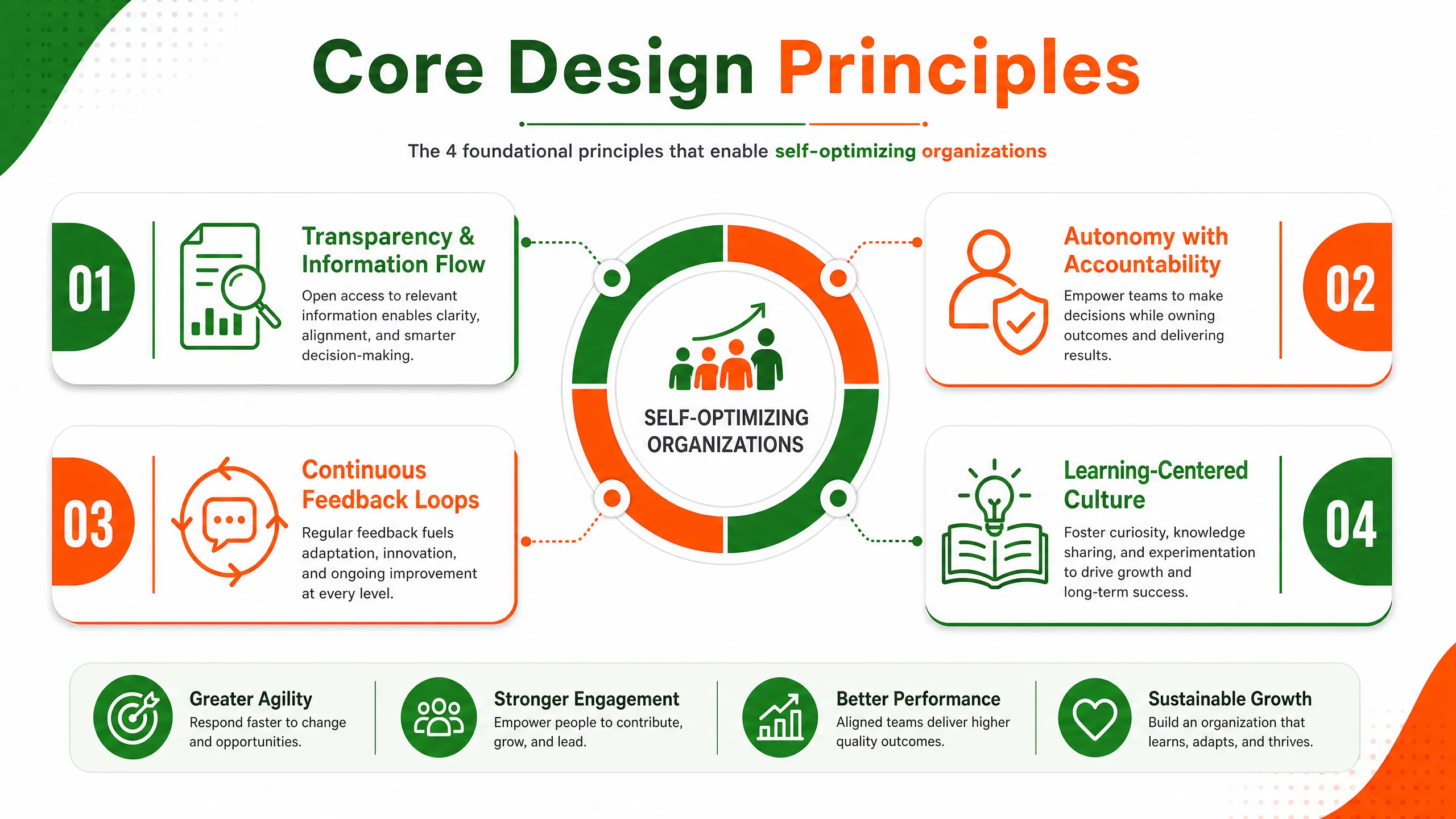
Core Design Principles of Self-Optimizing Organizations
Transparency and Information Flow
Organizations cannot self-optimize when critical information remains locked within management layers.
Transparency enables employees to understand performance metrics, customer feedback, strategic objectives, and operational challenges. Armed with this knowledge, teams can identify improvement opportunities independently.
Additionally, transparent communication builds trust and alignment. Employees make better decisions when they understand how their work contributes to broader organizational goals.
Autonomy with Accountability
Autonomy without accountability creates confusion. Accountability without autonomy creates frustration.
The most effective organizations balance both elements. Employees receive authority over decisions within clearly defined boundaries. Performance expectations remain visible, measurable, and consistent.
This balance encourages initiative while maintaining organizational discipline.
Continuous Feedback Loops
Self-optimizing organizations rely heavily on feedback. Feedback is not limited to annual performance reviews. Instead, it becomes a constant source of learning.
Customer insights, employee observations, operational data, and performance metrics continuously inform decision-making. Teams use this information to adjust strategies and improve outcomes.
Because of this, organizations become more adaptive and resilient.
Learning-Centered Cultures
Learning is the engine of self-optimization. Organizations that stop learning eventually stop improving.
Companies can strengthen organizational learning through targeted programs such as leadership development, strategic planning workshops, and professional skills training offered by Forelite Training Leadership Programs.
A learning-centered culture encourages curiosity, experimentation, reflection, and knowledge sharing across all levels of the organization.
Organizational Structures That Support Self-Optimization
Agile Teams and Cross-Functional Collaboration
Agile structures support faster adaptation because they bring together diverse expertise around shared objectives.
Cross-functional teams eliminate many of the delays associated with traditional departmental silos. Marketing, operations, technology, finance, and customer service professionals collaborate directly rather than communicating through lengthy chains of command.
Research examining large-scale agile organizations suggests that collaborative structures strengthen communication, learning, and productivity.
Decentralized Decision Frameworks
Decentralization does not mean chaos. Effective self-optimizing organizations establish clear decision-making frameworks.
Leaders define strategic priorities while empowering teams to determine how best to achieve them. This approach combines organizational alignment with operational flexibility.
Organizations pursuing transformation initiatives may benefit from strategic capability-building programs available through Forelite Training Corporate Solutions, which help teams develop modern organizational competencies.
Technology as an Optimization Enabler
Data-Driven Decision Making
Technology plays a critical role in enabling self-optimization. Data analytics platforms provide visibility into organizational performance, customer behavior, and operational trends.
Rather than relying solely on intuition, teams can use evidence-based insights to guide decisions.
Similarly, real-time dashboards allow employees to monitor progress continuously and respond quickly to emerging challenges.
AI and Predictive Analytics in Leadership
Artificial intelligence is transforming organizational decision-making. Predictive analytics can identify risks, forecast demand, and reveal patterns that might otherwise remain hidden.
Technology consulting providers such as Nexera Digital Solutions support organizations seeking to leverage digital transformation, AI integration, and data-driven innovation.
The objective is not to replace human judgment but to enhance it. Leaders who combine technological intelligence with human insight create stronger organizational capabilities.
Leadership Skills Required for the Future
Coaching Instead of Commanding
Future leaders must become exceptional coaches. Coaching focuses on developing people rather than directing them.
Employees are encouraged to think critically, solve problems independently, and take ownership of outcomes. This approach strengthens organizational capacity because expertise becomes distributed rather than concentrated.
Professional development opportunities such as those available through Forelite Training Executive Development Programs can help leaders cultivate coaching capabilities.
Systems Thinking and Adaptability
Self-optimizing organizations require leaders who understand complexity. Systems thinking involves recognizing how different organizational components interact and influence one another.
Rather than treating problems in isolation, systems thinkers examine root causes, interconnected relationships, and long-term consequences.
Accordingly, leaders become more effective at designing sustainable solutions rather than temporary fixes.
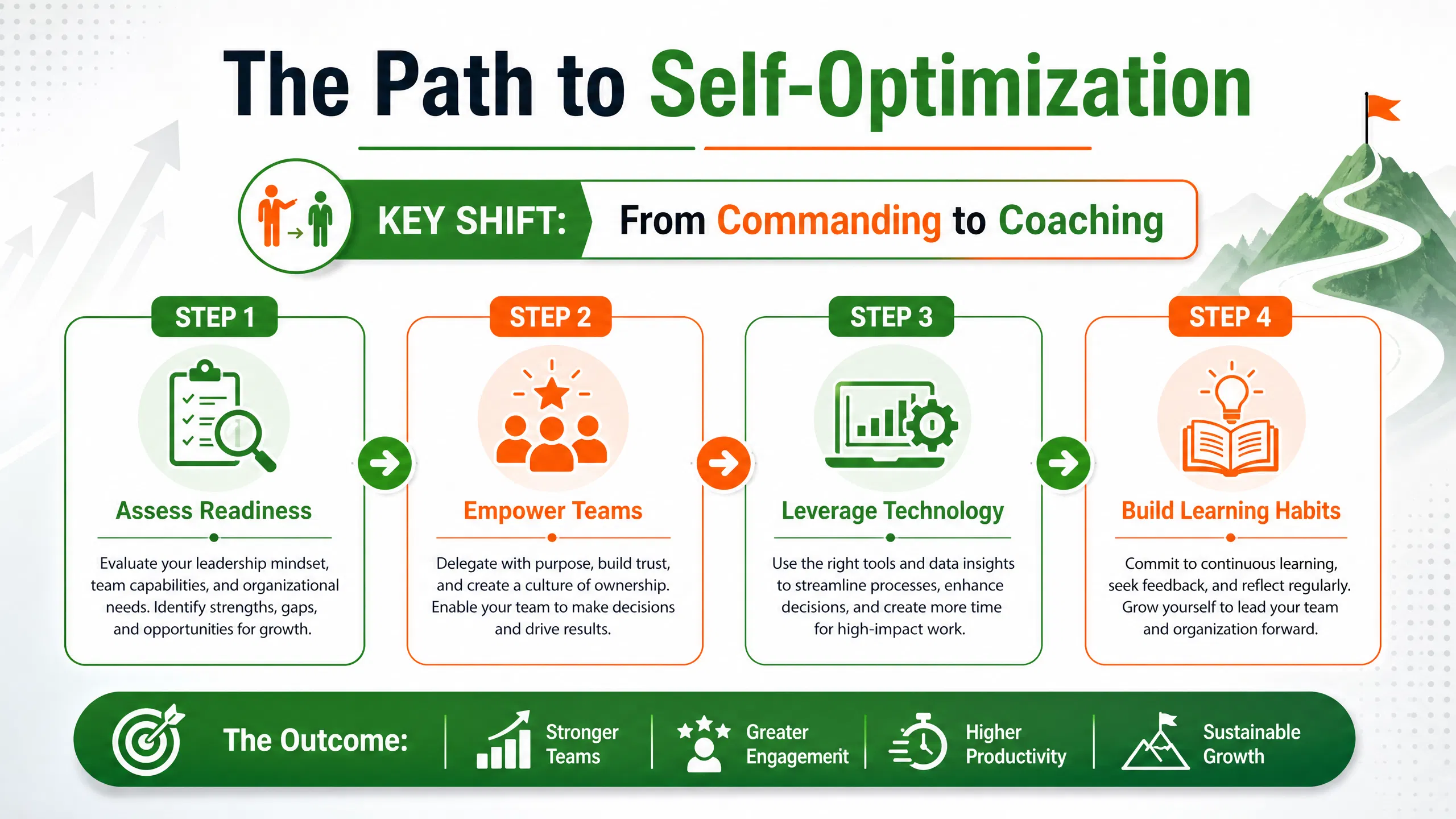
Building a Self-Optimizing Organization: Practical Steps
Assessing Organizational Readiness
The journey toward self-optimization begins with honest assessment. Leaders should evaluate organizational culture, communication patterns, decision-making processes, and learning capabilities.
Key questions include:
- Do employees have access to relevant information?
- Are teams empowered to solve problems?
- How quickly does the organization adapt to change?
- Are feedback mechanisms effective?
- Does leadership encourage experimentation?
Training initiatives from Forelite Training Professional Courses can support capability development during this assessment phase.
Creating Sustainable Change Mechanisms
Organizational transformation requires more than new structures. It requires new habits.
Leaders should introduce mechanisms that reinforce desired behaviors, including regular retrospectives, continuous learning opportunities, transparent performance metrics, and collaborative planning processes.
Over time, these mechanisms become embedded within organizational culture, creating self-reinforcing cycles of improvement.
Common Challenges and How to Overcome Them
Many organizations struggle during the transition toward self-optimization. Resistance often emerges because employees and managers are accustomed to traditional structures.
Some leaders fear losing control. Some employees fear increased responsibility. Others worry about ambiguity and uncertainty.
The solution lies in gradual implementation. Organizations should begin with pilot initiatives, establish clear expectations, provide training, and celebrate early successes.
Research consistently demonstrates that engagement, wellbeing, and performance improve when employees feel empowered and supported. Organizations that invest in leadership development, learning cultures, and distributed decision-making are better positioned to navigate future challenges.
Conclusion
Designing organizations that self-optimize represents one of the most important leadership challenges of the modern era. The traditional model of centralized authority and rigid control is increasingly unable to keep pace with the complexity and speed of today’s business environment.
Self-optimizing organizations succeed because they distribute intelligence throughout the system. They empower employees, encourage learning, leverage technology, and create feedback-rich environments where continuous improvement becomes a natural part of daily operations.
Leaders who embrace this shift move beyond managing tasks. They become architects of adaptive systems capable of evolving alongside changing markets, technologies, and customer expectations.
The future belongs to organizations that can learn faster, adapt quicker, and empower people more effectively. Building a self-optimizing organization is not simply a leadership strategy, it is a competitive advantage that can sustain success for years to come.
FAQs
1. What is a self-optimizing organization?
A self-optimizing organization continuously improves its performance through empowered teams, data-driven decision-making, feedback loops, and adaptive leadership structures.
2. Why are self-optimizing organizations important today?
Rapid technological change, shifting employee expectations, and market uncertainty require organizations to adapt quickly. Self-optimizing structures enable faster responses to these challenges.
3. How does leadership change in a self-optimizing organization?
Leaders transition from directing daily activities to designing systems, developing talent, facilitating collaboration, and enabling continuous improvement.
4. What role does technology play in self-optimization?
Technology provides real-time data, predictive insights, automation capabilities, and communication tools that help organizations identify opportunities and respond effectively.
5. How can organizations start becoming self-optimizing?
Organizations can begin by increasing transparency, empowering teams, strengthening feedback mechanisms, investing in leadership development, and building a culture focused on continuous learning.