
Financial Accounting in Oil and Gas: The Professional Framework Every Finance Leader Needs in 2026

A strategic guide to IFRS compliance, joint venture reporting, upstream cost structures, and building the accounting expertise that energy sector organisations demand today.
Financial accounting in the oil and gas sector requires specialised knowledge spanning upstream, midstream, and downstream operations, IFRS standards for extractive industries, and complex joint venture structures that differ fundamentally from general commercial accounting. Finance professionals and corporate leaders who invest in structured, industry-specific training gain the technical precision and governance confidence needed to manage regulatory scrutiny, attract institutional capital, and lead credible ESG reporting. ForElite Training Institute’s oil and gas financial accounting programmes are designed to close this expertise gap and position professionals for senior roles across Africa and global energy markets.
How does financial accounting work in oil and gas operations?
Oil and gas financial accounting is not a variation of standard commercial accounting. It is an entirely distinct discipline.
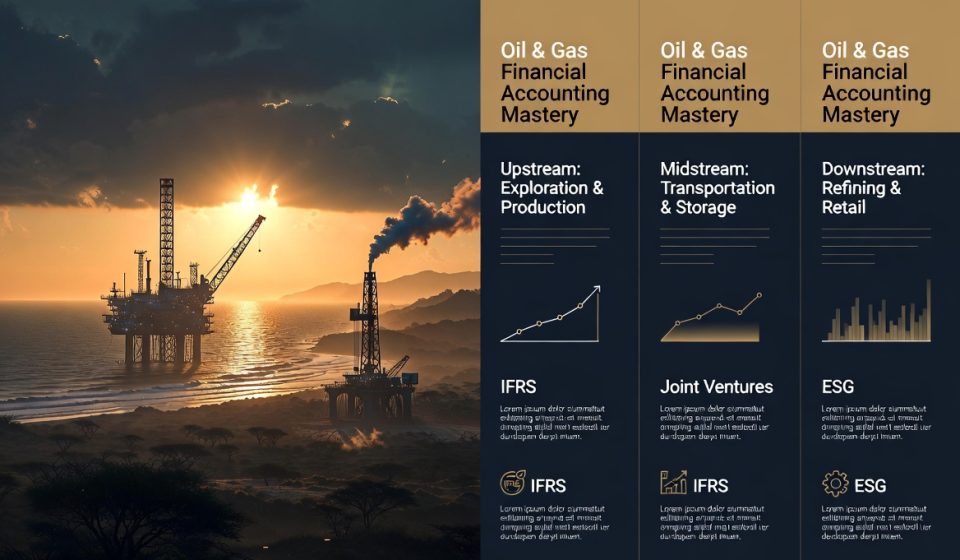
The industry operates across three interconnected segments. Upstream covers exploration, drilling, and production. Midstream covers transportation, storage, and processing. Downstream handles refining, distribution, and retail. Each segment carries its own cost structures, revenue timing challenges, and reporting obligations that demand specialised technical knowledge from every finance professional working within them.
At the upstream level, accountants must distinguish between successful efforts and full cost methods when capitalising exploration expenditure. A dry well treated incorrectly can misstate an organisation’s asset base by millions. Depletion, depreciation, and amortisation of oil and gas assets follows unit-of-production logic rather than the straight-line methods common in other industries. These are not small details. They are the foundation of accurate financial reporting.
Midstream and downstream accounting introduces transfer pricing complexity, pipeline capacity accounting, inventory valuation under volatile commodity pricing, and derivative financial instruments used to hedge oil price exposure. Finance directors who lack exposure to these structures are working with an incomplete map in one of the world’s most consequential industries.
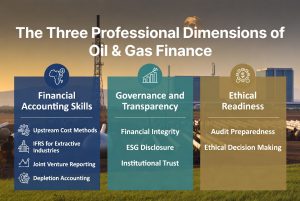
The Three Professional Dimensions
Financial Accounting Skills
Upstream cost methods, revenue recognition, depletion accounting, joint venture reporting, and IFRS for extractive industries.
Governance and Transparency
Financial integrity, energy sector accountability, institutional trust, and ESG disclosure frameworks.
Ethical Readiness
Audit preparedness, ethical decision making, and managing reporting complexity in high-pressure energy environments.
Why is IFRS important in oil and gas financial reporting?
The International Financial Reporting Standards framework is the language through which oil and gas organisations communicate their financial position to regulators, investors, and partner governments. For organisations operating in Africa, IFRS compliance is no longer optional. It is a prerequisite for attracting foreign direct investment, securing production-sharing agreements, and satisfying the transparency requirements of sovereign wealth funds and international development institutions.
IFRS 6, which governs exploration for and evaluation of mineral resources, permits a degree of flexibility in accounting policy that can create significant comparability challenges between organisations. Finance professionals must understand where that flexibility lies and how to apply it consistently. IFRS 15, the revenue recognition standard, changed how oil and gas companies recognise revenue from long-term supply contracts and take-or-pay arrangements. IFRS 16 reshaped lease accounting for drilling rigs, pipelines, and offshore platforms.
These are not abstract regulatory matters. They affect every line of the income statement, balance sheet, and cash flow report that a finance director presents to a board or a government ministry.
Key Regulatory Frameworks: IFRS 6 — Mineral Resources | IFRS 15 — Revenue Recognition | IFRS 16 — Lease Accounting | IFRS 9 — Financial Instruments | AU Agenda 2063 | ESG Disclosure Standards
Africa Union Agenda 2063 frames natural resource governance as a pillar of continental economic transformation. For finance professionals working in African energy markets, aligning financial reporting standards with this institutional framework is both a compliance requirement and a strategic advantage. Governments and multilateral institutions are actively seeking finance leaders who can speak the language of international standards while operating within regional governance realities.
“Financial transparency in extractive industries is not a compliance checkbox. It is the foundation upon which resource-rich nations build long-term institutional credibility and attract the capital that transforms reserves into sustained national prosperity.” — ForElite Training Institute
What makes joint venture accounting in oil and gas uniquely complex?
Joint ventures are the structural backbone of the oil and gas industry. Production sharing contracts, farm-in and farm-out arrangements, unitisations, and incorporated joint ventures each require a precise understanding of how costs, revenues, and liabilities are allocated, reported, and audited between multiple parties.
An oil block may be operated by one company but owned by four. The operator bears the costs and recovers them from the joint venture partners through a process called cash calling. The accounting for these cash calls, non-operated interest statements, joint interest billings, and operator audits represents a specialised body of knowledge that relatively few accountants outside the energy sector possess.
Finance professionals who understand joint venture accounting can move into roles as JV controllers, petroleum accountants, and joint venture audit managers. These are among the most sought-after and well-compensated positions in the sector. ForElite’s structured oil and gas finance courses build this competency systematically, from foundational concepts through to operational complexity.
Joint Venture Structure Overview
| JV Structure | Key Accounting Challenge | Reporting Standard |
|---|---|---|
| Production Sharing Contract | Cost oil vs profit oil allocation, cost recovery limits | IFRS 11, IFRS 6 |
| Farm-in / Farm-out | Gain recognition, carried interest accounting | IFRS 6, IAS 16 |
| Unincorporated JV | Proportionate consolidation vs equity method | IFRS 11 |
| Unitisation Agreement | Redetermination accounting, asset reallocation | IAS 8, IFRS 3 |
Why does financial governance matter for energy sector organisations and governments?
The stakes in oil and gas financial reporting are not measured in thousands. They are measured in billions. A single misstated reserve estimation, an incorrectly capitalised exploration cost, or a flawed decommissioning liability calculation can trigger regulatory investigations, restate years of published accounts, and destroy investor confidence overnight.
For governments, particularly across sub-Saharan Africa where oil and gas revenues fund public infrastructure, healthcare, and education, the quality of financial governance in extractive industries is a matter of national interest. Finance directors and public sector decision makers who understand how oil and gas accounts are constructed are better equipped to negotiate with international operators, protect national interest clauses in production agreements, and ensure that resource revenues flow transparently to public budgets.
This is why organisations such as the Extractive Industries Transparency Initiative set global norms for revenue disclosure. It is why the IFRS Foundation is developing sustainability disclosure standards that intersect directly with oil and gas operations. And it is why professionals with verifiable expertise in this area carry significant institutional weight.
ForElite Training Institute builds these capabilities within a framework that understands both the technical rigour required and the organisational context in which African finance leaders operate.
How can professionals build genuine expertise in energy sector accounting?
Building credible expertise in oil and gas financial accounting requires more than reading a textbook. It requires exposure to the operational logic of the industry, the commercial structures that drive financial decisions, and the regulatory environment that governs disclosure.
The most effective learning pathway combines three elements: structured technical training in oil and gas accounting principles, applied case study work using real-world industry scenarios, and a learning community that includes professionals already working within the sector.
For finance directors and HR leaders evaluating training investments, the question is not simply whether a course covers IFRS. The question is whether it builds the kind of applied judgment that enables a professional to walk into a joint venture audit, a board finance committee, or a government ministry meeting and contribute with confidence and precision.
Core Competency Areas
- Upstream, midstream and downstream cost structures
- IFRS for extractive industries (IFRS 6, 15, 16)
- Joint venture and production sharing accounting
- Oil and gas revenue recognition
- Depletion, depreciation and amortisation
- Decommissioning and abandonment provisions
- Commodity hedging and financial instruments
- ESG and sustainability reporting integration
- Cost control in capital-intensive projects
- Petroleum fiscal regime analysis
What skills are required for modern oil and gas financial analysts?
The profile of a high-performing oil and gas financial analyst has shifted considerably in recent years. Technical accounting proficiency remains non-negotiable. But organisations now equally value professionals who can integrate financial data with operational metrics, communicate complex positions to non-finance stakeholders, and navigate the evolving landscape of ESG reporting requirements.
Advanced cost accounting in energy sectors is particularly in demand. Understanding how lifting costs, finding costs, and development costs flow through a production company’s accounts gives analysts the ability to benchmark performance, identify inefficiency, and support strategic capital allocation decisions.
Data literacy is now part of this professional profile as well. Financial analysts who can interrogate production accounting systems, validate petroleum allocation data, and stress-test reserve-based lending models are operating at the frontier of the profession. This is the direction that training and professional development in oil and gas finance must address.
The ForElite oil and gas accounting programme is structured to develop precisely these layered competencies, moving professionals from technical foundation through to strategic financial analysis within the energy sector context.
How does ethical decision making shape financial reporting in extractive industries?
The complexity of oil and gas accounting creates conditions where errors of judgment can masquerade as errors of interpretation. A finance professional under pressure may encounter situations where the technically permissible choice and the ethically correct choice are not the same.
Reserve estimation involves significant management judgment. Decommissioning liabilities require assumptions about future costs and discount rates that can be constructed conservatively or aggressively. Related party transactions between joint venture partners and affiliated service companies can obscure the true economic substance of arrangements.
Professionals who are grounded in both the technical standards and the ethical principles of their profession are better equipped to handle these situations with integrity. Audit readiness, in this context, is not simply about having the correct documents in order. It is about having built a culture of financial transparency from the ground up.
Reducing financial reporting stress in complex extractive environments begins with competence. When a finance team fully understands the standards they are applying and the judgments they are making, the audit process shifts from a source of anxiety to a demonstration of professional confidence. This is the human dimension of technical training that is too rarely discussed and too important to ignore.
Frequently Asked Questions
Do I need prior oil and gas experience to enrol in a financial accounting programme for the energy sector?
No prior industry experience is required for most structured programmes, including those offered by ForElite Training Institute. A foundational understanding of financial accounting or a relevant professional qualification provides sufficient preparation. The programme builds sector-specific knowledge from first principles, making it accessible to qualified accountants, finance managers, and analysts from adjacent industries such as banking, infrastructure, and public sector finance who are transitioning into or supporting energy sector roles.
What certifications or qualifications are most valued in oil and gas financial accounting?
Professional qualifications such as ACCA, CPA, CIMA, and CFA provide important foundational credibility. However, sector-specific training certificates in oil and gas accounting, IFRS for extractive industries, and petroleum economics carry distinct value with hiring managers in energy companies, government ministries, and development finance institutions. Many senior professionals hold a combination of general professional qualifications and specialised industry certifications to signal both depth and focus.
How is IFRS applied differently in oil and gas compared to other sectors?
Oil and gas sits within a unique carve-out under IFRS 6, which permits significant flexibility in accounting for exploration and evaluation assets not available to other industries. Additionally, the application of IFRS 15 to long-term supply contracts, take-or-pay clauses, and variable pricing mechanisms in oil and gas differs substantially from its application in retail or manufacturing. IFRS 16 impacts the sector through the accounting treatment of rigs, vessels, and long-term equipment leases. These distinctions require focused study rather than general IFRS knowledge alone.
What career roles does specialised oil and gas accounting training open up?
Professionals with this specialisation are well positioned for roles including petroleum accountant, joint venture controller, finance manager in exploration and production companies, fiscal analyst in government petroleum ministries, and financial advisory roles within oil-sector focused banking and consulting. Across East Africa and in global energy hubs, these roles command premium compensation and offer strong career progression into CFO and director-level positions within energy organisations.
How long does it take to develop competency in oil and gas financial accounting?
A structured training programme covering the core technical domains typically runs between five and fifteen days of intensive instruction, depending on the depth of content and whether upstream, midstream, and downstream are all addressed. Participants with strong general accounting backgrounds often find that focused sector-specific training produces meaningful competency gains within a short period, particularly when the programme uses applied case studies drawn from real industry scenarios. ForElite’s programme is designed to deliver this depth within a practical, executive-friendly format.
Is oil and gas financial accounting training relevant for public sector and government professionals?
It is particularly relevant. Government officials in petroleum ministries, national oil companies, revenue authorities, and public accounts committees are increasingly required to scrutinise oil company accounts, negotiate production agreements, and evaluate fiscal regime proposals. A working knowledge of oil and gas accounting gives public sector professionals the technical foundation to engage with industry counterparts on equal terms and to protect national interests in complex commercial arrangements.
The energy sector rewards technical precision and punishes ambiguity. In a landscape shaped by IFRS evolution, ESG accountability, and Africa’s growing role in global energy markets, the finance professionals who invest in deep sector-specific knowledge are the ones who lead with authority, advise with confidence, and build the institutions that turn natural resources into shared national prosperity.
Explore ForElite Training Institute’s specialist programmes for finance professionals, corporate leaders, and public sector decision makers in the energy sector: https://forelitetraining.com/