

The Agility Mandate: How Anticipatory Leadership Drives Business Success in a Changing World

Understanding the New Leadership Reality
The business landscape has changed dramatically over the last decade. Organizations no longer operate in environments where long-term plans remain relevant for years. Instead, leaders are navigating economic uncertainty, rapid technological disruption, evolving customer expectations, and global competition. As a result, leadership today requires more than operational excellence. It demands foresight, adaptability, and the ability to anticipate change before it becomes unavoidable.
Recent research highlights how quickly leadership expectations are evolving. An IBM CEO study reported that 76% of organizations now have a Chief AI Officer, compared to only 26% a year earlier. The same study found that organizations with AI-focused leadership structures are implementing significantly more AI initiatives than their peers. This shift demonstrates that proactive leadership is becoming a competitive advantage rather than an optional capability.
Therefore, the modern leader must move beyond simply managing current operations. Instead, they must identify emerging opportunities, recognize risks before they materialize, and prepare their organizations for multiple possible futures. This shift represents what many experts call the agility mandate, the expectation that organizations and their leaders continuously adapt to changing conditions.
Why Traditional Leadership Models Are Losing Effectiveness
Traditional leadership approaches were built around stability and predictability. Leaders analyzed historical data, developed detailed plans, and executed them over extended periods. While this model worked effectively in slower-moving markets, it struggles in today’s environment where disruption can emerge overnight.
For example, artificial intelligence, automation, and digital transformation are reshaping entire industries at unprecedented speeds. Organizations that rely solely on historical performance metrics may find themselves reacting too late. Consequently, leaders must adopt a forward-looking mindset that emphasizes scenario planning, experimentation, and rapid adaptation.
The challenge is not simply responding faster. It is developing the capability to recognize patterns before competitors do. Organizations that master this capability gain a significant advantage because they can shape market outcomes rather than merely react to them.
What Is Anticipatory Leadership?
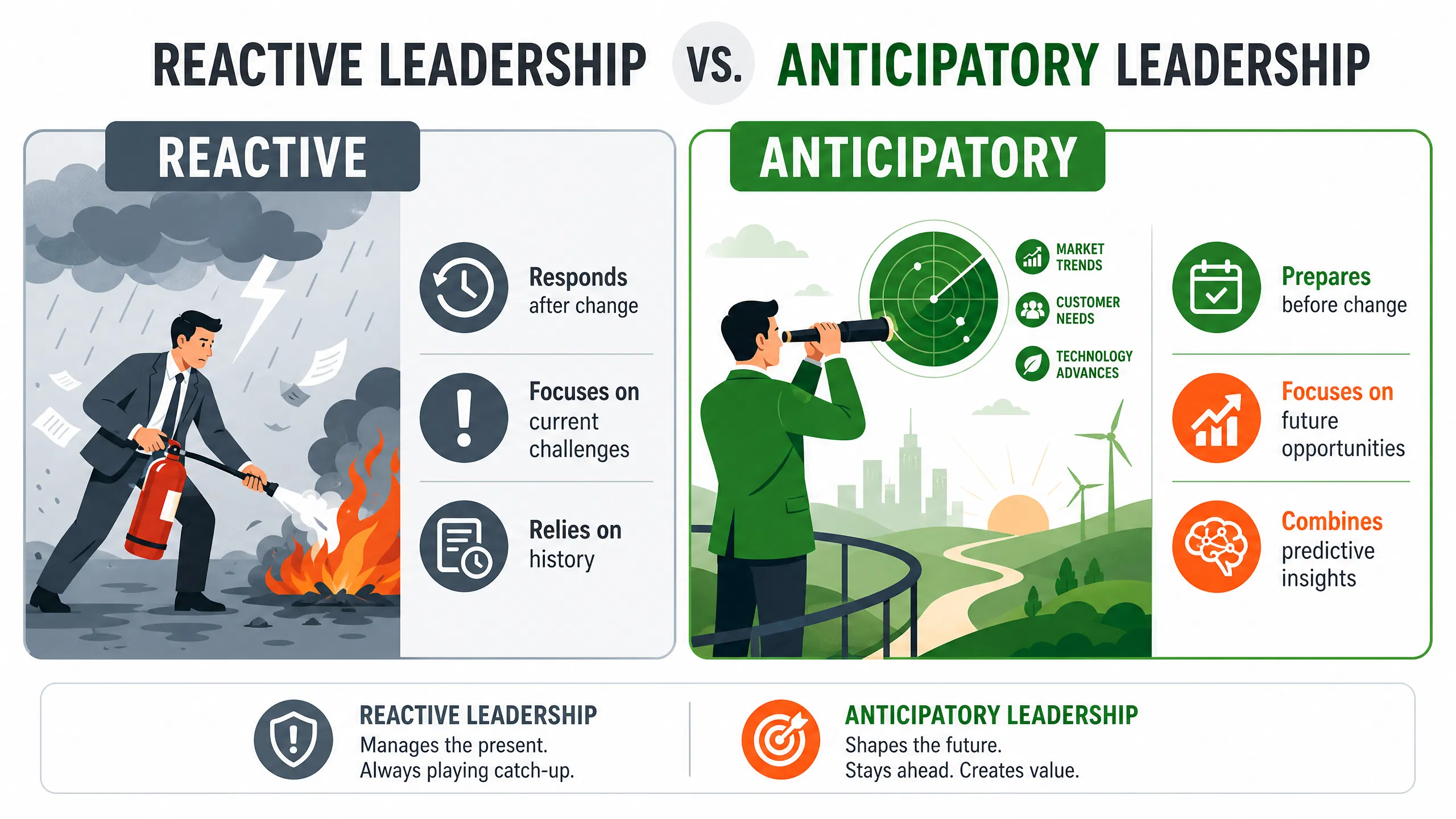
Anticipatory leadership is a proactive approach that focuses on identifying future trends, opportunities, and challenges before they become immediate concerns. Unlike reactive leadership, which addresses problems after they emerge, anticipatory leadership seeks to prepare organizations in advance.
Think of anticipatory leadership as navigating a ship through changing weather conditions. A reactive captain waits for the storm to arrive before adjusting course. An anticipatory captain studies weather patterns, predicts potential challenges, and changes direction early enough to avoid danger altogether.
Similarly, anticipatory leaders constantly scan their environments for signals of change. They analyze industry developments, technological advancements, workforce trends, customer behaviors, and economic indicators. As a result, they can make informed decisions that position their organizations for long-term success.
The Difference Between Reactive and Anticipatory Leaders
| Reactive Leadership | Anticipatory Leadership |
|---|---|
| Responds after change occurs | Prepares before change occurs |
| Focuses on current challenges | Focuses on future opportunities |
| Relies heavily on historical data | Combines historical and predictive insights |
| Prioritizes stability | Balances stability with adaptability |
| Seeks certainty | Embraces uncertainty as a strategic reality |
Organizations increasingly recognize the value of anticipatory leadership because uncertainty has become a permanent feature of modern business rather than an occasional disruption.
The Business Case for Agility
Enterprise agility has emerged as a critical factor in workforce transformation and organizational success. Industry analysis indicates that businesses are shifting away from rigid hierarchies and toward more adaptable structures that emphasize collaboration, responsiveness, and innovation.
Meanwhile, customer expectations continue to evolve rapidly. Consumers demand personalized experiences, faster service delivery, and continuous innovation. Organizations that cannot adapt quickly risk losing market share to more agile competitors.
Technology Disruption and AI Adoption
Artificial intelligence represents one of the most significant drivers of organizational change. Recent studies suggest that AI will influence nearly every aspect of business operations, from decision-making and customer service to workforce management and strategic planning.
However, technology alone does not create competitive advantage. Leadership determines whether technological investments generate meaningful outcomes. Organizations need leaders who can understand emerging technologies, evaluate their potential impact, and guide successful implementation.
Interestingly, surveys indicate that 67% of CEOs expect AI to increase entry-level hiring opportunities while simultaneously creating new leadership and specialist roles. This finding challenges the assumption that automation simply replaces workers. Instead, it highlights the importance of leadership in managing workforce transformation effectively.
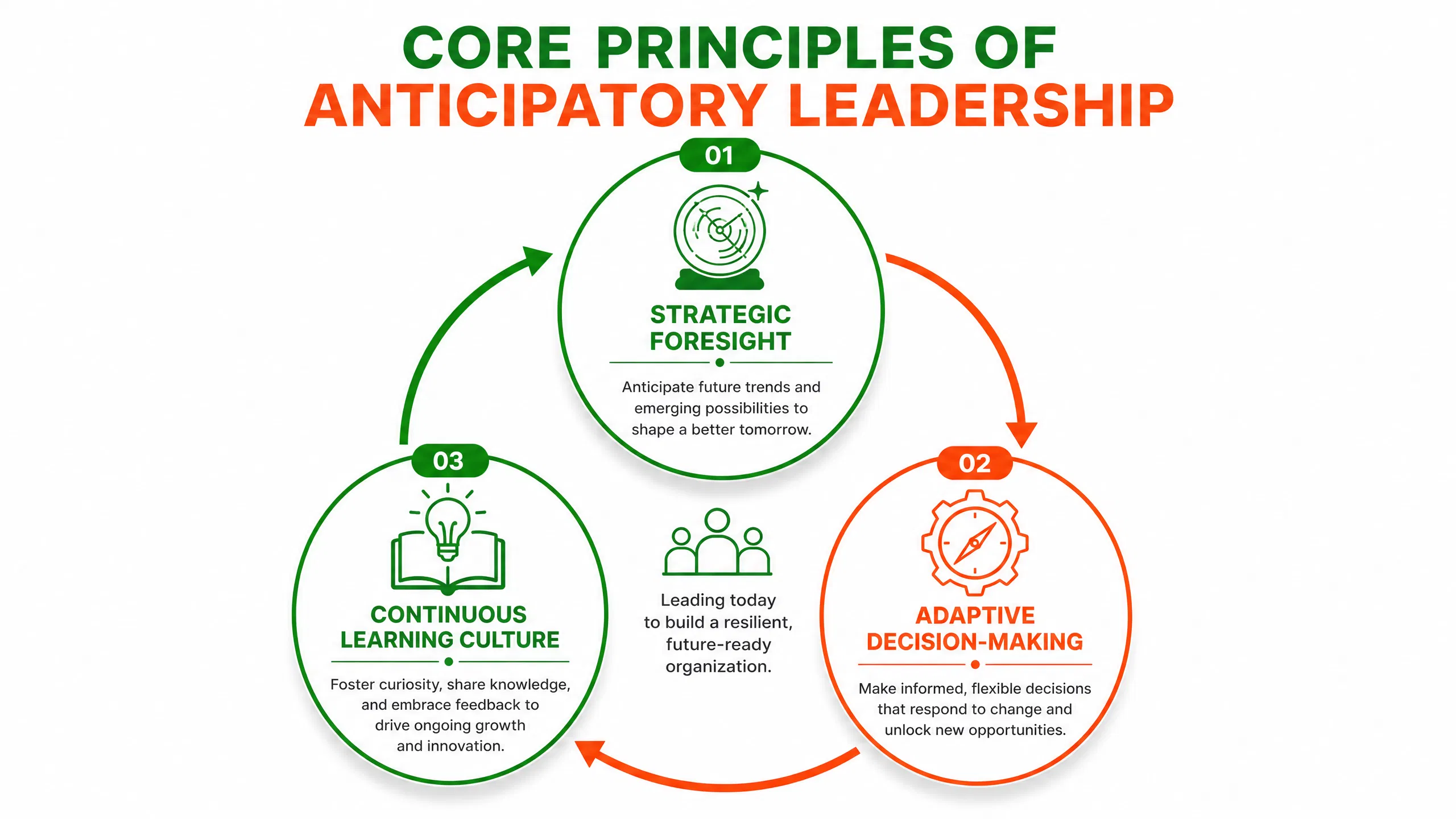
Core Principles of Anticipatory Leadership
Strategic Foresight
Strategic foresight involves systematically exploring possible futures and preparing for multiple scenarios. Rather than attempting to predict a single outcome, leaders develop flexibility by considering various possibilities.
Organizations practicing strategic foresight regularly examine emerging trends, conduct scenario planning exercises, and identify potential disruptions. Consequently, they are better equipped to respond when unexpected changes occur.
Adaptive Decision-Making
Adaptive decision-making recognizes that perfect information rarely exists. Effective leaders make informed decisions based on available evidence while remaining prepared to adjust course when circumstances change.
This approach requires balancing confidence with humility. Leaders must trust their judgment while acknowledging that new information may require different actions. As a result, adaptive organizations remain resilient even during periods of uncertainty.
Continuous Learning Culture
A culture of continuous learning enables organizations to evolve alongside changing environments. Employees are encouraged to develop new skills, experiment with innovative approaches, and share knowledge across teams.
Research increasingly suggests that leadership effectiveness depends heavily on learning agility. Organizations that prioritize learning can adapt more quickly because employees possess the capabilities needed to navigate change successfully.
Building Agile Organizations
Agility extends beyond leadership behavior. It requires organizational structures, processes, and cultures that support rapid adaptation.
Empowering Teams for Faster Responses
Traditional organizations often rely on centralized decision-making. While this approach can ensure consistency, it may also slow responses to emerging opportunities and challenges.
Agile organizations empower teams to make decisions closer to the point of action. Employees receive the authority, information, and resources needed to respond quickly to changing conditions.
Consequently, organizations become more responsive because decisions do not require multiple layers of approval. Teams can identify issues, test solutions, and implement improvements without unnecessary delays.
Cross-Functional Collaboration
Complex challenges rarely fit neatly within departmental boundaries. Anticipatory leadership encourages collaboration across functions, enabling organizations to combine diverse perspectives and expertise.
Cross-functional teams often identify opportunities and risks more effectively because they view problems from multiple angles. Therefore, collaboration becomes a critical component of organizational agility.
The Role of Digital Transformation
Digital transformation serves as a powerful enabler of anticipatory leadership. Modern technologies provide access to real-time data, predictive analytics, and automation capabilities that support informed decision-making.
Organizations seeking to strengthen their leadership capabilities can benefit from professional development programs such as the training opportunities available through ForEliTe Training Institute, which focuses on building practical leadership, management, and organizational effectiveness skills.
Data-Driven Decision Making
Data has become one of the most valuable organizational assets. Leaders who effectively leverage data can identify trends, measure performance, and evaluate strategic options with greater confidence.
At the same time, data alone is insufficient. Anticipatory leaders combine analytical insights with human judgment, experience, and contextual understanding.
Leveraging AI and Automation
Digital transformation specialists such as Nexera Digital Solutions emphasize the importance of integrating technology, analytics, and automation to drive sustainable business growth. Organizations that successfully combine technological innovation with agile leadership often achieve stronger competitive positioning.
AI-powered tools can enhance forecasting, automate routine tasks, and support strategic planning. However, leadership remains essential because technology cannot replace vision, empathy, ethical judgment, and organizational culture.
Developing Future-Ready Leaders
Leadership development is no longer a one-time event. It has become a continuous process that prepares individuals for evolving challenges and opportunities.
Organizations can strengthen leadership capabilities through specialized programs such as:
- Leadership and Management Skills for New Managers and Supervisors Training
- Human Capital and Institutional Development Programs
- Project Management and Organizational Effectiveness Courses
- Performance Management and Talent Development Training
- Corporate Leadership Development Solutions
These programs help leaders build competencies related to communication, strategic thinking, team management, and change leadership.
Essential Skills for the Next Decade
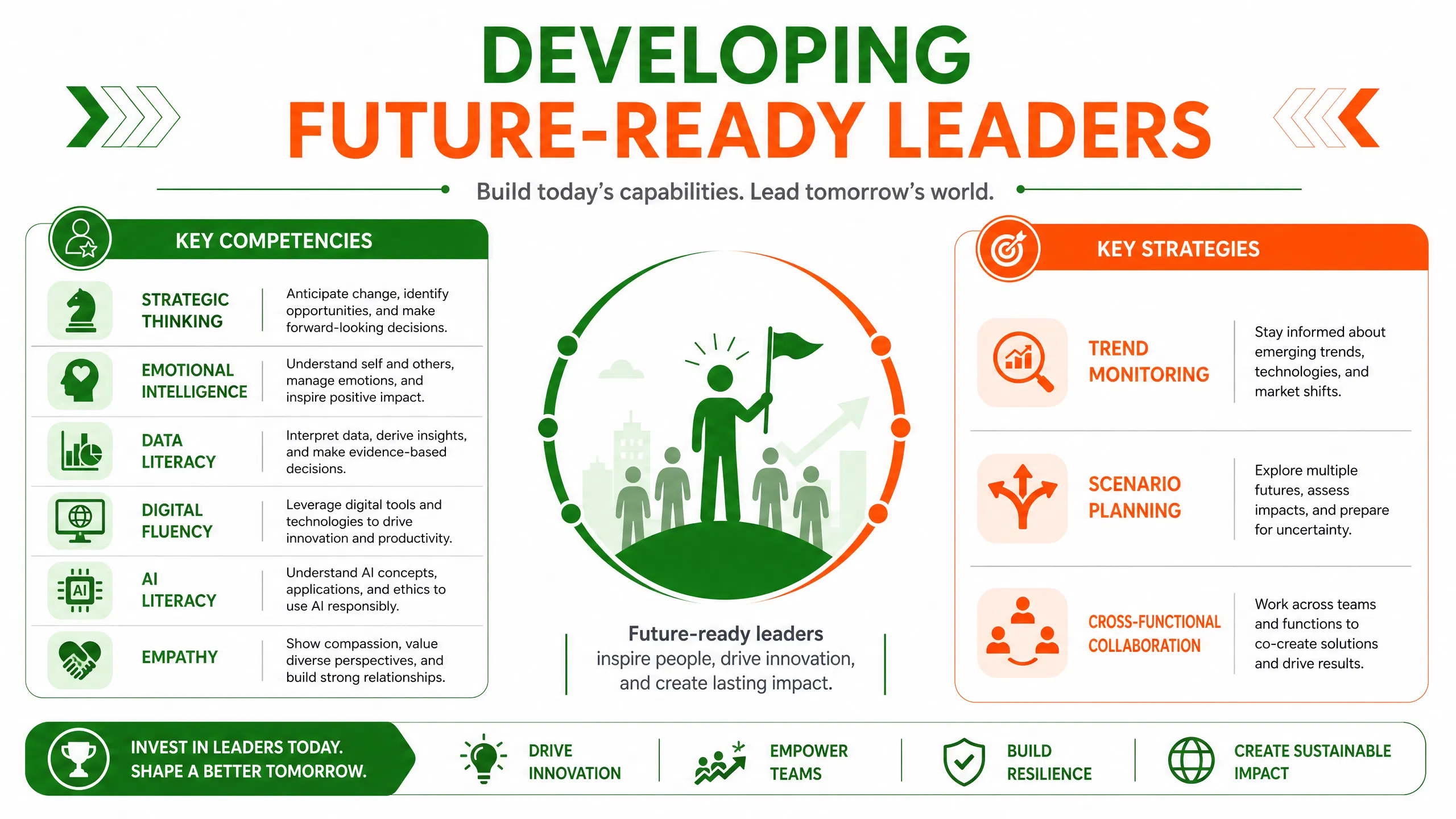
Future-ready leaders require a diverse combination of technical and human-centered capabilities. Key competencies include:
- Strategic thinking
- Emotional intelligence
- Data literacy
- Digital fluency
- Change management
- Collaborative leadership
- Innovation management
- Ethical decision-making
Notably, experts increasingly emphasize agility, empathy, and AI literacy as defining characteristics of successful leadership in the modern era.
Challenges to Implementing Anticipatory Leadership
Despite its benefits, anticipatory leadership presents several challenges.
Resistance to Change
Employees and leaders may resist new approaches because change introduces uncertainty. Established processes often feel safer than unfamiliar alternatives.
Successful organizations address resistance through communication, education, and involvement. People are more likely to support change when they understand its purpose and participate in shaping outcomes.
Balancing Stability and Innovation
Organizations cannot pursue innovation at the expense of operational excellence. Effective leaders balance experimentation with disciplined execution.
This balance requires clear priorities, strong governance, and ongoing evaluation. Therefore, anticipatory leadership is not about constant disruption. It is about making intentional adjustments that improve long-term performance.
Real-World Strategies for Success
Organizations seeking to strengthen anticipatory leadership capabilities should consider several practical actions:
- Establish formal trend-monitoring processes.
- Conduct regular scenario-planning exercises.
- Invest in leadership development programs.
- Encourage experimentation and learning.
- Build cross-functional collaboration networks.
- Leverage digital technologies for predictive insights.
- Develop workforce adaptability through continuous training.
Research on human-AI collaboration also suggests that effective leaders excel at asking questions, encouraging dialogue, and facilitating collaborative problem-solving. These skills remain valuable regardless of technological advancements.
Conclusion
The agility mandate is reshaping leadership expectations across every industry. Organizations can no longer rely solely on traditional management practices designed for stable and predictable environments. Instead, they must embrace anticipatory leadership that combines strategic foresight, adaptability, continuous learning, and technological awareness.
Leaders who anticipate change rather than react to it position their organizations for sustained success. They create cultures that embrace innovation, empower employees, and leverage emerging technologies responsibly. As digital transformation accelerates and uncertainty becomes a defining feature of business, anticipatory leadership will increasingly separate thriving organizations from those struggling to keep pace.
The future belongs to leaders who can see beyond today’s challenges, prepare for tomorrow’s opportunities, and guide their organizations confidently through an ever-changing landscape.
FAQs
1. What is anticipatory leadership?
Anticipatory leadership is a proactive leadership approach focused on identifying future trends, opportunities, and risks before they become immediate challenges.
2. Why is organizational agility important?
Organizational agility enables businesses to adapt quickly to market changes, technological disruptions, and evolving customer expectations while maintaining competitiveness.
3. How does AI influence anticipatory leadership?
AI provides predictive insights, automation capabilities, and data-driven intelligence that help leaders make more informed strategic decisions.
4. What skills are essential for future leaders?
Strategic thinking, emotional intelligence, adaptability, digital literacy, change management, collaboration, and innovation are among the most important leadership skills.
5. How can organizations develop anticipatory leaders?
Organizations can invest in leadership training, scenario planning, continuous learning programs, digital transformation initiatives, and cross-functional collaboration opportunities.