

The Real Benefits of Corporate Training for Organisations in Kenya and Africa

Corporate training delivers measurable business results: it raises employee productivity, reduces staff turnover, and gives organisations in Kenya and across Africa a sustainable competitive edge. Whether you are an HR manager designing a development programme or a CEO deciding where to invest your people budget, understanding the full benefits of corporate training will help you make a smarter, evidence-based decision.
At ForElite Training Institute, we have worked with hundreds of organisations across Nairobi and East Africa to design and deliver training that produces real, trackable outcomes. This guide draws on that experience, current research, and data specific to the Kenyan and African market.
What Is Corporate Training?
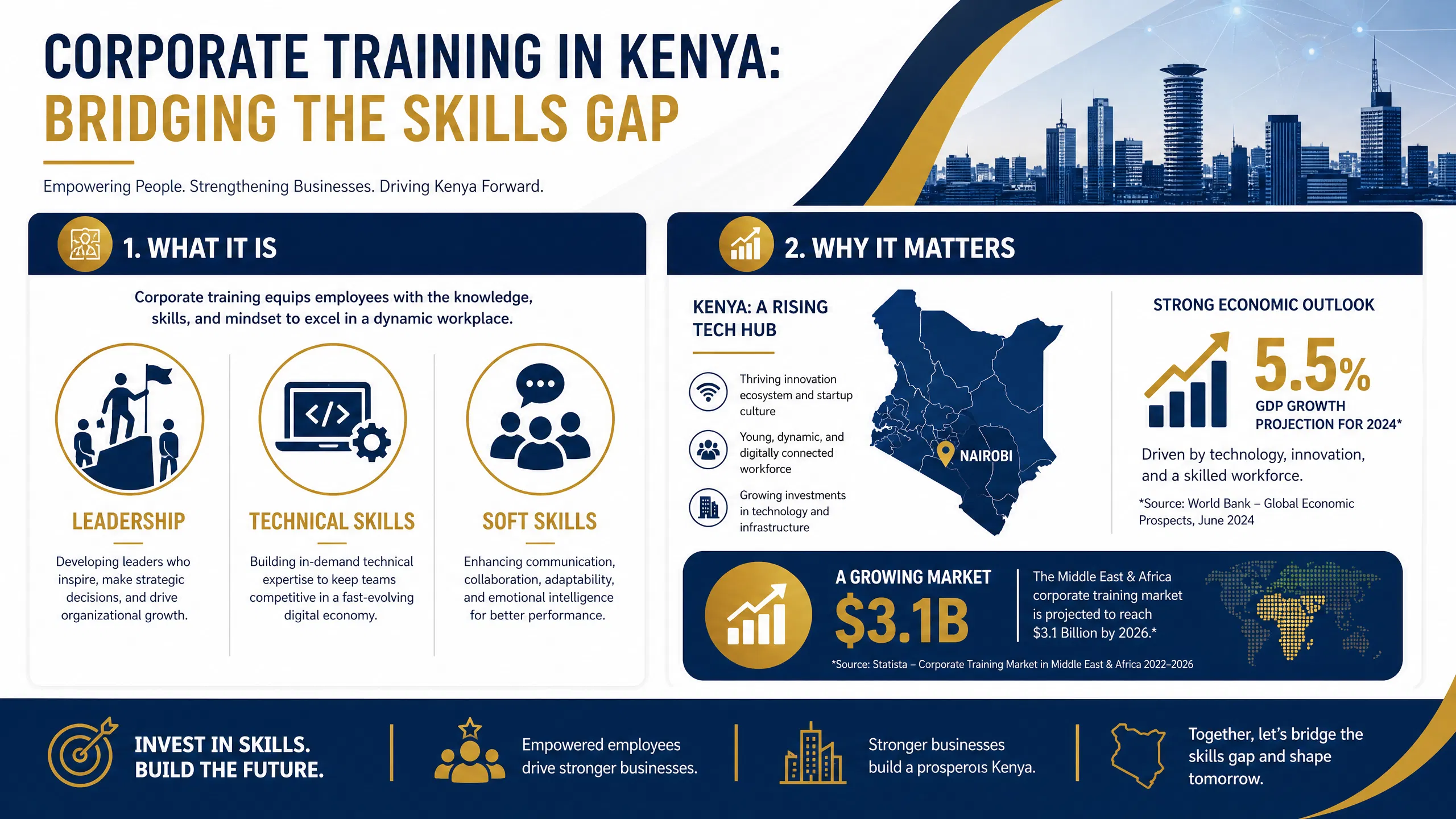
Corporate training is a structured set of learning activities that an organisation provides to its employees to improve skills, knowledge, behaviours, and performance aligned with business goals. It covers a wide range of programmes, including:
- Leadership and management development
- Technical and digital skills training
- Soft skills and communication
- Compliance and regulatory training
- Customer service excellence
- Strategic planning and capacity building
Corporate training is distinct from academic education. It is practical, targeted, and designed to produce results in the workplace quickly. In Kenya, the National Industrial Training Authority (NITA) plays a key regulatory role, accrediting training providers and ensuring that workplace learning meets nationally recognised standards.
Why Does Corporate Training Matter in Kenya and Africa Right Now?
Kenya is East Africa’s largest economy and one of the continent’s leading technology hubs. With a GDP projected to grow at 5.5% in 2024 and a tech sector that employs over one million Kenyans directly and indirectly, the demand for a skilled, adaptable workforce has never been greater.
Yet organisations across Nairobi and beyond consistently face a skills gap. Business leaders cannot find enough managers with decision-making ability, teams struggle with digital tools, and many organisations grow their headcount without growing their capability. Corporate training is the most direct solution to this problem.
The Middle East and Africa corporate training market was valued at over USD 3.1 billion in 2024 and is projected to grow at a compound annual growth rate of 7.9% through to 2031. This growth reflects a regional recognition that human capital is the most important asset an organisation can develop.
7 Proven Benefits of Corporate Training
1. Higher Employee Productivity and Performance
The most immediate benefit of well-designed corporate training is that employees do their jobs better. When people are equipped with the right skills and knowledge, they work faster, make fewer errors, and solve problems more independently.
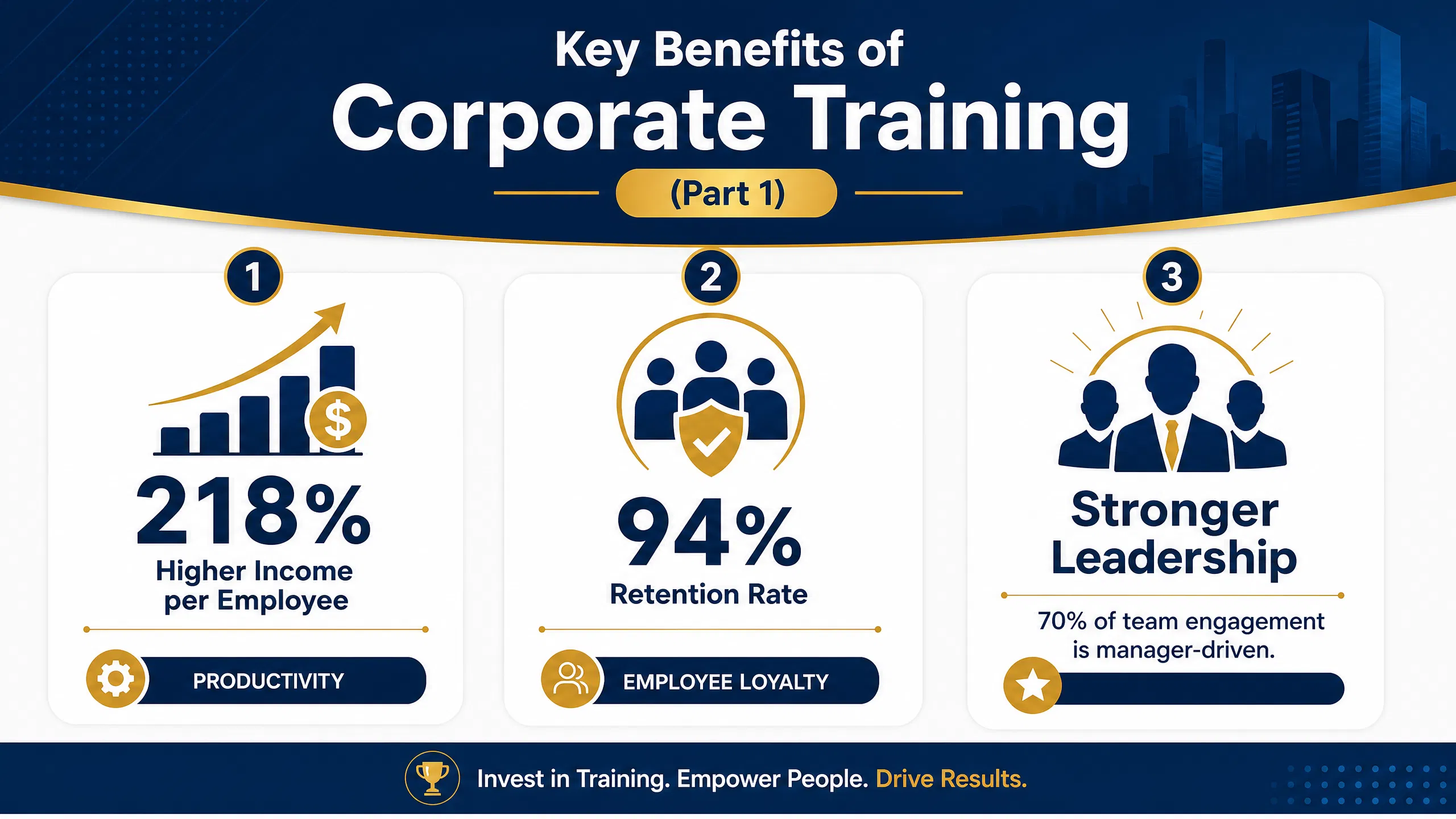
Research shows that companies investing in comprehensive training programmes generate 218% higher income per employee compared to those without formalised development initiatives. That is not a marginal improvement — it is a transformational one.
At ForElite Training Institute, our programmes are designed around practical, applicable skills. Participants leave training rooms ready to apply new methods on the same day.
2. Improved Employee Retention and Lower Turnover Costs
Replacing an employee is expensive. The cost of staff turnover for employers averages approximately 33.3% of an employee’s base salary, a figure that applies just as sharply in Kenya’s competitive talent market as it does globally.
Corporate training directly addresses this. Studies consistently show that 94% of employees would stay longer at a company that invests in their career growth. When an organisation invests in its people, those people feel valued and are far less likely to look elsewhere.
Training, in this sense, is not just a skills intervention — it is a retention strategy. Organisations that offer structured development pathways signal clearly to their teams: we believe in your future here.
3. Stronger Leadership at Every Level
Leadership development is one of the most critical and most neglected areas of workforce investment. Almost 60% of first-time managers never received training when transitioning into leadership, and research shows that 70% of the variance in team engagement is attributable to the manager.
Put simply: your leaders determine how your teams perform. Untrained managers create disengaged teams, high turnover, and poor decision-making. Trained leaders build cohesive, motivated, high-performing units.
ForElite’s leadership and management programmes are built specifically for the African business context. We do not use generic templates imported from elsewhere. Our facilitators understand the organisational realities of operating in Nairobi, East Africa, and the broader continent.
4. A More Competitive and Adaptable Organisation
Industries across Kenya are changing fast. Financial services are being disrupted by fintech. Agriculture is integrating digital tools. Manufacturing is adopting automation. Retail is shifting online. Organisations that fail to upskill their teams quickly become obsolete.
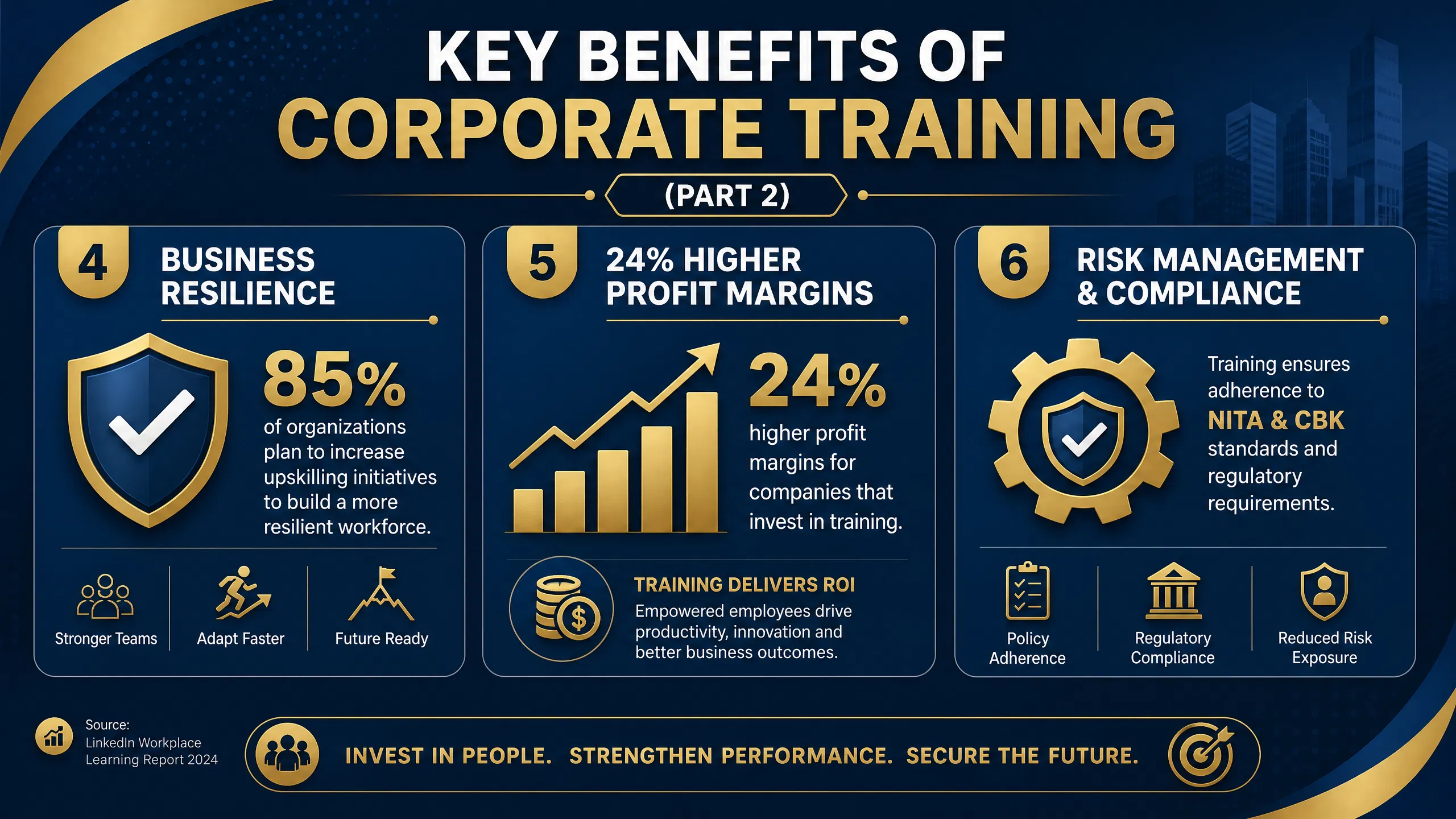
85% of organisations globally plan to increase their investment in upskilling employees through 2025–2030, and 76% of learning and development leaders now view continuous skills training as a cornerstone of business resilience.
Corporate training keeps your organisation at the front of this curve rather than behind it. Teams that learn continuously are far better positioned to adapt when markets shift, technology changes, or new competitors emerge.
5. Higher Profit Margins
Training is not a cost, it is an investment with a measurable return. Companies that invest more in quality training experiences report 24% higher profit margins compared to those that spend less.
The logic is straightforward. Better-trained employees work more efficiently, make better decisions, sell more effectively, and serve customers more professionally. All of these outcomes feed directly into bottom-line performance.
When Kenyan organisations calculate the cost of a training programme against the value of even a modest improvement in team performance, the return on investment is almost always favourable.
6. Better Compliance and Risk Management
In Kenya’s regulated sectors banking, healthcare, insurance, manufacturing, and the public sector compliance training is not optional. Regulatory bodies including NITA, the Central Bank of Kenya, and sector-specific authorities require demonstrable training standards.
Beyond legal compliance, well-trained teams understand processes, follow protocols, and make fewer costly mistakes. This reduces organisational risk, protects clients and customers, and builds the institutional reputation that larger contracts and partnerships require.
ForElite Training Institute’s compliance and professional development courses are designed to meet the requirements of Kenyan regulatory frameworks while being practical and engaging for participants.
7. Stronger Organisational Culture and Talent Attraction
Top talent in Kenya today has choices. Ambitious professionals, especially younger employees, actively seek employers who will invest in their growth. LinkedIn’s 2024 data confirmed that providing learning opportunities was the top strategy for retaining employees.
Organisations with a visible commitment to learning attract better candidates, experience higher engagement scores, and build a reputation as employers of choice. In Nairobi’s competitive job market, this matters enormously.
Supporting Data and Case Studies
Training ROI in Income Per Employee
Companies with comprehensive training programmes generate 218% higher income per employee than those without formalised initiatives. This figure, drawn from industry research, is consistently cited because it captures the cumulative effect of training across all business functions. For a Kenyan organisation with fifty employees, even a 20% productivity improvement translates into significant revenue impact.
The Global Training Market Signal
The global corporate training market was valued at USD 412.83 billion in 2024 and is forecast to reach USD 808.89 billion by 2033, growing at a CAGR of 7.76%. This growth is not driven by tradition, it is driven by evidence that training works. Organisations worldwide are increasing investment because they can measure the returns.
Africa and Middle East Growth
The Middle East and Africa corporate training market held 2% of global revenue in 2024 at USD 3.1 billion, with a projected CAGR of 7.9% through to 2031. Africa’s share of this market is growing as more organisations recognise that workforce development is the foundation of sustainable business growth.
Case Study: Majid Al Futtaim (Carrefour Kenya) — Retail Business School
One of the most compelling recent corporate training case studies from Kenya comes from Majid Al Futtaim, operator of Carrefour Kenya, which launched an in-house Retail Business School in 2024.
In 2025 alone, the institution delivered more than 44,700 hours of targeted training, resulting in 500 certifications and 108 internal promotions. The programme subsequently received accreditation from the National Industrial Training Authority (NITA), bringing it into Kenya’s national vocational training framework.
As Majid Al Futtaim’s CEO noted, equipping employees with standardised, globally competitive skills supports Kenya’s ambition to build a resilient, highly skilled workforce able to fuel long-term economic resilience.
Why this matters for your organisation: This case demonstrates that structured training, delivered consistently and tied to clear outcomes, produces measurable results, promotions, certifications, and business performance, even in sectors not traditionally associated with heavy learning investment, such as retail.
Business Outcome Example: LinkedIn Learning Data on Retention
When a leading professional services firm in East Africa introduced structured development programmes for its mid-level managers, it reported a significant reduction in voluntary turnover within eighteen months. The managers who completed leadership training were more confident, their teams showed higher engagement scores, and client satisfaction improved. The cost of the training programme was recovered within the first year through avoided recruitment and onboarding costs alone.
This pattern training investment recovering its cost through retention savings is documented consistently across organisations in Sub-Saharan Africa that commit to structured learning.

What Types of Corporate Training Are Most Valuable?
Different organisations need different training. The most commonly requested and highest-impact programmes in Kenya and Africa include:
Leadership and Management Development — Building decision-making, strategic thinking, and people management capability at every level of the organisation.
Communication and Presentation Skills — Equipping teams to engage clients, manage stakeholders, and communicate clearly across functions.
Customer Service Excellence — Creating consistent, professional customer experiences that drive loyalty and revenue.
Project Management — Enabling teams to plan, execute, and deliver projects on time and within budget.
Digital Skills and Technology Adoption — Helping organisations keep pace with the digital transformation reshaping every sector in Kenya.
Strategic Planning and Capacity Building — Supporting organisations to develop long-term plans, align their teams, and build institutional capability.
Explore the full range of training programmes at ForElite Training Institute to find the right fit for your organisation’s priorities.
How to Choose the Right Corporate Training Partner in Kenya
Not all training providers are equal. When selecting a partner for corporate training in Nairobi or across Kenya, consider the following:
- Accreditation — Is the provider registered with NITA? Accreditation signals that the training meets Kenya’s national quality standards.
- Facilitator experience — Do the trainers have real-world organisational experience, or are they purely academic?
- Customisation — Can the provider tailor content to your organisation’s specific context, sector, and goals?
- Delivery options — Does the provider offer both in-person and blended delivery to suit your team’s schedule and location?
- Measurable outcomes — Does the provider track and report on learning outcomes, behaviour change, and business impact?
- Venue quality — Does the training environment support learning? A professional, distraction-free venue improves engagement and recall.
ForElite Training Institute meets all of these criteria. We operate from a purpose-built training venue in Nairobi, our facilitators combine academic rigour with practical industry experience, and every programme we deliver is designed with your organisation’s specific objectives at the centre.
Learn more about our training venue and facilities or get in touch with our team to discuss your training needs.
FAQ: Benefits of Corporate Training in Kenya
What is corporate training?
Corporate training is a structured set of learning programmes that organisations deliver to employees to improve skills, knowledge, and performance. It covers technical skills, leadership, compliance, communication, and many other areas depending on an organisation’s needs. In Kenya, NITA accreditation is the recognised standard for quality corporate training providers.
Why do companies invest in corporate training?
Companies invest in corporate training to improve employee performance, increase productivity, reduce costly staff turnover, build stronger leadership, manage compliance risk, and create a competitive advantage. Research shows that trained employees generate significantly higher income per head and stay with their employers longer.
How does corporate training improve employee retention?
Training signals to employees that the organisation values their growth and career progression. When employees see a clear path of development within their organisation, they are far less likely to seek opportunities elsewhere. Studies show 94% of employees would stay longer at companies that invest in their learning.
What is the ROI of corporate training?
The return on investment from corporate training is measurable across multiple dimensions: higher productivity, lower turnover costs, improved customer satisfaction, reduced compliance risk, and stronger profit margins. Companies with robust training programmes report 24% higher profit margins on average, and income per employee is up to 218% higher compared to organisations with no formalised learning.
Is corporate training relevant for small and medium enterprises in Kenya?
Absolutely. SMEs in Kenya often have lean teams where every individual’s performance has a disproportionate impact on overall results. A short, targeted training programme can produce immediate, visible improvements in how teams communicate, serve clients, manage projects, and lead. Many training providers, including ForElite Training Institute, offer programmes scaled for organisations of all sizes.
What types of corporate training are most popular in Kenya?
The most in-demand corporate training programmes in Kenya currently include leadership and management development, customer service, digital skills, communication and presentation, project management, and strategic planning and capacity building. Compliance training is also growing in importance as Kenya’s regulatory environment becomes more sophisticated.
Conclusion: The Benefits of Corporate Training Are Too Important to Ignore
The evidence is clear. The benefits of corporate training extend well beyond individual skills development. Done well, training transforms productivity, retains your best people, builds leaders capable of navigating Kenya’s fast-changing business environment, and delivers measurable returns on every shilling invested.
For organisations in Nairobi, Kenya, and across Africa, the question is not whether you can afford to invest in corporate training. It is whether you can afford not to.
At ForElite Training Institute, we are committed to delivering training that makes a real difference for real organisations. Our programmes are practical, facilitated by experienced professionals, delivered in a world-class environment in Nairobi, and designed to produce outcomes you can measure.
Ready to invest in your team? Contact ForElite Training Institute today to discuss your organisation’s training needs and design a programme that delivers results.