
What Should Your Professional Development Goals Look Like in 2026 and Who Is Setting the Standard?

The rules of institutional excellence have changed. Here is how Africa and MENA’s most forward-thinking organisations are rewriting the playbook for human capital in a year defined by agentic AI, regulatory tightening, and the irreversible rise of the whole professional.
In 2026, meaningful professional development goals for corporate leaders, HR directors, and public sector decision-makers must address three converging priorities: technical upskilling in AI-augmented workflows, strategic leadership capability aligned with Agenda 2063 and the Public Officers Leadership and Development (POLD) Regulations 2023, and a measurable investment in resilience and wellness. Organisations that treat these as separate line items rather than an integrated whole will face compounding capability gaps within 18 months. ForElite Training Institute designs its high-impact programmes precisely to close all three gaps simultaneously, across in-person venues in Nairobi and Johannesburg, virtual instructor-led formats, and customised on-site deployments.
Why Do Professional Development Goals Feel Hollow in 2026?
Most professional development frameworks were built for a different era. They assumed stable job roles. They assumed predictable markets. They assumed learning cycles measured in years.
None of those assumptions hold today.
Agentic AI is reshaping workflows faster than annual appraisal cycles can track. Regulatory environments are codifying new performance standards into law. Kenya’s POLD Regulations 2023 and the African Union’s Agenda 2063 human capital imperatives are no longer aspirational. They are enforceable.
The global workforce has also definitively rejected the idea that technical competence alone constitutes excellence.
The result is a dangerous gap. Many organisations still invest in narrow skills training. A procurement course here. A project management certification there. But no unifying philosophy answers the more important question: What kind of professional are we building?
What Is the ‘Whole Professional’ Framework and Why Does It Matter Now?
At ForElite, we use the term Whole Professional deliberately. It is not a soft concept. It is a structural response to a structural problem. The fragmentation of professional identity under the pressure of accelerating change demands a structural answer.
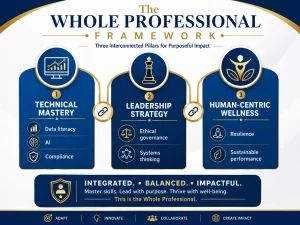
The framework rests on three pillars. Each is equally load-bearing.
The What: Technical Mastery Data literacy, AI-augmented decision-making, regulatory compliance, and domain-specific expertise. This is the competence that gets you in the room.
The Why: Leadership Strategy Cross-cultural influence, ethical governance, systems thinking, and institutional mandate alignment. This is the vision that determines what you do in the room.
The How: Human-Centric Wellness Cognitive resilience, adaptive capacity, psychological safety culture, and sustainable high performance. This is the foundation that keeps you in the game.
Most competitors address one of these pillars. Very few address all three. None design their curriculum so that each pillar actively reinforces the others. That integration is the ForElite difference.
How Can Africa and MENA Firms Scale Agentic AI Responsibly in Their Workforce?
The arrival of agentic AI is the defining professional challenge of 2026. These are not systems that simply respond to prompts. They plan autonomously. They execute. They adapt.
The question is no longer whether your organisation will be affected. It is whether your people will direct these systems or be directed by them.
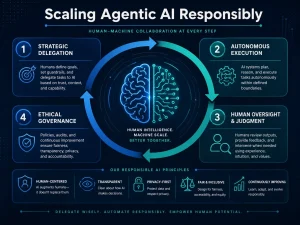
Responsible AI scaling requires more than a technology course. It demands a new mental model of human-machine collaboration. Leaders must understand what to delegate, what to retain, and where human judgment is not just preferable but legally and ethically required.
“The professional who understands agentic AI’s limits is worth ten times the one who simply knows how to prompt it.”
Our Digital Transformation and Emerging Technologies programmes are built on exactly this principle. Participants do not leave with theoretical knowledge. They leave with decision frameworks, governance protocols, and the practical confidence to lead AI integration in their own institutional contexts. Whether in Nairobi’s financial sector, Accra’s public ministries, or Dubai’s infrastructure corridor.
What Does Ethical AI Governance Look Like for Public Sector Leaders?
Public sector leaders face an additional layer of obligation. The POLD Regulations 2023 create explicit accountability structures that AI-driven decisions must sit within.
A procurement officer who delegates a sourcing decision to an AI system without documented oversight is not just operationally exposed. They are potentially legally exposed.
Our Training on Procurement for Governments integrates this regulatory reality directly into the curriculum. Participants learn not only best practice but the specific governance architecture that 2026 compliance demands.
What Professional Development Goals Should Corporate Leaders Set for Q3 and Q4 2026?
The second half of 2026 calls for specificity. Vague goals are the enemy of measurable ROI. Here is the architecture we recommend for senior professionals and the HR directors who support them.
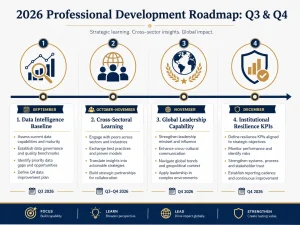
1. Establish a Data Intelligence Baseline by September
Every leader operating in a data-rich environment needs a minimum viable data literacy. The ability to read a dashboard critically. The ability to interrogate an analytical model’s assumptions. The ability to communicate data-driven recommendations to a non-technical board.
This is no longer a specialist skill. It is a leadership prerequisite.
2. Complete at Least One Cross-Sectoral Learning Experience
Africa’s most consequential challenges do not respect sectoral boundaries. Climate finance, food security, and urban infrastructure cut across every institution. Neither should professional development goals.
A health systems director who understands procurement reform is a more effective negotiator. A trade economist who understands data science is a more persuasive policy architect. Cross-pollination is not a luxury. It is competitive advantage.
3. Invest in Global Leadership Capability Before Regional Expansion
If your organisation is expanding into new markets, the window for building intercultural competence is before the move, not during.
Our Training on Global Leadership equips participants to lead diverse teams, manage cross-border mandates, and make decisions that hold across jurisdictions and cultures.
4. Build Institutional Resilience into Team-Level KPIs
Wellness is not a benefit. In 2026, it is a performance metric. Organisations with measurable psychological safety, lower burnout indices, and structured recovery practices consistently outperform peers on innovation velocity and staff retention.
HR directors should be writing these into their Q4 dashboards. Not leaving them to an annual staff survey.
How Should HR Directors in the Public Sector Align Training with Agenda 2063?
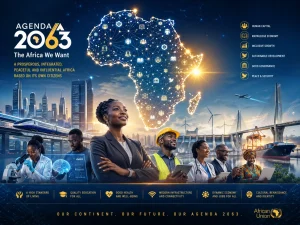
Agenda 2063 is not an abstract aspiration. It is a procurement criterion, a funding benchmark, and an institutional performance standard for any public body operating in an AU member state or seeking continental development financing.
For HR directors, alignment means three concrete things.
First, invest in the human capital pillars explicitly named in the framework: skills development, institutional capacity, and knowledge economy infrastructure.
Second, build the capability to report on those investments in the language that continental bodies and international donors actually use.
Third, choose training partners who understand the regulatory and political architecture well enough to design programmes that produce demonstrable alignment. Not just a certificate.
“Agenda 2063 does not reward organisations that talk about capacity. It rewards organisations that build it and can prove it.”
Our Human Capital and Institutional Development programmes are designed with precisely this reporting and alignment architecture in mind. Our faculty includes practitioners who have worked within AU frameworks, bilateral development agencies, and national planning ministries.
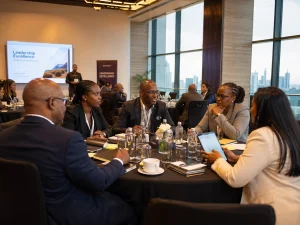
Is In-Person Training Still Worth the Investment in 2026?
Yes. Emphatically. But the rationale has changed.
In-person training is no longer primarily about content delivery. AI and virtual learning have solved that problem. It is about context.
The peer relationships built across a five-day residential programme in Nairobi or Johannesburg generate a different quality of insight than any synchronous online session. The dinner conversations, the site visits, the informal problem-solving between professionals from different sectors and countries. These are the learning moments that create lasting organisational change.
ForElite operates across 21 or more elite venues globally. Our 2026 training calendar spans Nairobi, Johannesburg, Kisumu, and international hubs. Formats include fully in-person residential, virtual instructor-led, hybrid, and customised on-site deployments. The logistics adapt. The standard does not.
The Bottom Line: What Separates Good Professional Development from Transformative Professional Development?
It is not the topics covered.
It is the integration of those topics into a coherent professional identity. One that can navigate technical change, institutional complexity, regulatory demand, and personal sustainability simultaneously.
The organisations that will define Africa’s next decade are already making that investment. They are not waiting for the perfect moment, the approved budget, or the annual learning cycle. They are building capability now.
Because they understand that the gap between who your people are today and who they need to be tomorrow is not closing on its own.
That is what high-velocity training means. Not fast. Directional. Purposeful. ROI-bearing.
Ready to define your organisation’s professional development goals for 2026?
Browse the full 2026 training calendar or request a custom corporate proposal from our advisory team at forelitetraining.com.