
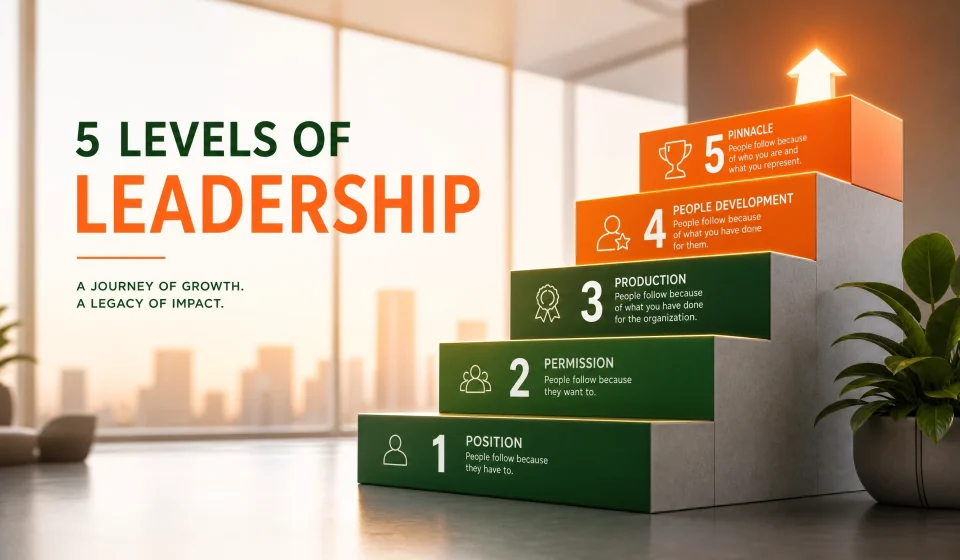

5 Levels of Leadership
Leadership is more than holding a management position or supervising a team. The most respected leaders influence people through trust, competence, and a genuine commitment to helping others succeed. The 5 levels of leadership model provides a practical roadmap for anyone who wants to grow from simply managing people to inspiring them.
Whether you’re a new supervisor, a department head, an entrepreneur, or an executive, understanding these leadership levels can help you identify where you are today and what you need to improve tomorrow.
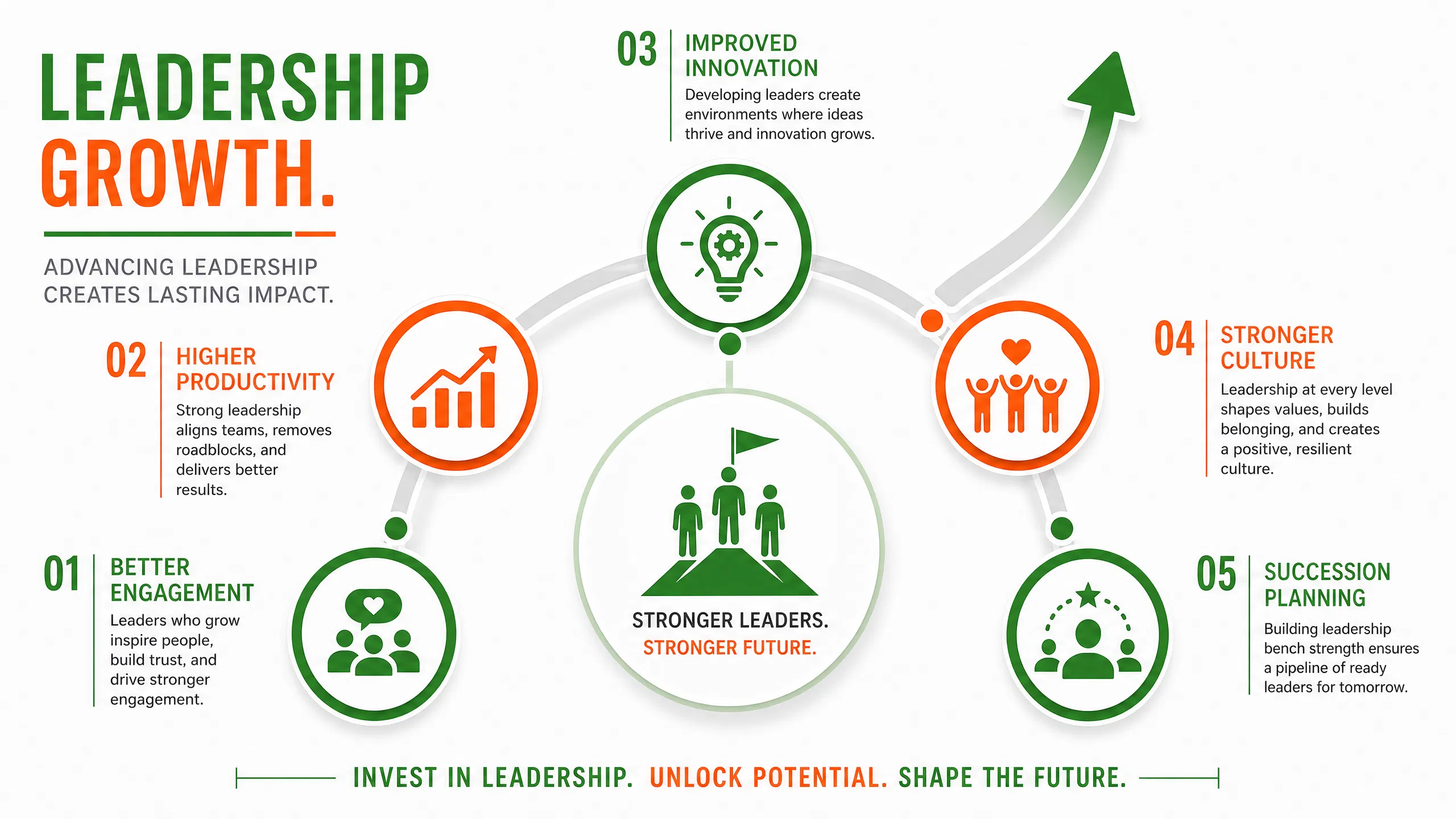
Moreover, leadership development doesn’t happen overnight. It requires continuous learning, practical experience, and the willingness to adapt to changing workplace challenges. Therefore, organizations that invest in leadership development often experience stronger employee engagement, higher productivity, and improved organizational performance.
Understanding Leadership Beyond a Job Title
Many people assume leadership comes automatically with a promotion. However, a title alone doesn’t guarantee influence.
Real leadership is about earning respect, guiding others toward shared goals, and creating an environment where people can thrive.
Effective leaders:
- Build trust
- Communicate clearly
- Make informed decisions
- Encourage collaboration
- Develop future leaders
- Lead by example
Furthermore, today’s workplaces demand leaders who can navigate technological changes, manage diverse teams, and inspire innovation. Employees increasingly expect leaders to demonstrate empathy, transparency, and accountability.
Leadership is also a lifelong learning journey. As a result, successful organizations encourage managers to strengthen their leadership capabilities through coaching, mentoring, and professional training.
Professionals looking to strengthen these essential skills can benefit from the Leadership and Management Skills for New Managers and Supervisors course offered by ForElite Training, which focuses on practical leadership techniques for modern workplaces.
What Are the 5 Levels of Leadership?
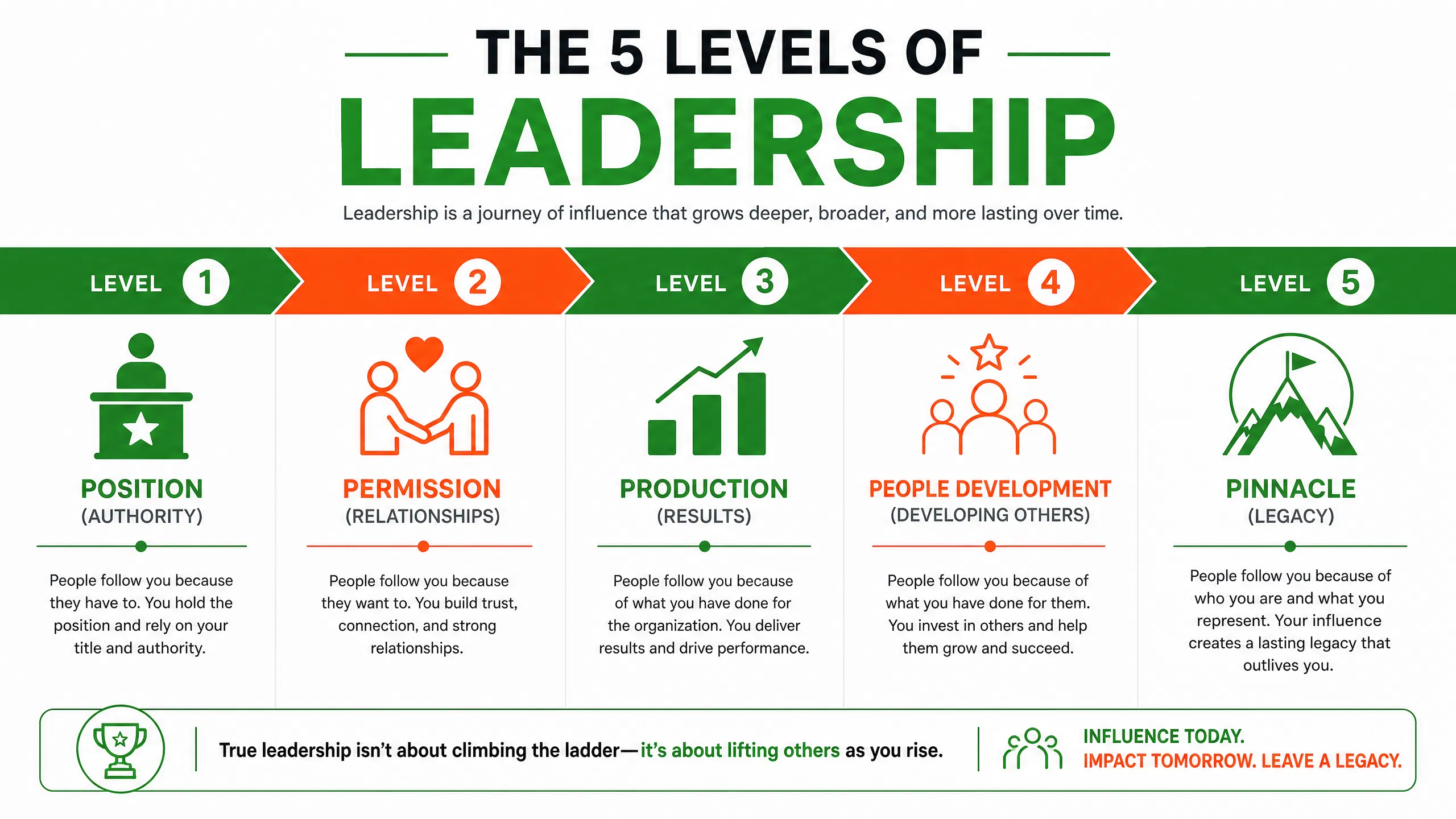
The 5 levels of leadership describe how leaders develop increasing influence over time. Rather than relying solely on authority, they gradually earn trust, deliver results, develop people, and ultimately leave a lasting legacy.
The five levels include:
| Level | Focus | Influence Source |
|---|---|---|
| Level 1 | Position | Authority |
| Level 2 | Permission | Relationships |
| Level 3 | Production | Results |
| Level 4 | People Development | Developing Others |
| Level 5 | Pinnacle | Legacy and Influence |
Each level builds upon the previous one. Consequently, skipping stages rarely leads to sustainable leadership success.
Why Leadership Levels Matter
Organizations benefit greatly when leaders continue progressing through these levels.
Some advantages include:
- Better employee engagement
- Higher productivity
- Improved innovation
- Stronger workplace culture
- Reduced employee turnover
- Increased customer satisfaction
- Better succession planning
Likewise, employees benefit because they receive better guidance, clearer communication, and greater opportunities for growth.
Level 1 – Position
Position is where every leadership journey begins.
At this stage, people follow because they have to. The leader has formal authority through a job title or organizational role.
Examples include:
- Team supervisors
- Department managers
- Project coordinators
- Newly promoted executives
While authority allows leaders to assign tasks and make decisions, it does not automatically create trust or commitment.
Strengths of Position Leadership
Position leaders can:
- Establish expectations
- Define responsibilities
- Organize workflows
- Ensure accountability
- Maintain organizational structure
Additionally, having clear authority helps organizations operate efficiently, particularly during periods of change or crisis.
Challenges at Level 1
Many leaders become stuck at this level.
Common mistakes include:
- Micromanaging employees
- Relying on authority instead of influence
- Ignoring employee feedback
- Focusing only on rules
- Resisting collaboration
These behaviors often reduce morale and limit innovation.
How to Grow Beyond Position
Leaders should begin developing stronger relationships by:
- Listening actively
- Showing appreciation
- Being approachable
- Demonstrating integrity
- Keeping commitments
Eventually, employees begin following because they want to, not because they must.
Professional development programs such as ForElite Training’s Leadership and Management Skills for New Managers and Supervisors help emerging leaders strengthen these foundational skills while building confidence in leading teams.
Level 2 – Permission
Permission leadership begins when people choose to follow.
Relationships become the foundation of influence.
Rather than relying solely on authority, leaders earn trust through respect, empathy, and consistency.
Employees at this stage feel valued, heard, and appreciated.
Permission leaders typically:
- Build strong relationships
- Encourage teamwork
- Practice active listening
- Resolve conflicts respectfully
- Foster psychological safety
Characteristics of Permission Leaders
Successful permission leaders demonstrate:
Emotional Intelligence
They recognize emotions in themselves and others.
Effective Communication
They communicate openly and honestly.
Empathy
They understand employees’ concerns and respond thoughtfully.
Collaboration
They encourage teamwork instead of competition.
Trustworthiness
They consistently do what they promise.
These qualities create healthier workplace relationships.
Benefits of Permission Leadership
When employees trust their leaders, organizations experience:
- Better communication
- Greater innovation
- Higher engagement
- Stronger collaboration
- Improved morale
Furthermore, trust encourages employees to share ideas, report challenges early, and contribute more confidently to organizational success.
Moving Beyond Permission
Although relationships are essential, they are not enough.
Eventually, leaders must produce measurable results.
Growth requires:
- Setting performance goals
- Improving productivity
- Leading strategic initiatives
- Measuring outcomes
- Delivering organizational value
For managers seeking to strengthen both interpersonal and strategic leadership skills, ForElite Training’s Strategic Leadership and Future-Ready Management course provides practical frameworks for leading organizations through change while delivering measurable performance improvements.
Level 3 – Production
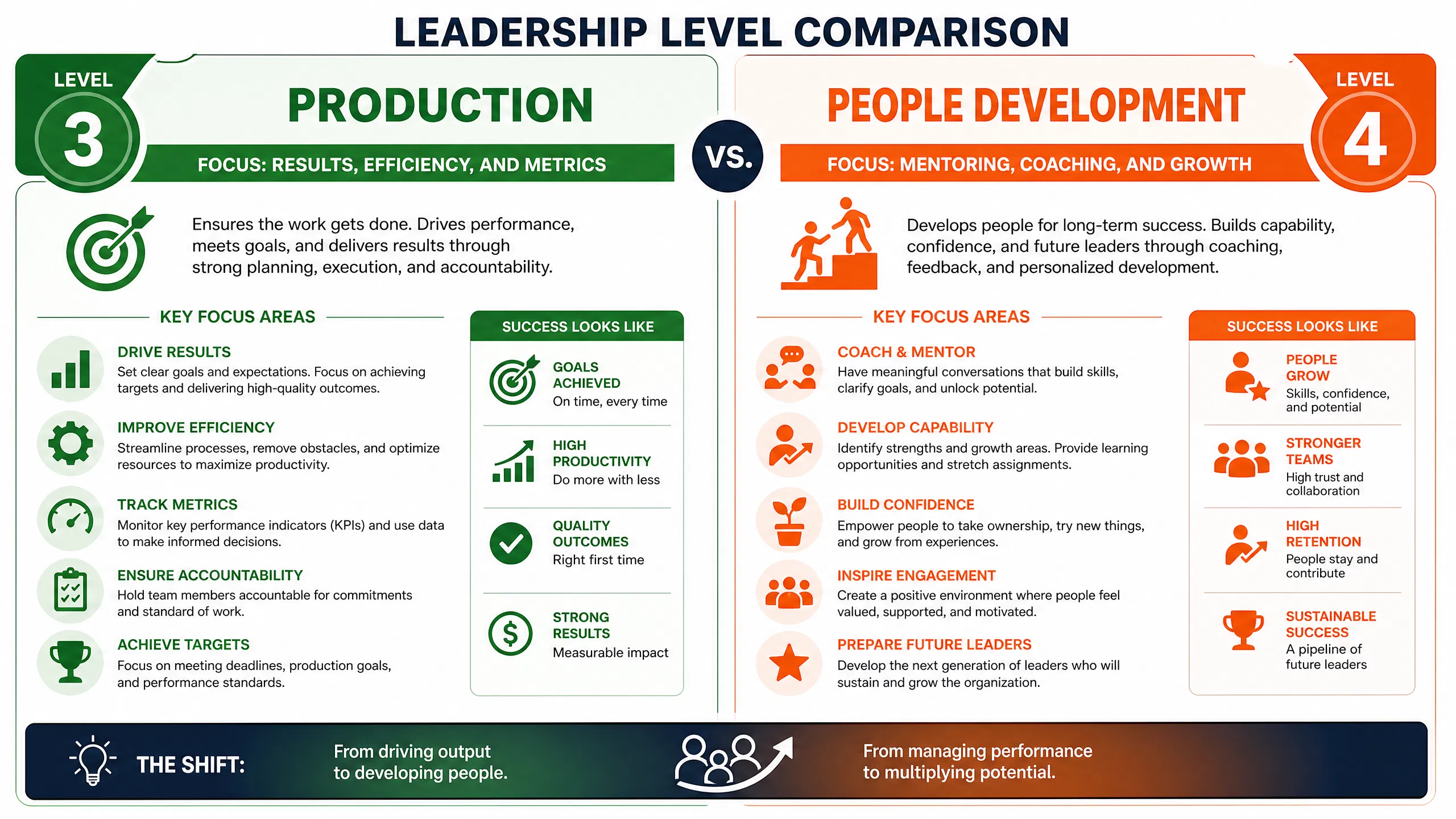
At Level 3, leaders earn credibility through results. People follow because they see that the leader consistently delivers value to the organization. While relationships remain important, performance becomes the defining characteristic of leadership at this stage.
A Production leader inspires confidence by setting clear goals, making informed decisions, and achieving measurable outcomes. Teams are more willing to trust leaders who not only communicate a vision but also demonstrate the ability to turn that vision into reality.
Moreover, organizations depend on Production leaders to improve efficiency, solve complex problems, and drive innovation. These leaders understand that success is not measured solely by personal achievements but by the accomplishments of the entire team.
What Defines a Production Leader?
Production leaders are known for balancing people management with operational excellence. They create environments where employees understand expectations and feel motivated to perform at their best.
Some defining characteristics include:
- Setting clear and realistic objectives
- Aligning team efforts with organizational goals
- Monitoring performance using measurable indicators
- Encouraging accountability without micromanaging
- Celebrating team achievements
- Addressing challenges promptly
Additionally, Production leaders recognize that consistent improvement requires continuous learning. They regularly evaluate processes, gather feedback, and look for opportunities to increase productivity.
The Benefits of Leading Through Results
When leaders consistently produce positive outcomes, organizations experience numerous advantages.
| Benefit | Impact |
|---|---|
| Higher productivity | Teams accomplish more with available resources. |
| Improved morale | Employees gain confidence in leadership. |
| Better customer satisfaction | High-performing teams deliver quality services. |
| Increased innovation | Employees feel empowered to improve processes. |
| Stronger organizational reputation | Reliable performance builds stakeholder trust. |
Furthermore, success at this level creates momentum. Employees become more motivated because they can see tangible progress, and leaders gain greater influence across departments.
Common Challenges at Level 3
Despite its many strengths, Production leadership comes with potential pitfalls.
Some leaders become so focused on performance that they overlook employee well-being. Others may prioritize short-term results over long-term sustainability.
Common mistakes include:
- Ignoring work-life balance
- Measuring only financial outcomes
- Overlooking employee development
- Failing to delegate responsibilities
- Becoming overly competitive
These habits can eventually reduce employee engagement and increase turnover.
How to Advance Beyond Production
Moving to Level 4 requires a shift in mindset.
Instead of asking, “How can I produce better results?” leaders begin asking, “How can I help others become successful leaders?”
Practical steps include:
- Mentor promising employees.
- Delegate meaningful responsibilities.
- Encourage independent decision-making.
- Invest in coaching and professional development.
- Recognize potential rather than experience alone.
Consequently, leaders begin multiplying their impact by helping others grow.
Organizations looking to strengthen this transition can benefit from ForElite Training’s Middle Managers Leadership and Management Program, which equips experienced managers with practical tools for coaching teams, managing organizational change, and developing leadership pipelines.
Level 4 – People Development
Many leadership experts consider Level 4 to be the turning point where great managers become exceptional leaders.
At this stage, success is no longer measured by what the leader accomplishes personally. Instead, it is measured by how many other leaders they develop.
People Development leaders understand that organizations become stronger when knowledge, skills, and opportunities are shared. They intentionally invest time in mentoring employees, creating learning opportunities, and preparing future leaders for greater responsibilities.
Therefore, organizations with strong Level 4 leaders often enjoy higher employee retention, better succession planning, and stronger organizational cultures.
Why Developing People Matters
Employees want more than a paycheck. They want opportunities to learn, grow, and contribute in meaningful ways.
Leaders who invest in employee development often experience:
- Higher engagement
- Greater loyalty
- Increased innovation
- Better collaboration
- Improved organizational resilience
Likewise, employees become more confident when leaders trust them with meaningful responsibilities.
Characteristics of People Development Leaders
These leaders consistently demonstrate behaviors that encourage growth.
They Coach Rather Than Command
Instead of providing every answer, they ask thoughtful questions that help employees think critically.
They Delegate Strategically
Delegation becomes a learning opportunity rather than simply transferring work.
They Provide Constructive Feedback
Feedback focuses on improvement rather than criticism.
They Celebrate Progress
Recognizing achievements builds confidence and motivation.
They Create Learning Cultures
Training, mentoring, and continuous improvement become part of everyday work.
Practical Ways to Develop Future Leaders
Leadership development should be intentional rather than accidental.
Some effective strategies include:
1. Mentorship Programs
Pair experienced professionals with emerging leaders to encourage knowledge sharing.
2. Leadership Workshops
Provide structured learning opportunities that strengthen communication, decision-making, and strategic thinking.
3. Cross-Functional Projects
Allow employees to collaborate across departments to broaden their experience.
4. Stretch Assignments
Assign challenging projects that encourage growth beyond current responsibilities.
5. Regular Coaching Sessions
Frequent conversations help employees identify strengths, overcome challenges, and set future goals.
Creating a Leadership Pipeline
Organizations that develop leaders internally are often better prepared for change.
Benefits include:
| Leadership Practice | Organizational Benefit |
|---|---|
| Mentoring | Stronger succession planning |
| Coaching | Improved employee confidence |
| Skills training | Better performance |
| Delegation | Greater organizational flexibility |
| Leadership development | Long-term sustainability |
Furthermore, investing in people creates a culture where leadership becomes everyone’s responsibility rather than the responsibility of a few individuals.
For organizations committed to building future-ready leaders, ForElite Training offers the Strategic Leadership and Future-Ready Management programs, which helps leaders cultivate innovation, resilience, and long-term organizational success. Additionally, professionals interested in responsible leadership practices can explore the Sustainable Finance and Leadership course, which integrates strategic decision-making with sustainable business principles.
The Transition to Level 5
Reaching Level 5 does not happen quickly.
It requires years of:
- Building trust
- Delivering results
- Developing others
- Demonstrating integrity
- Leading consistently through change
Only after mastering these areas do leaders begin creating a legacy that extends beyond their own careers.
Level 5 – Pinnacle
The fifth and highest stage in the 5 levels of leadership is known as the Pinnacle. Very few leaders reach this level because it requires years of consistent excellence, humility, and service. At this stage, leadership is no longer about authority, relationships, results, or even developing people alone. Instead, it is about creating a lasting legacy that continues to influence individuals and organizations long after the leader has moved on.
People follow Pinnacle leaders because of who they are and the positive impact they have made over time. Their reputation is built on trust, integrity, vision, and a genuine commitment to helping others succeed.
Moreover, Pinnacle leaders understand that leadership is not a destination but an ongoing responsibility. They continue learning, mentoring, and adapting to new challenges while inspiring others to pursue excellence.
Characteristics of Pinnacle Leaders
Leaders at this level consistently demonstrate qualities that set them apart.
Visionary Thinking
Pinnacle leaders see beyond immediate challenges. They anticipate future trends, identify emerging opportunities, and position their organizations for long-term success.
Unwavering Integrity
Their decisions are guided by strong ethical principles. Employees, customers, and stakeholders trust them because they consistently act with honesty and transparency.
Influence Beyond Their Organization
Many Pinnacle leaders influence entire industries, communities, or professions. They speak at conferences, mentor leaders across organizations, and contribute to thought leadership.
Commitment to Lifelong Learning
Despite their accomplishments, they remain curious. They seek new knowledge, embrace innovation, and continuously refine their leadership approach.
Building Leaders Who Build Leaders
Perhaps the most defining characteristic of Level 5 leaders is their ability to create leaders who, in turn, develop even more leaders. This multiplier effect strengthens organizations for generations.
Examples of Legacy Leadership
While every organization has its own context, legacy leaders often share common practices.
They:
- Inspire through actions rather than words.
- Empower people to exceed their own expectations.
- Foster cultures of innovation and accountability.
- Leave organizations stronger than they found them.
- Continue serving as mentors even after retirement or career transitions.
Consequently, their influence extends far beyond their official role.
Practical Tips for Advancing Through the 5 Levels of Leadership
Progressing through the 5 levels of leadership requires intentional effort. Every leader develops at a different pace, but consistent practice can accelerate growth.
1. Commit to Continuous Learning
Leadership skills evolve as workplaces change. Read books, attend seminars, participate in workshops, and seek opportunities to expand your knowledge.
Professional leadership development programs can provide structured learning and practical tools. For example, ForElite Training offers courses designed for professionals at different stages of their leadership journey, from new supervisors to senior executives.
2. Seek Honest Feedback
Ask colleagues, supervisors, and team members for constructive feedback about your leadership style.
Questions to consider include:
- Do I communicate effectively?
- Do I listen actively?
- Do I empower others?
- How can I improve?
Feedback provides valuable insights that self-assessment alone cannot offer.
3. Build Emotional Intelligence
Leadership involves understanding people as much as managing processes.
Develop skills such as:
- Self-awareness
- Self-regulation
- Empathy
- Active listening
- Conflict resolution
Furthermore, emotionally intelligent leaders often create healthier workplace relationships and stronger team performance.
4. Focus on Service
The best leaders ask, “How can I help my team succeed?”
Servant leadership builds trust, encourages collaboration, and strengthens organizational culture.
5. Develop Future Leaders
Every interaction is an opportunity to mentor someone.
Encourage employees by:
- Delegating meaningful responsibilities
- Providing regular coaching
- Celebrating achievements
- Offering learning opportunities
- Supporting career development
Eventually, your success will be measured by the success of those you have helped grow.
Why Professional Leadership Training Makes a Difference
While experience is invaluable, structured learning accelerates leadership development by providing proven frameworks, practical tools, and expert guidance.
Professional training helps leaders:
- Improve communication skills.
- Strengthen strategic thinking.
- Enhance decision-making.
- Build resilient teams.
- Manage organizational change.
- Foster innovation.
For professionals looking to strengthen their leadership capabilities, ForElite Training offers a wide range of leadership and management programs tailored to different career stages. Whether you are a new manager, a middle-level leader, or a senior executive, these programs combine practical learning with real-world applications to help you lead confidently.
Organizations seeking to enhance their digital presence while supporting leadership initiatives can also benefit from the services provided by Nexera Digital Solutions, which specializes in digital marketing, branding, and technology solutions that help businesses grow in an increasingly competitive marketplace.
Frequently Asked Questions (FAQs)
1. What are the 5 levels of leadership?
The five levels are Position, Permission, Production, People Development, and Pinnacle. Each level represents a deeper level of influence and leadership effectiveness.
2. Can anyone reach Level 5 leadership?
Yes, but it requires years of consistent growth, integrity, continuous learning, and a commitment to developing others. Very few leaders achieve this level because it demands sustained excellence over time.
3. Is leadership based on natural talent or learned skills?
While some individuals possess natural leadership qualities, most leadership skills can be developed through education, experience, coaching, and deliberate practice.
4. Why is Level 2 important?
Permission leadership builds trust and strong relationships. Without trust, it becomes difficult for leaders to motivate teams or inspire long-term commitment.
5. How long does it take to progress through the 5 levels of leadership?
There is no fixed timeline. Progress depends on experience, learning opportunities, organizational culture, and the leader’s willingness to grow.
6. Why should organizations invest in leadership training?
Leadership training improves communication, employee engagement, productivity, innovation, succession planning, and overall organizational performance.
Conclusion
The 5 levels of leadership provide a powerful framework for understanding how influence grows over time. Leadership begins with a position, but lasting success comes from earning trust, delivering meaningful results, developing future leaders, and ultimately creating a legacy that inspires others.
Moreover, every stage presents unique opportunities for learning and growth. Leaders who intentionally develop their skills become better equipped to navigate change, motivate teams, and achieve organizational goals.
Finally, leadership is not about personal recognition, it is about making a positive difference in the lives of others. Whether you are just beginning your leadership journey or preparing for executive responsibilities, investing in continuous learning, mentoring, and professional development will help you progress through each level with confidence and purpose.
By embracing the principles of the 5 levels of leadership, you can strengthen your influence, empower those around you, and contribute to building resilient organizations that thrive well into the future.