

Recent project management research and industry discussions show that traditional linear (predictive) project management remains highly relevant in industries where requirements, budgets, and timelines are clearly defined. Structured planning, critical path scheduling, risk management, and governance continue to be essential in construction, infrastructure, manufacturing, healthcare, and regulated sectors. Modern organizations increasingly combine digital tools with predictive methodologies to improve project visibility and control.
Linear Project Management: A Complete Guide to Structured Project Success
Linear project management remains one of the most widely used methodologies for planning and executing projects across multiple industries. While Agile and hybrid frameworks often dominate modern discussions, organizations continue to rely heavily on structured project management approaches when objectives, timelines, and deliverables are clearly defined. Think of linear project management as constructing a building. Before the first brick is laid, architects complete the designs, engineers verify the calculations, contractors establish schedules, and materials are procured. Every stage follows a predetermined sequence. Skipping steps would create confusion and increase risk.
This method thrives on predictability. Teams know what needs to be done, when it should be completed, and who is responsible for each activity. Such clarity makes linear project management particularly valuable in industries where regulatory compliance, safety standards, and budget controls are critical. Organizations seeking consistent project outcomes often prefer this methodology because it minimizes uncertainty and creates measurable accountability.
As businesses continue embracing digital transformation, structured project management remains highly relevant. Modern technologies have enhanced traditional methodologies rather than replaced them. Today’s project managers use advanced software, data analytics, and collaborative platforms to strengthen planning, scheduling, and performance monitoring while maintaining the discipline of a linear approach.
Understanding Linear Project Management
Definition and Core Principles
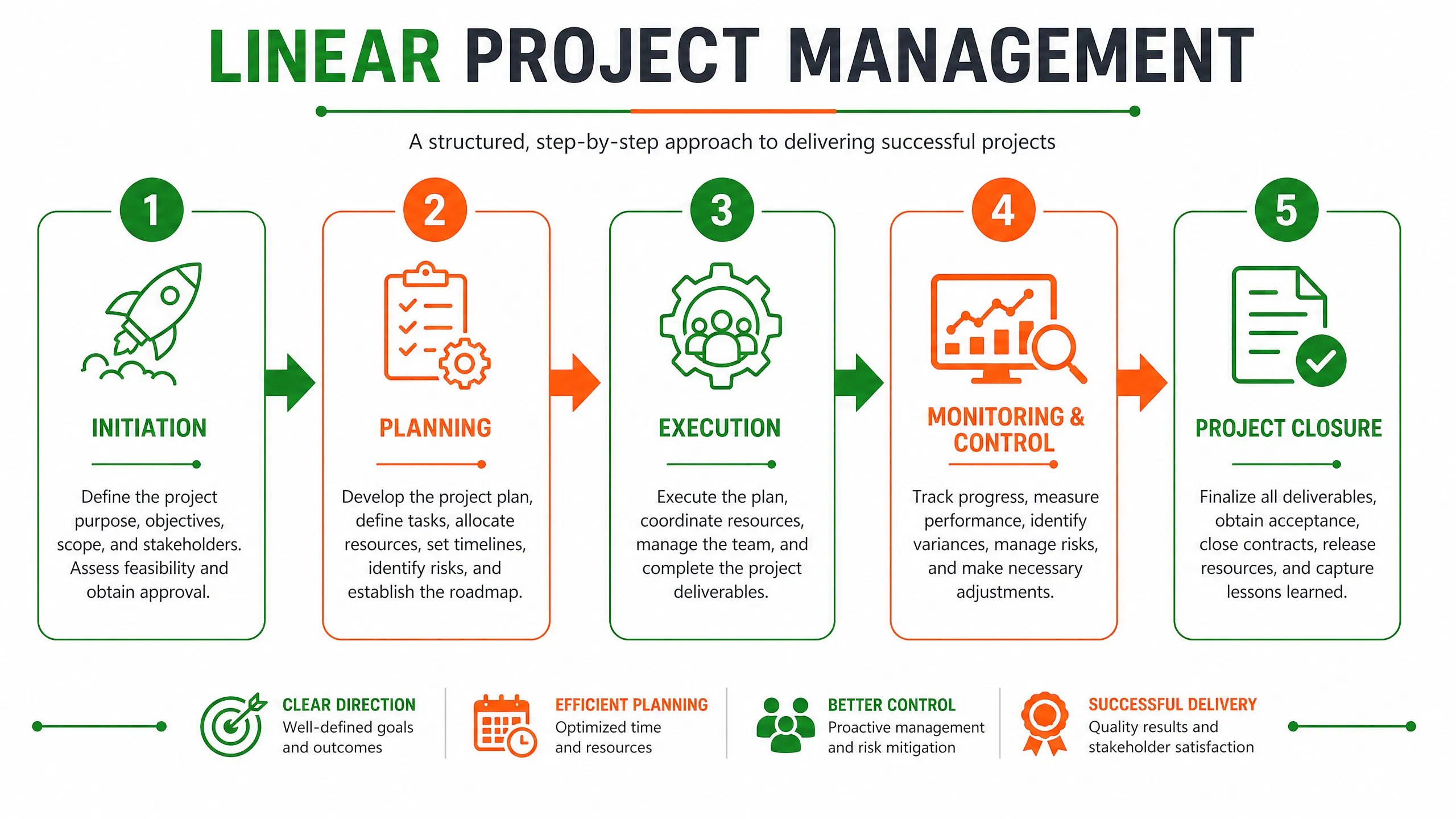
Linear project management, often associated with predictive or waterfall methodologies, follows a sequential process where one phase must be completed before the next begins. The approach is grounded in extensive planning and detailed documentation. Before execution starts, project teams define requirements, establish timelines, allocate resources, identify risks, and develop budgets.
The philosophy behind linear project management is straightforward. Careful preparation reduces uncertainty and improves project outcomes. Rather than adapting continuously throughout the project lifecycle, teams focus on creating a comprehensive roadmap at the beginning. This roadmap serves as the primary guide for project execution.
Several principles define the methodology:
| Principle | Description |
|---|---|
| Clear Scope | Requirements are established early |
| Sequential Phases | Tasks follow a predetermined order |
| Detailed Documentation | Decisions and processes are recorded |
| Predictable Scheduling | Timelines are established before execution |
| Formal Change Control | Changes undergo structured review |
These principles provide a foundation for consistent project delivery. Organizations working on infrastructure development, engineering projects, government programs, and large-scale implementations frequently rely on this structured framework.
Why It Is Called a Linear Approach
The term “linear” reflects the project’s progression through a straight path. Each phase depends on the successful completion of the previous one. Imagine a train traveling along a track. The train cannot skip stations or suddenly change direction without disrupting the journey. Similarly, linear projects advance through clearly defined stages.
This sequential flow provides transparency for stakeholders. Managers can easily track progress, identify delays, and assess performance against planned milestones. Because deliverables are established early, stakeholders gain confidence in project expectations and outcomes.
The Evolution of Linear Project Management
Historical Background
Linear project management has roots dating back to major engineering and military initiatives of the twentieth century. Large infrastructure projects required extensive planning because mistakes could be extraordinarily costly. As industries became more complex, organizations developed structured methodologies to manage risks and coordinate large teams.
Techniques such as Critical Path Method (CPM), Gantt Charts, and Work Breakdown Structures emerged to support detailed project planning. These tools remain fundamental components of project management today. Their continued use demonstrates the lasting value of structured project execution.
Relevance in Modern Organizations
Despite the popularity of Agile methodologies, linear project management remains indispensable. Industries dealing with strict regulations, fixed contracts, and safety-critical operations often require a predictive approach. Projects involving construction, manufacturing, energy systems, and public infrastructure benefit from the stability and governance that linear methodologies provide.
Organizations also recognize that not every project requires continuous adaptation. When requirements are clear from the beginning, extensive iteration may introduce unnecessary complexity. Research on project management evolution shows that predictive methods continue to serve as foundational frameworks even as hybrid models emerge.
Key Phases of Linear Project Management
Project Initiation
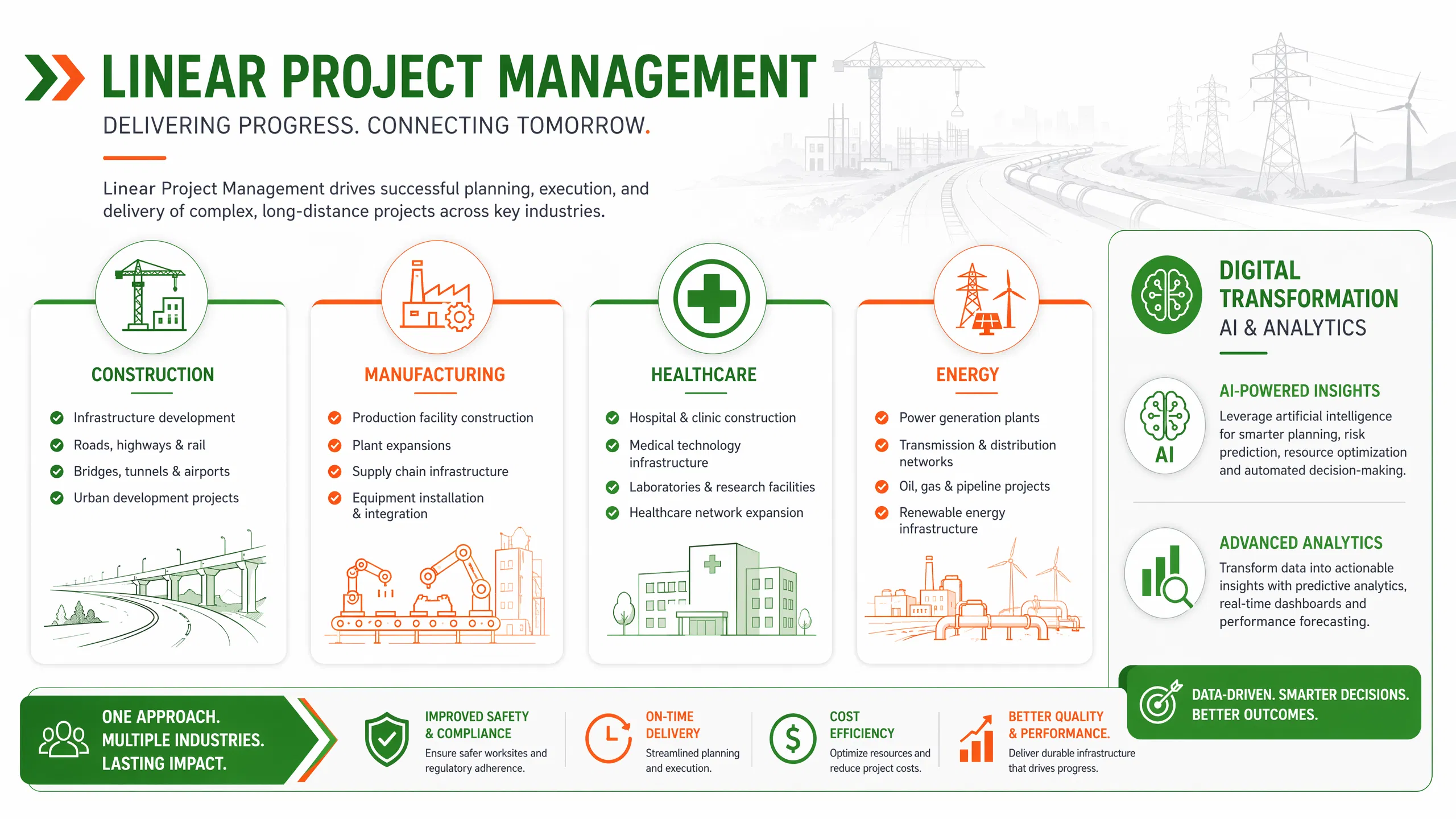
Every successful project begins with a clear purpose. During initiation, project sponsors identify objectives, define business needs, and determine feasibility. Teams establish project charters, identify stakeholders, and secure organizational approval.
This phase creates alignment among decision-makers. Without a shared understanding of goals, projects often struggle with conflicting expectations. Initiation provides the strategic foundation upon which all future activities are built.
Project Planning
Planning represents the heart of linear project management. During this stage, teams develop schedules, budgets, resource plans, risk registers, communication plans, and performance metrics. Every major activity is mapped before execution begins.
Many organizations strengthen planning capabilities through specialized programs such as the Project Management Essentials for Managers course offered by ForElite Training Institute, which emphasizes lifecycle management, scheduling, stakeholder engagement, and risk mitigation.
Project Execution
Execution transforms plans into reality. Team members complete assigned tasks while managers coordinate resources and maintain alignment with project objectives. Communication becomes especially important during this phase because multiple stakeholders contribute to project success.
Execution in a linear environment prioritizes adherence to approved plans. Managers focus on maintaining schedule integrity, controlling costs, and ensuring quality standards are met.
Monitoring and Control
Monitoring occurs alongside execution. Project managers compare actual performance against planned targets. Variances in schedule, budget, or quality trigger corrective actions.
Performance dashboards, status reports, and earned value management techniques provide valuable insights. Continuous monitoring allows organizations to address problems before they escalate into significant risks.
Project Closure
Closure marks the formal completion of project activities. Teams verify deliverables, obtain stakeholder approval, document lessons learned, and release resources. Closure ensures organizational knowledge is preserved for future projects.
Projects that conclude with structured reviews often generate valuable insights that improve future performance and strengthen organizational maturity.
Core Characteristics of Linear Projects
Sequential Workflow Structure
One defining characteristic of linear projects is their structured progression. Activities follow a logical sequence that minimizes uncertainty and establishes accountability. Teams know exactly when deliverables should be completed and how tasks relate to one another.
This structure simplifies coordination, particularly in large projects involving multiple departments, vendors, and stakeholders.
Defined Scope and Deliverables
Linear projects typically begin with comprehensive requirements gathering. Once approved, project scope remains relatively stable. Any modifications require formal evaluation through change control processes.
This disciplined approach protects project objectives and prevents uncontrolled expansion, often referred to as scope creep.
Benefits of Linear Project Management
Predictability and Control
Perhaps the greatest advantage of linear project management is predictability. Stakeholders gain visibility into schedules, budgets, and milestones long before execution begins. This transparency supports informed decision-making and resource allocation.
Organizations frequently choose linear methodologies when contractual obligations, regulatory requirements, or financial constraints demand precise planning. The ability to forecast outcomes improves confidence among sponsors and investors.
Enhanced Documentation
Documentation serves as another major strength. Every decision, requirement, and process is recorded, creating a valuable knowledge repository. Detailed documentation improves accountability, simplifies audits, and supports organizational learning.
Training programs such as the Project Management for Leaders Course by ForElite Training Institute help professionals develop advanced competencies in strategic alignment, governance, and project leadership.
Challenges of Linear Project Management
Limited Flexibility
While structure provides stability, it can also create limitations. Projects operating in rapidly changing environments may struggle when requirements evolve unexpectedly. Adapting plans often requires extensive approvals and documentation updates.
As a result, organizations must carefully assess project characteristics before selecting a methodology.
Managing Change Requests
Change management represents one of the most challenging aspects of linear projects. Stakeholders may request new features, revised specifications, or additional deliverables after planning has concluded. Each modification can impact timelines, budgets, and resource allocations.
Effective change control processes help balance flexibility with project stability, ensuring that modifications are evaluated objectively.
Linear Project Management vs Agile Project Management
Key Differences
| Feature | Linear Project Management | Agile Project Management |
|---|---|---|
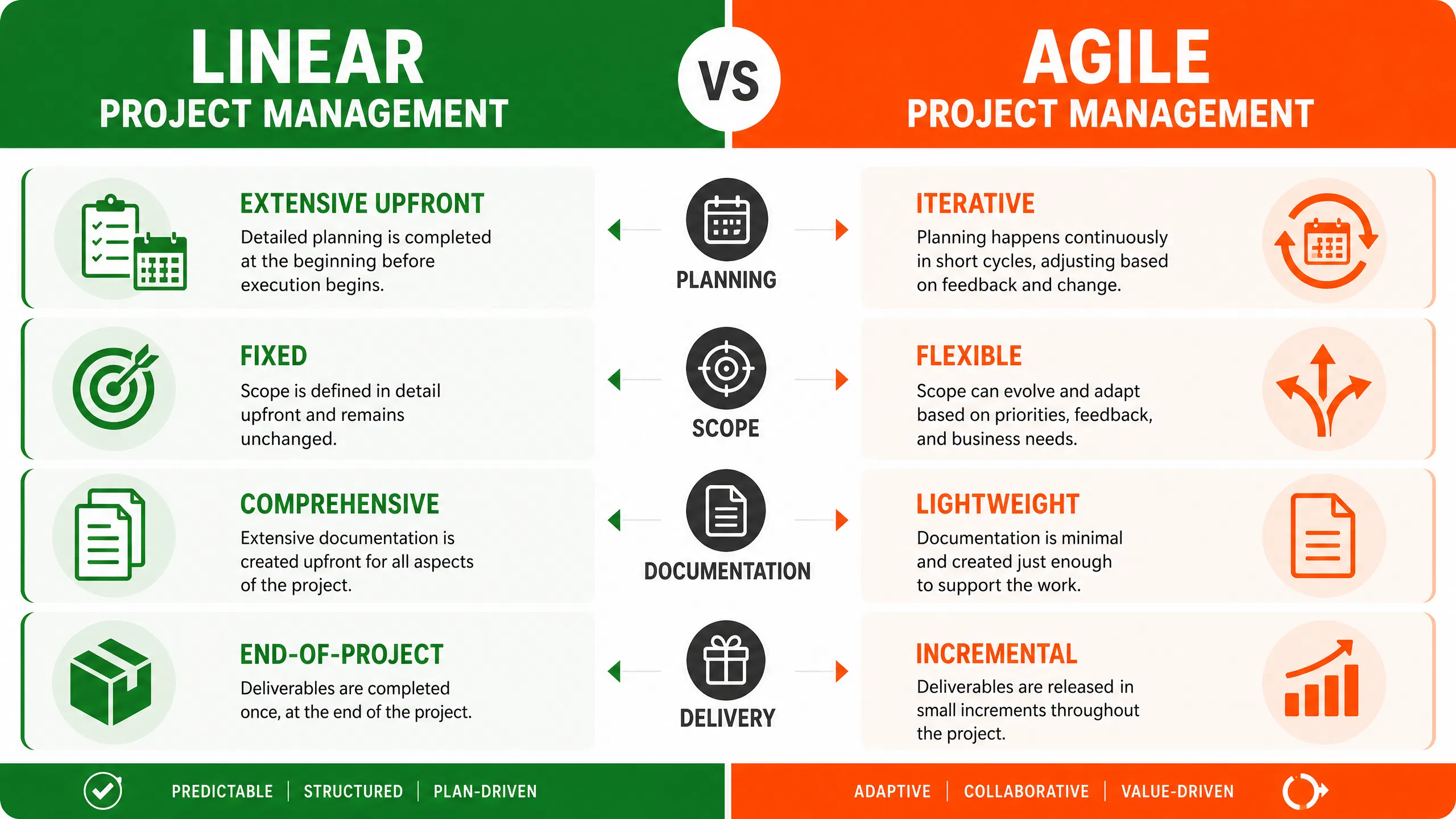
| Planning | Extensive upfront planning | Iterative planning |
| Scope | Fixed and defined | Flexible and evolving |
| Documentation | Comprehensive | Lightweight |
| Change Management | Formal process | Continuous adaptation |
| Delivery | End-of-project delivery | Incremental delivery |
When to Choose Each Approach
Linear project management works best when requirements are stable and outcomes are predictable. Agile excels when innovation, experimentation, and continuous customer feedback are essential.
Many organizations now blend elements of both approaches. Research on project management evolution highlights the growing popularity of hybrid frameworks that combine predictive governance with adaptive delivery practices.
Industries That Benefit Most from Linear Project Management
Several industries continue to depend heavily on structured methodologies:
- Construction and infrastructure
- Manufacturing
- Government projects
- Defense programs
- Healthcare systems
- Energy and utilities
- Engineering services
- Telecommunications
These sectors often operate under strict regulatory requirements, making predictable planning essential. Detailed documentation and governance structures help organizations maintain compliance while reducing operational risk.
Professionals seeking specialized expertise can explore training opportunities such as:
- Project Management Essentials for Managers
- Project Management for Leaders
- ForElite Project Management Category Programs
- Project Management and Organizational Effectiveness Programs
- Corporate Professional Development Courses at ForElite Training Institute
Digital Tools Supporting Linear Project Management
Technology has transformed traditional project management. Modern software platforms enable real-time collaboration, automated reporting, resource optimization, and predictive analytics. Digital dashboards provide instant visibility into project performance, allowing managers to make data-driven decisions.
Organizations pursuing digital transformation increasingly integrate project management systems with enterprise platforms. Companies such as Nexera Digital Solutions focus on digital process optimization, operational monitoring, smart data management, and workflow automation that support structured project execution. Digital technologies enhance efficiency while preserving the discipline of predictive project management.
Building Linear Project Management Skills Through Professional Training
Successful project managers require a blend of technical knowledge, leadership capabilities, communication skills, and analytical thinking. Professional training helps individuals develop these competencies while staying current with industry best practices.
Organizations investing in project management education often experience improved project success rates, stronger stakeholder engagement, and more effective resource utilization. Structured learning programs provide practical frameworks that participants can apply immediately within their organizations.
The growing complexity of projects makes continuous professional development increasingly important. Project managers who understand scheduling techniques, risk management methodologies, budgeting practices, and governance frameworks are better positioned to deliver successful outcomes.
Future Trends and the Role of Digital Transformation
The future of linear project management lies not in replacement but in evolution. Emerging technologies such as artificial intelligence, automation, digital twins, predictive analytics, and advanced reporting platforms are strengthening traditional methodologies rather than eliminating them.
Project managers increasingly leverage intelligent systems to forecast risks, optimize schedules, and improve decision-making. Digital transformation initiatives are creating environments where structured planning coexists with real-time data insights. This combination delivers greater visibility, efficiency, and control.
Organizations that successfully integrate technology with established project management principles gain a significant competitive advantage. They maintain governance and predictability while improving responsiveness and operational performance.
Conclusion
Linear project management continues to serve as a cornerstone of successful project delivery across numerous industries. Its emphasis on planning, documentation, accountability, and structured execution makes it particularly valuable when requirements are clearly defined and outcomes must be predictable. While Agile and hybrid methodologies have expanded the project management landscape, the fundamental strengths of the linear approach remain highly relevant.
Businesses operating in regulated environments, managing large-scale infrastructure initiatives, or executing projects with fixed budgets and timelines often achieve superior results through predictive methodologies. When combined with modern digital tools and continuous professional development, linear project management provides a powerful framework for delivering projects efficiently, consistently, and successfully.
FAQs
1. What is linear project management?
Linear project management is a structured methodology where project phases occur sequentially. Each phase must be completed before the next begins, ensuring predictable delivery and strong governance.
2. Is linear project management the same as waterfall?
They are closely related. Waterfall is one of the most recognized forms of linear or predictive project management, emphasizing sequential progression through project phases.
3. What industries use linear project management most frequently?
Construction, manufacturing, engineering, healthcare, government, telecommunications, and energy sectors commonly use linear methodologies due to their need for predictability and compliance.
4. What are the biggest advantages of linear project management?
The primary advantages include clear planning, predictable outcomes, detailed documentation, strong budget control, and effective risk management.
5. Can linear project management work alongside digital transformation?
Yes. Modern technologies such as analytics, automation, and digital monitoring systems enhance linear project management by improving visibility, reporting, and operational efficiency.