
Mobile and Digital Data Collection: 15 Powerful Ways to Improve Accuracy, Speed, and Decision-Making

Understanding Mobile and Digital Data Collection
Mobile and digital data collection has become one of the most significant technological advancements in modern business operations. Organizations across government agencies, NGOs, healthcare institutions, financial organizations, educational institutions, agriculture, logistics, and manufacturing are increasingly replacing paper forms with digital platforms that enable fast, reliable, and accurate data collection.
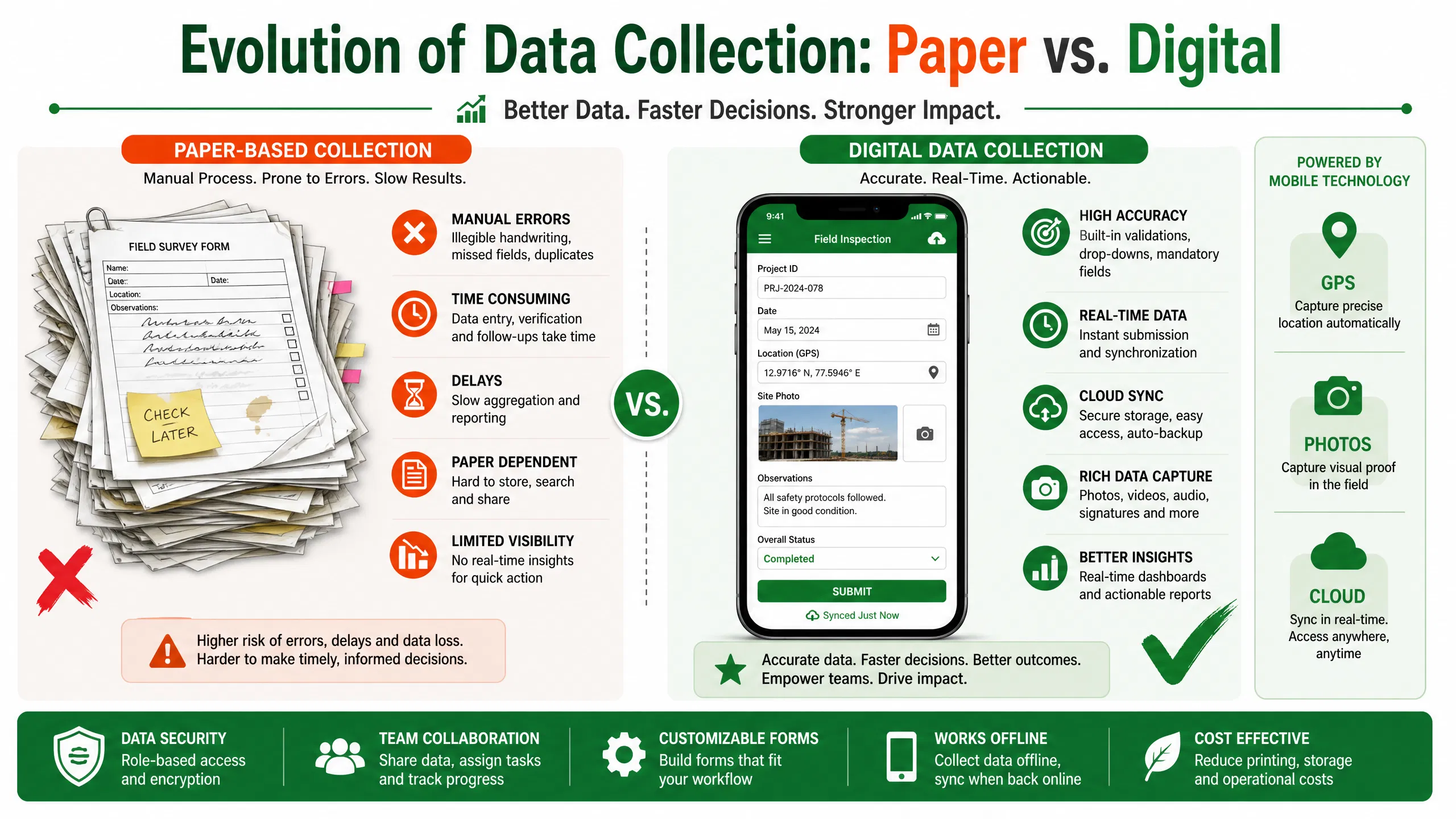
Traditionally, data collectors relied on printed questionnaires, notebooks, and spreadsheets that required manual entry into databases. However, these methods often resulted in missing information, duplicate records, transcription mistakes, delayed reporting, and increased operational expenses.
Today, mobile devices such as smartphones and tablets allow field officers to collect information electronically using specialized applications. Once data is captured, it can be synchronized instantly to cloud-based databases where supervisors, analysts, and decision-makers can access real-time reports.
This transformation has dramatically improved operational efficiency. Instead of waiting days or weeks for field reports, organizations now receive live updates from anywhere in the world.
The rise of cloud computing, faster internet connectivity, GPS technology, and affordable mobile devices has made digital data collection accessible even in remote areas. Consequently, organizations can monitor projects more effectively, improve accountability, and make evidence-based decisions.
Many professionals are enhancing their skills through specialized training programs such as the Mobile and Digital Data Collection Short Courses offered by ForElite Training
These professional programs equip participants with practical skills for designing digital forms, deploying surveys, managing databases, and producing analytical dashboards.
Evolution from Paper-Based Systems
For decades, paper questionnaires served as the backbone of surveys, inspections, censuses, monitoring programs, healthcare reporting, and market research.
Although paper forms appeared simple, they created several operational problems.
Some of these included:
- Manual errors
- Missing responses
- Illegible handwriting
- Delayed reporting
- High printing costs
- Expensive transportation
- Storage challenges
- Duplicate records
- Data loss
Moreover, organizations often employed additional personnel solely for entering paper records into computer systems.
Digital technology has eliminated many of these inefficiencies.
Modern mobile applications now provide:
- Automatic validation
- Mandatory fields
- GPS coordinates
- Barcode scanning
- QR code support
- Image capture
- Audio recording
- Video recording
- Electronic signatures
- Timestamp verification
These capabilities improve both the completeness and credibility of collected information.
Furthermore, cloud synchronization ensures that supervisors can review incoming data immediately without waiting for field teams to return to the office.
Why Organizations Are Going Digital
Organizations are embracing digital transformation because accurate information drives better decisions.
Whether conducting household surveys, customer feedback, environmental assessments, infrastructure inspections, or healthcare monitoring, reliable data is essential.
Some of the biggest advantages include:
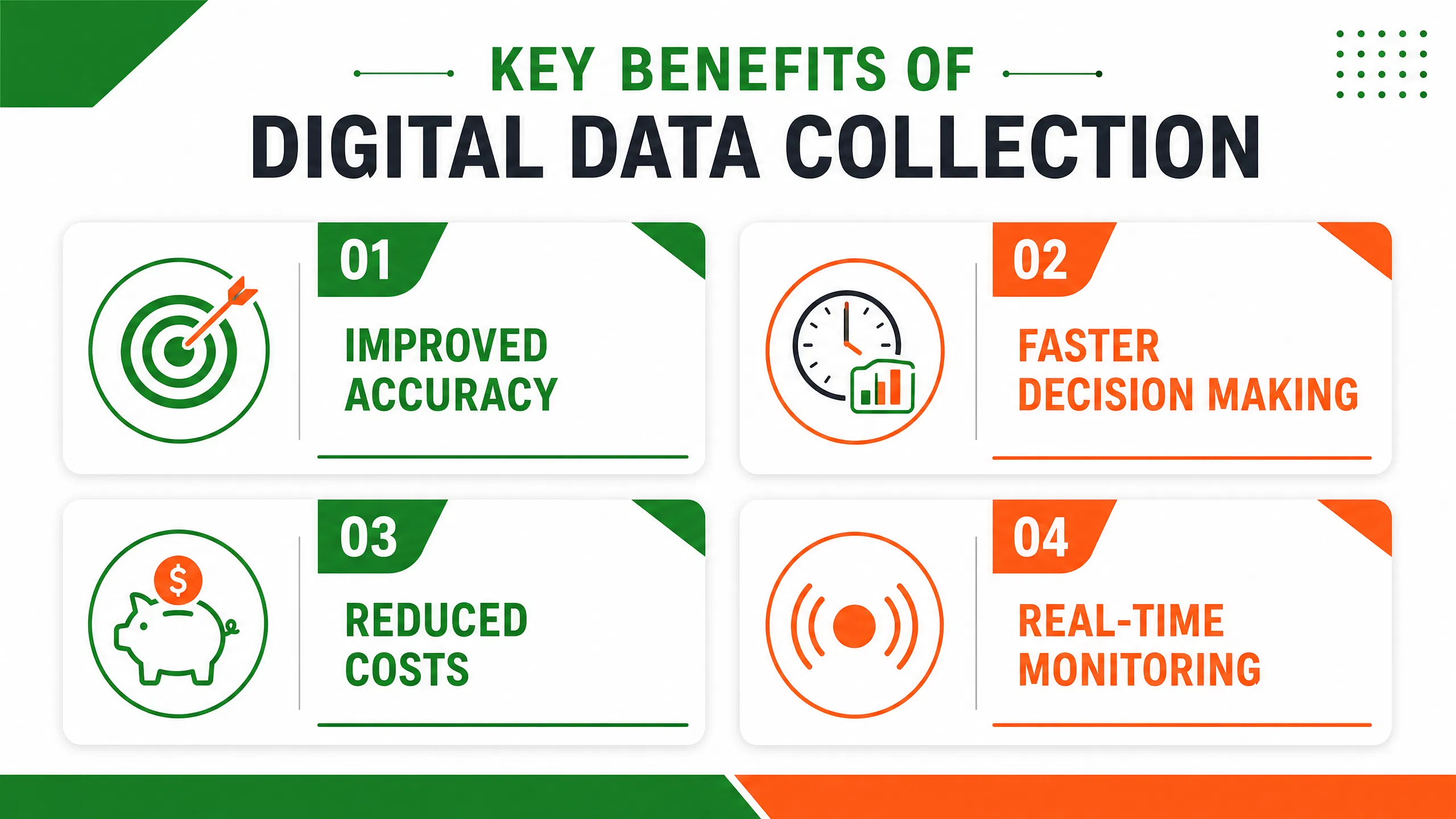
Improved Accuracy
Digital forms reduce human error through automatic validation rules.
For example:
- Numeric fields only accept numbers.
- Dates follow predefined formats.
- Required questions cannot be skipped.
- Duplicate entries can be detected automatically.
As a result, organizations achieve significantly higher data quality.
Faster Decision Making
Real-time synchronization enables managers to monitor activities as they happen.
Instead of waiting for weekly reports, executives can view dashboards that update every few minutes.
This allows organizations to:
- Respond to emergencies quickly
- Monitor project performance
- Identify trends early
- Allocate resources efficiently
Reduced Operational Costs
Although digital implementation requires initial investment, long-term savings are substantial.
Organizations reduce expenses related to:
- Printing
- Transport
- Data entry
- Document storage
- Archiving
- Paper handling
Additionally, fewer manual processes translate into improved productivity and lower operational risks.
Training programs help organizations maximize these benefits by ensuring teams understand industry best practices and modern digital tools.
Key Components of Mobile and Digital Data Collection
An effective mobile data collection system consists of several interconnected components that work together to deliver accurate, timely, and secure information.
Mobile Devices
These include:
- Smartphones
- Tablets
- Rugged handheld devices
Modern devices offer:
- GPS functionality
- Cameras
- High-speed processors
- Offline capabilities
- Long battery life
Data Collection Software
Applications provide customizable electronic forms that replace traditional questionnaires.
Features often include:
- Conditional logic
- Skip patterns
- Validation rules
- Offline data capture
- Automatic synchronization
Cloud Storage
Collected information is stored securely in centralized databases.
Cloud platforms provide:
- Backup
- Disaster recovery
- Access control
- Multi-user collaboration
- Scalability
Dashboards and Analytics
Decision-makers rely on interactive dashboards to visualize:
- Performance indicators
- Maps
- Charts
- Trends
- Project progress
These analytical tools transform raw data into actionable insights.
Popular Mobile and Digital Data Collection Technologies
Selecting the right technology is one of the most important decisions an organization can make when implementing mobile and digital data collection. The ideal solution depends on project size, available resources, internet connectivity, security requirements, and reporting needs. Fortunately, today’s market offers numerous tools that make digital data collection easier than ever before.
Mobile Data Collection Applications
Modern applications allow organizations to design electronic forms that can be completed on smartphones, tablets, or rugged handheld devices. These forms often include intelligent features that improve both speed and accuracy.
Common capabilities include:
- Offline data collection
- GPS location tracking
- Automatic timestamps
- Photo capture
- Video recording
- Audio recording
- Barcode scanning
- QR code scanning
- Digital signatures
- Conditional questions
- Skip logic
- Real-time synchronization
As a result, organizations reduce manual work while ensuring that collected information meets quality standards.
Professionals seeking practical skills in deploying these technologies can explore specialized training through ForElite Training’s Mobile and Digital Data Collection programs.
Cloud-Based Platforms
Cloud computing has become the backbone of modern mobile and digital data collection systems. Instead of storing records on individual devices or office computers, organizations upload information to secure online servers.
Cloud platforms offer several benefits:
| Feature | Benefit |
|---|---|
| Automatic backup | Prevents data loss |
| Remote access | Teams work from anywhere |
| Centralized database | Eliminates duplicate files |
| Live reporting | Supports faster decisions |
| Role-based permissions | Improves security |
| Automatic synchronization | Keeps data current |
Consequently, managers can monitor projects in real time regardless of where field teams are located.
Geographic Information Systems (GIS)
Location-based information is increasingly important in sectors such as agriculture, humanitarian response, environmental conservation, utilities, and infrastructure development.
GIS integration enables organizations to:
- Map survey locations
- Track field activities
- Monitor asset distribution
- Analyze geographic trends
- Identify service gaps
- Improve planning
Furthermore, combining GIS with mobile and digital data collection provides valuable spatial insights that paper-based methods simply cannot deliver.
Applications Across Different Industries
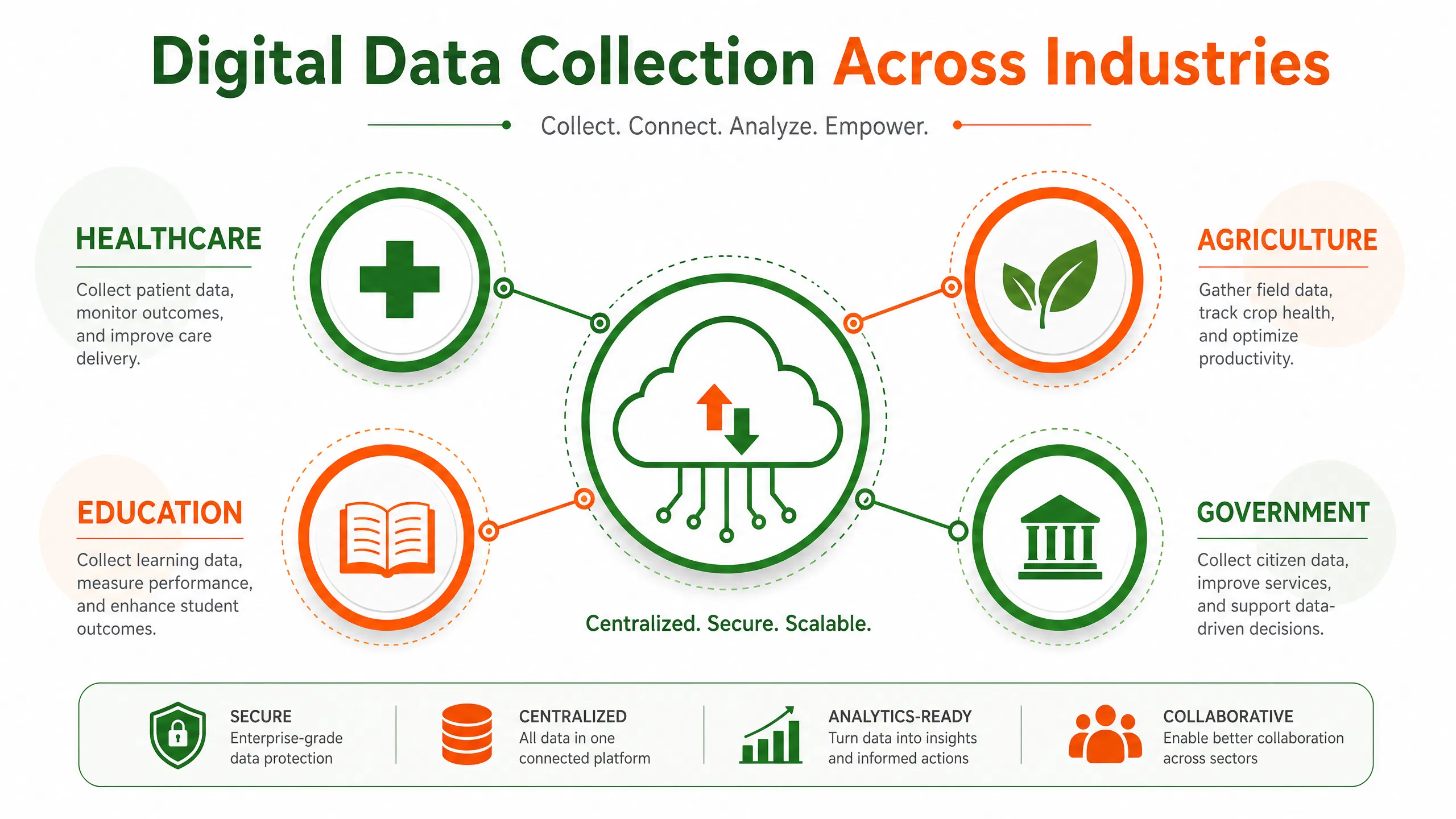
One reason mobile and digital data collection has gained widespread adoption is its flexibility. Almost every industry depends on accurate information to improve planning and service delivery.
Healthcare
Healthcare professionals use digital tools to record patient information, conduct disease surveillance, monitor vaccination campaigns, and manage public health programs.
Benefits include:
- Faster patient registration
- Improved medical records
- Better outbreak monitoring
- Reduced paperwork
- Improved reporting accuracy
Additionally, healthcare organizations can quickly analyze trends and respond to emergencies using real-time dashboards.
Agriculture
Farmers, extension officers, and agricultural researchers increasingly rely on digital platforms to monitor crops, assess soil conditions, conduct farm surveys, and evaluate agricultural programs.
Applications include:
- Crop monitoring
- Pest surveillance
- Soil data collection
- Farmer registration
- Yield estimation
- Livestock management
Likewise, agricultural development organizations benefit from more accurate and timely field information.
Education
Educational institutions use digital data collection to monitor attendance, evaluate learning outcomes, conduct research, and improve institutional management.
Examples include:
- Student enrollment
- Teacher assessments
- School inspections
- Online surveys
- Classroom observations
- Institutional evaluations
As a result, administrators gain immediate access to performance indicators that support evidence-based decision-making.
Government
Government agencies conduct numerous field activities that require reliable data.
These include:
- National censuses
- Household surveys
- Tax inspections
- Infrastructure monitoring
- Public service assessments
- Environmental inspections
Digital systems help improve transparency, accountability, and service delivery.
Humanitarian Organizations
NGOs and humanitarian agencies frequently operate in remote or emergency settings where timely information is critical.
Digital tools assist with:
- Disaster assessments
- Refugee registration
- Food distribution
- Water and sanitation monitoring
- Livelihood surveys
- Protection assessments
Therefore, humanitarian organizations can deliver aid more efficiently while maintaining high-quality records.
To strengthen these capabilities, organizations often invest in professional capacity building through courses such as those available at: Mobile and Digital Data Collection Short Courses.
Best Practices for Successful Implementation
Technology alone does not guarantee success. Organizations must also establish effective processes that promote quality, consistency, and accountability.
1. Clearly Define Objectives
Before designing electronic forms, identify:
- What information is needed
- Why it is being collected
- Who will use the results
- How often data should be collected
Without clear objectives, projects often collect unnecessary information that complicates analysis.
2. Design User-Friendly Forms
Digital forms should be simple and intuitive.
Best practices include:
- Short questions
- Clear instructions
- Logical sequencing
- Required fields where necessary
- Appropriate validation rules
Moreover, reducing complexity minimizes respondent fatigue and improves data quality.
3. Train Field Teams Thoroughly
Even the best technology requires competent users.
Training should cover:
- Device operation
- Form navigation
- GPS usage
- Data synchronization
- Troubleshooting
- Ethical data collection
- Privacy requirements
Organizations can build these competencies through practical short courses offered by ForElite Training Institute
4. Pilot Before Full Deployment
A pilot project helps identify:
- Technical issues
- Missing questions
- Poor workflows
- Connectivity challenges
- User experience problems
Afterward, organizations can refine their systems before rolling them out on a larger scale.
5. Monitor Data Quality Continuously
Data quality should be reviewed throughout the project—not only at the end.
Supervisors should regularly check for:
- Missing values
- Duplicate entries
- GPS accuracy
- Inconsistent responses
- Suspicious records
- Outliers
Continuous monitoring improves confidence in the final dataset.
Data Security and Privacy Considerations
As organizations collect increasing amounts of digital information, protecting that data becomes a top priority.
Key security measures include:
- Strong passwords
- Multi-factor authentication
- Data encryption
- Secure cloud storage
- Role-based user access
- Automatic backups
- Regular software updates
Equally important, organizations should comply with relevant data protection regulations and obtain informed consent from respondents before collecting personal information.
A well-designed mobile and digital data collection system balances accessibility with strong security controls.
Partnering with Technology Experts
Successful digital transformation often requires experienced technical partners who can customize solutions, integrate systems, and provide ongoing support.
Organizations looking to implement secure digital platforms, modern web applications, system integrations, or digital transformation strategies can benefit from working with experts such as Nexera Digital Solutions.
Professional technology partners help organizations develop scalable, secure, and user-friendly digital ecosystems that support long-term growth and innovation.
Common Challenges in Mobile and Digital Data Collection
While mobile and digital data collection offers significant advantages, organizations may encounter challenges during implementation. Fortunately, most of these obstacles can be addressed through careful planning, proper training, and the right technology.
Limited Internet Connectivity
Many field operations take place in rural or remote areas where internet access is unreliable.
However, modern mobile data collection applications support offline functionality. Field staff can capture information without an internet connection and synchronize the data automatically once connectivity is restored.
Best practices include:
- Using applications with offline capabilities.
- Scheduling regular synchronization when network access is available.
- Equipping teams with backup power banks to prevent device shutdowns.
Device Management
Managing dozens or even hundreds of mobile devices can become complex.
Organizations should establish policies for:
- Device registration
- Security updates
- Lost or stolen device reporting
- Routine maintenance
- Software upgrades
Additionally, Mobile Device Management (MDM) solutions can simplify administration and improve security across the organization.
Data Quality Issues
Even with digital forms, inaccurate data can still occur if users are not properly trained.
Common causes include:
- Incorrect GPS locations
- Careless data entry
- Poorly designed forms
- Inadequate supervision
Therefore, organizations should implement continuous quality assurance measures, including automated validation rules, supervisor reviews, and periodic audits.
Resistance to Change
Employees who are accustomed to paper-based systems may initially resist adopting digital tools.
Successful change management includes:
- Early stakeholder engagement
- Practical demonstrations
- Hands-on training
- Ongoing technical support
- Recognition of successful adoption
Over time, users typically recognize the benefits of faster workflows, reduced paperwork, and improved reporting.
Future Trends in Mobile and Digital Data Collection
Technology continues to evolve rapidly, creating exciting opportunities for organizations that rely on mobile and digital data collection.
Artificial Intelligence (AI)
Artificial Intelligence is beginning to automate many aspects of data collection and analysis.
Emerging capabilities include:
- Automated data validation
- Predictive analytics
- Intelligent anomaly detection
- Automated report generation
- Smart survey recommendations
Consequently, organizations can spend less time cleaning data and more time acting on insights.
Internet of Things (IoT)
IoT devices automatically collect data from connected sensors without requiring manual input.
Examples include:
- Weather stations
- Smart water meters
- Environmental sensors
- Traffic monitoring systems
- Industrial equipment
When integrated with mobile applications, IoT devices provide continuous streams of real-time information.
Machine Learning
Machine learning algorithms help organizations identify trends that might otherwise go unnoticed.
Applications include:
- Forecasting demand
- Predicting equipment failures
- Detecting fraud
- Monitoring project performance
- Identifying high-risk areas
Cloud-Native Analytics
Cloud platforms continue to improve by offering:
- Interactive dashboards
- Automated reporting
- Collaboration tools
- Scalable storage
- Enhanced security
These features make it easier for organizations to transform raw data into actionable business intelligence.
Increased Automation
Automation is reducing repetitive manual tasks throughout the data lifecycle.
Examples include:
- Automatic notifications
- Workflow approvals
- Scheduled reports
- Data synchronization
- Quality checks
As a result, organizations achieve greater efficiency while minimizing human error.
Building Digital Data Collection Capacity
Investing in technology is only one part of successful digital transformation. Equally important is developing the skills of the people who design, manage, and analyze digital data collection systems.
Professionals who want to strengthen their expertise can benefit from specialized training programs that cover topics such as:
- Mobile survey design
- Digital questionnaire development
- Data quality management
- Geographic Information Systems (GIS)
- Dashboard creation
- Cloud-based data management
- Field data collection best practices
Explore available programs through ForElite Training’s Mobile and Digital Data Collection category.
These practical courses are designed to help professionals apply modern tools and techniques in real-world projects.
Relevant External Resource
For organizations seeking internationally recognized guidance on digital development and data-driven transformation, the World Bank Digital Development initiative provides valuable publications, case studies, and best practices:
Frequently Asked Questions (FAQs)
1. What is mobile and digital data collection?
Mobile and digital data collection is the process of gathering information electronically using smartphones, tablets, or other digital devices instead of paper forms. It improves accuracy, reduces manual work, and enables real-time reporting.
2. What are the main benefits of mobile and digital data collection?
The primary benefits include improved data accuracy, faster reporting, reduced operational costs, real-time monitoring, enhanced collaboration, and better decision-making.
3. Can mobile data collection work without internet access?
Yes. Many modern applications support offline functionality, allowing users to collect data in remote locations and synchronize it later when an internet connection becomes available.
4. Which industries benefit the most from digital data collection?
Healthcare, agriculture, education, government, humanitarian organizations, finance, logistics, manufacturing, construction, and environmental management all benefit from digital data collection systems.
5. How can organizations ensure data security?
Organizations should implement encryption, secure cloud storage, multi-factor authentication, role-based access controls, regular software updates, backups, and staff training on data privacy and cybersecurity.
6. Why is professional training important for mobile and digital data collection?
Training helps users design effective digital forms, improve data quality, manage field operations efficiently, analyze collected information, and maximize the return on technology investments.
Conclusion
Mobile and digital data collection has fundamentally transformed how organizations gather, manage, and use information. Compared to traditional paper-based methods, digital solutions provide greater accuracy, faster reporting, enhanced security, and significant cost savings.
Moreover, the integration of cloud computing, artificial intelligence, geographic information systems, and mobile technologies continues to expand the possibilities for efficient and reliable data collection across every sector.
Organizations that embrace these technologies position themselves to make faster, evidence-based decisions, improve operational performance, and deliver better outcomes for their stakeholders. At the same time, investing in staff training ensures that teams can fully leverage the capabilities of modern digital tools while maintaining high standards of data quality and security.
Whether you are beginning your digital transformation journey or enhancing existing systems, continuous learning and strategic technology partnerships are essential for long-term success. By combining robust mobile data collection platforms, skilled professionals, and trusted technology partners, organizations can build resilient, data-driven operations that thrive in an increasingly digital world.
Thank you for reading this comprehensive guide on mobile and digital data collection. If you’d like to deepen your expertise, explore professional training opportunities through ForElite Training and discover innovative digital transformation solutions with Nexera Digital Solutions to support your organization’s future growth.