


Understanding Digital Upskilling
What Digital Upskilling Means Today
The modern workplace is changing at a speed that few could have imagined a decade ago. Businesses are embracing automation, artificial intelligence, cloud platforms, digital collaboration tools, and advanced analytics to remain competitive. As a result, employees and organizations are under increasing pressure to adapt. This is where digital upskilling becomes essential. Digital upskilling refers to the process of learning and enhancing digital competencies that enable individuals to perform effectively in technology-driven environments. These skills can range from basic digital literacy to advanced capabilities in artificial intelligence, cybersecurity, cloud computing, and data science.
Meanwhile, digital upskilling is no longer limited to IT professionals. Healthcare workers use digital platforms for patient management, marketers rely on analytics tools, educators deliver online learning experiences, and government agencies increasingly offer digital services. The ability to navigate digital systems has become a core requirement across sectors. Organizations worldwide are investing heavily in workforce development initiatives because they recognize that technology alone cannot drive transformation. Employees must possess the skills to leverage digital tools effectively. According to industry reports, the demand for digital competencies continues to rise as businesses accelerate their digital transformation efforts.
Why Digital Skills Matter Across Every Industry
Digital skills have evolved from being a competitive advantage to becoming a necessity. Employers now seek candidates who can adapt to new technologies, analyze data, collaborate through digital platforms, and contribute to innovation initiatives. Consequently, professionals who continuously improve their digital capabilities often enjoy greater career opportunities and increased job security.
Consider the workplace as a vehicle traveling on a rapidly changing road. Technology acts as the engine, but digital skills are the fuel that keeps the journey moving forward. Without the right skills, organizations struggle to maximize their investments in technology. Employees who understand digital systems can identify opportunities, streamline operations, and create value for customers. Additionally, digital competence enhances problem-solving abilities and encourages innovation. Companies increasingly prioritize workers who can think critically while using technology to achieve business objectives. As industries continue evolving, digital upskilling remains one of the most reliable ways to remain relevant and competitive.
The Growing Demand for Digital Talent
How Digital Transformation Is Reshaping Workplaces
Digital transformation has fundamentally altered how businesses operate. Organizations are implementing cloud-based systems, adopting automation tools, integrating artificial intelligence into workflows, and leveraging data analytics to improve decision-making. As a result, traditional job roles are evolving, and entirely new career paths are emerging.
The shift toward digital-first operations creates opportunities while also introducing challenges. Employees who fail to adapt may find their skills becoming obsolete. On the other hand, professionals who embrace continuous learning position themselves for advancement. Businesses require talent capable of managing digital systems, interpreting complex data, and driving innovation. This demand spans industries including healthcare, finance, education, manufacturing, logistics, and public administration. The rapid pace of technological advancement means organizations cannot rely solely on hiring external talent. Instead, many are focusing on internal upskilling programs that empower existing employees to meet new demands.
The Global Digital Skills Gap
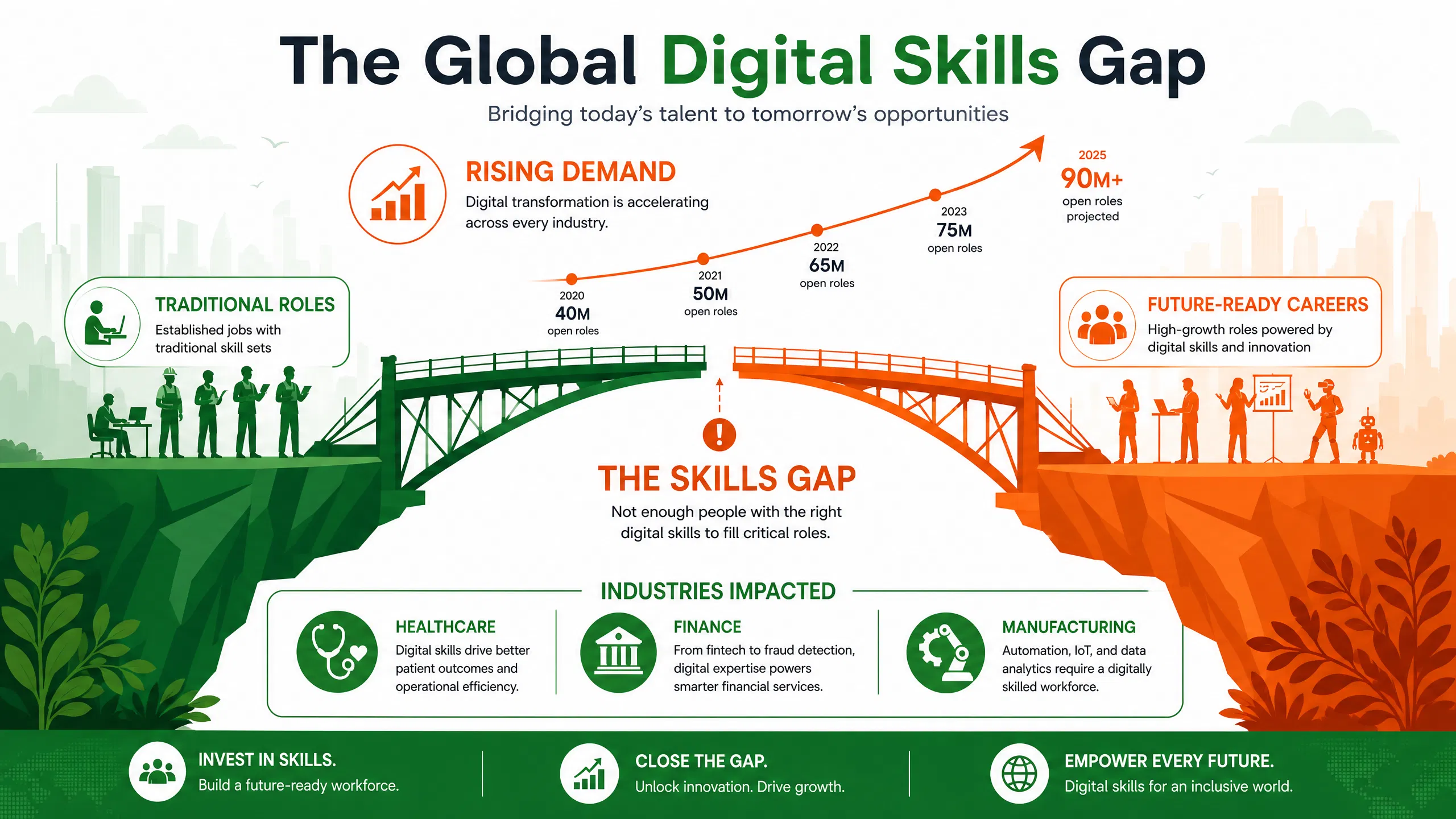
One of the most significant challenges facing businesses today is the widening digital skills gap. Employers frequently report difficulties finding qualified candidates with the necessary digital competencies. This gap affects productivity, innovation, and overall competitiveness. Therefore, organizations are investing in training initiatives designed to close this gap and future-proof their workforce.
The shortage of digital talent is particularly evident in areas such as cybersecurity, artificial intelligence, cloud computing, and data analytics. Many organizations are recognizing that continuous learning is not optional but essential. Educational institutions and professional training providers are responding by offering specialized programs that align with industry needs. Consequently, learners now have greater access to practical and career-focused digital training opportunities than ever before.
Core Digital Skills Every Professional Needs
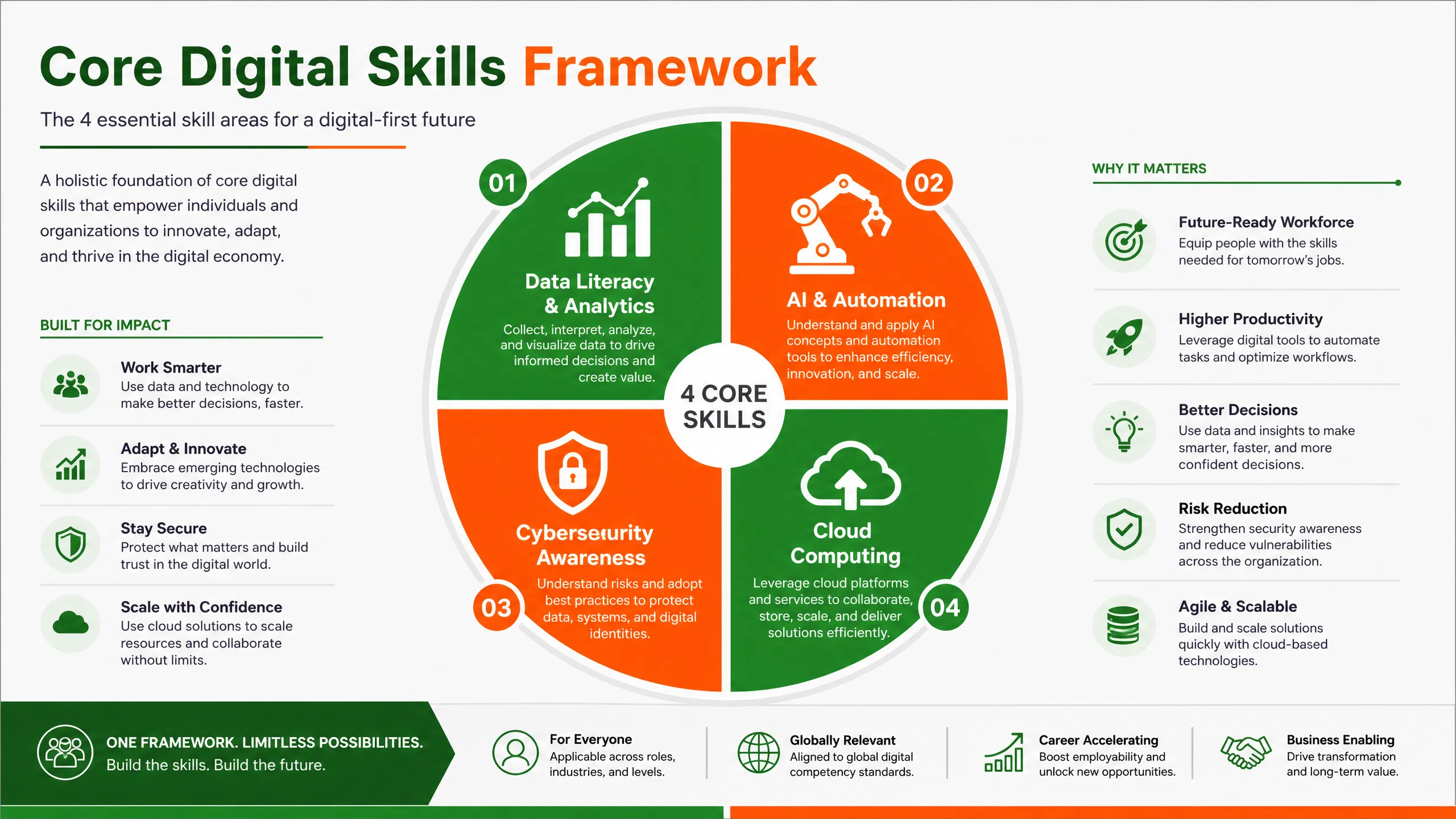
Data Literacy and Analytics
Data has become one of the most valuable assets in modern business. Organizations collect vast amounts of information from customers, operations, and digital interactions. However, data only becomes valuable when individuals can interpret and apply it effectively. Data literacy enables professionals to understand, analyze, and communicate insights derived from data.
Employees with strong analytical skills can identify trends, support decision-making, and contribute to strategic planning. Whether working in marketing, finance, healthcare, or logistics, understanding data has become increasingly important. Training programs in analytics help professionals transform raw information into actionable intelligence. This capability supports better business outcomes while enhancing individual career prospects.
Artificial Intelligence and Automation
Artificial intelligence is reshaping industries worldwide. From predictive analytics to intelligent automation, AI technologies are transforming workflows and creating new opportunities for efficiency. Therefore, professionals who understand AI concepts and applications are increasingly valuable.
AI does not replace human expertise; rather, it enhances it. Employees who can work alongside AI tools are better equipped to solve complex problems and deliver innovative solutions. Learning about machine learning, automation, and AI-driven decision-making enables professionals to remain competitive in an evolving labor market. Organizations that invest in AI training often experience improved productivity and stronger innovation capabilities.
Cybersecurity Awareness
As businesses become more digital, cybersecurity risks continue to increase. Data breaches, ransomware attacks, and phishing scams pose significant threats to organizations of all sizes. Consequently, cybersecurity awareness has become an essential skill for every employee, not just IT specialists.
Understanding cybersecurity principles helps individuals recognize threats and follow best practices for protecting sensitive information. Organizations that prioritize cybersecurity training reduce their risk exposure and strengthen overall resilience. Employees play a critical role in maintaining secure digital environments, making cybersecurity education a key component of digital upskilling initiatives.
Cloud Computing and Digital Infrastructure
Cloud technology powers many of today’s digital services and business operations. Organizations rely on cloud platforms to store data, support remote work, and deliver scalable solutions. As cloud adoption continues to grow, professionals with cloud computing knowledge are increasingly in demand.
Understanding cloud concepts enables employees to collaborate effectively, manage digital resources, and support organizational objectives. Cloud skills are particularly valuable in sectors undergoing digital transformation. Training in cloud infrastructure provides learners with practical knowledge that can be applied across a wide range of industries and job roles.
Benefits of Digital Upskilling
Career Growth and Employability
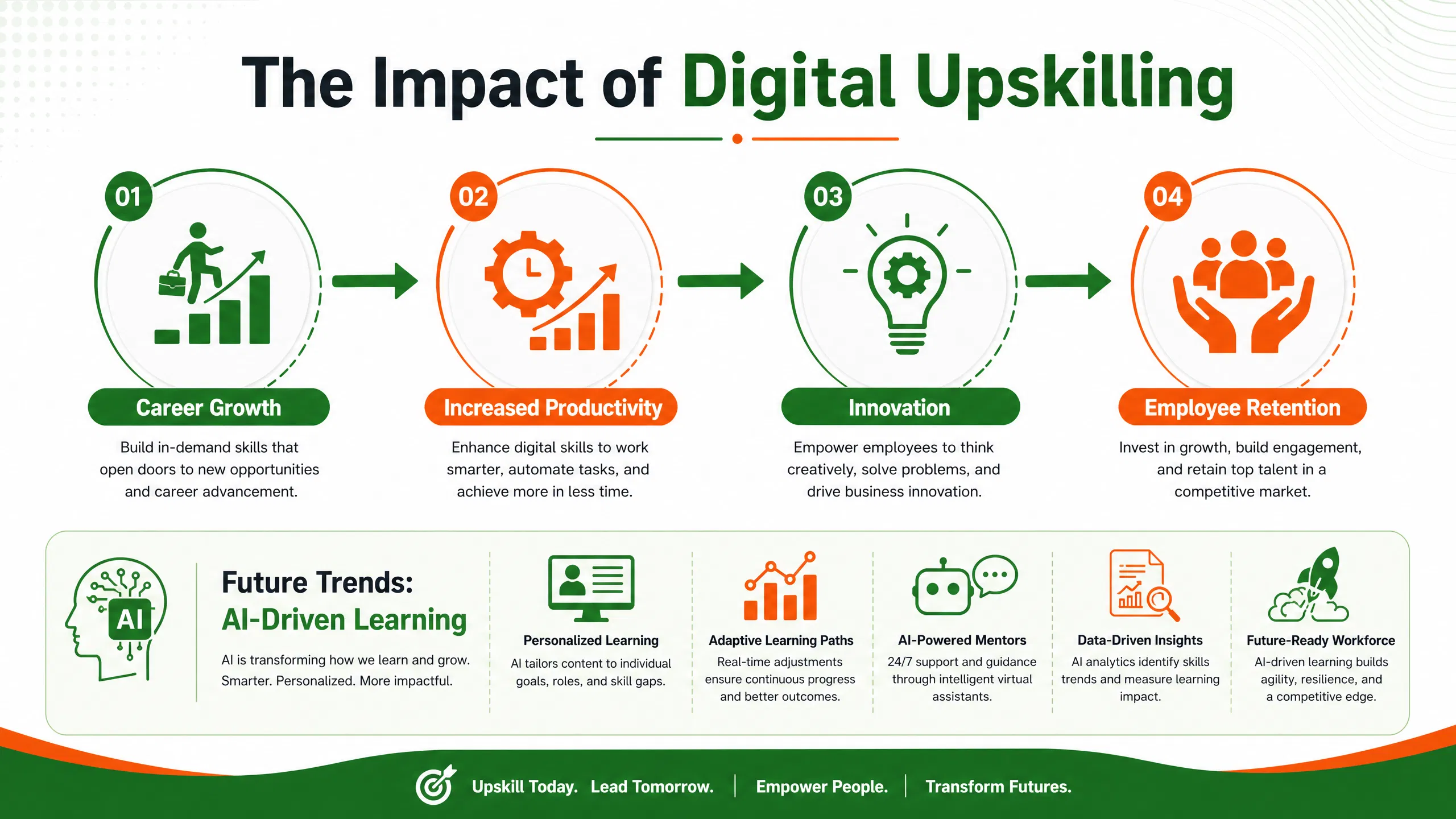
One of the most compelling reasons to invest in digital upskilling is career advancement. Employers consistently seek candidates who demonstrate adaptability, technical proficiency, and a commitment to continuous learning. Therefore, acquiring digital skills can significantly improve employability and earning potential.
Professionals who embrace learning often gain access to new opportunities, promotions, and leadership roles. Digital competencies also enable individuals to transition into emerging fields such as data science, AI, cybersecurity, and digital marketing. Additionally, upskilling enhances confidence by providing learners with practical capabilities that can be immediately applied in the workplace.
Improved Productivity and Innovation
Digital skills empower employees to work more efficiently and effectively. Automation tools reduce repetitive tasks, analytics platforms improve decision-making, and collaboration technologies enhance communication. As a result, organizations benefit from increased productivity and improved operational performance.
Innovation also thrives in digitally skilled environments. Employees who understand technology are more likely to identify opportunities for improvement and develop creative solutions to business challenges. This culture of innovation supports long-term growth and competitiveness. Businesses that prioritize upskilling often achieve stronger outcomes because their workforce is equipped to adapt and evolve alongside technological advancements.
How Organizations Benefit from Upskilling
Increased Competitiveness
Organizations that invest in digital upskilling gain a significant competitive advantage. Skilled employees can leverage technology to improve efficiency, enhance customer experiences, and support strategic initiatives. Consequently, businesses become more agile and better positioned to respond to market changes.
The relationship between technology and talent is similar to that of a high-performance vehicle and an experienced driver. Advanced technology alone cannot deliver results without capable individuals who understand how to use it effectively. Upskilling initiatives ensure that employees can maximize the value of digital investments and contribute to organizational success.
Better Employee Retention
Employees value organizations that invest in their professional development. Providing access to training and learning opportunities demonstrates a commitment to employee growth. Therefore, companies that prioritize upskilling often experience higher levels of engagement and retention.
A culture of continuous learning fosters motivation and loyalty. Employees who feel supported in their development are more likely to remain with an organization and contribute to its long-term success. This reduces recruitment costs while strengthening institutional knowledge and expertise.
Choosing the Right Digital Upskilling Path
Identifying Skill Gaps
Successful upskilling begins with understanding existing capabilities and identifying areas for improvement. Organizations should conduct assessments to determine which skills are needed to support strategic goals. Likewise, individuals should evaluate their current competencies and career aspirations.
Skill gap analysis provides a roadmap for targeted learning and development. Rather than pursuing random courses, learners can focus on acquiring skills that align with industry demand and organizational priorities. This strategic approach maximizes the return on investment in training and development.
Selecting Industry-Relevant Training Programs
Choosing the right training provider is critical. High-quality programs combine theoretical knowledge with practical application, ensuring learners can immediately apply new skills in real-world environments. Additionally, industry-recognized certifications can enhance credibility and employability.
The following table highlights key areas of digital upskilling:
| Skill Area | Business Impact | Career Opportunities |
|---|---|---|
| AI & Machine Learning | Automation and innovation | AI Specialist, Data Scientist |
| Cybersecurity | Risk reduction and compliance | Security Analyst |
| Cloud Computing | Scalability and flexibility | Cloud Engineer |
| Data Analytics | Better decision-making | Data Analyst |
| Digital Marketing | Customer acquisition | Digital Marketing Specialist |
Leading Training Providers and Learning Resources
Forelite Training Courses for Digital Excellence
Organizations and professionals seeking comprehensive digital upskilling opportunities can benefit from the diverse programs offered by Forelite Training. The platform provides specialized learning pathways in digital transformation and emerging technologies, helping learners acquire practical skills that align with modern workforce demands.
Some notable learning areas include:
- AI and Machine Learning Short Courses
- Cloud Computing and Digital Infrastructure Short Courses
- Cybersecurity and Data Protection Short Courses
- Internet of Things (IoT) Short Courses
- Robotic Process Automation (RPA) Short Courses
- E-Government and Digital Service Delivery Short Courses
These programs cover essential areas of digital transformation, enabling professionals to build future-ready capabilities and remain competitive in evolving industries. Forelite Training also offers flexible learning formats, including virtual, in-person, and customized corporate training solutions.
Digital Growth Solutions from Nexera Digital Solutions
Digital upskilling extends beyond technical capabilities to include digital marketing, online visibility, and business growth strategies. Organizations seeking support in these areas can explore the services offered by Nexera Digital Solutions. The company specializes in digital marketing consulting, SEO strategy, website development, analytics, and performance optimization designed to help businesses achieve measurable online growth.
As organizations continue expanding their digital presence, understanding digital marketing technologies and data-driven decision-making becomes increasingly valuable. Combining technical upskilling with digital business strategies creates a powerful foundation for long-term success in the digital economy.
Future Trends in Digital Upskilling
AI-Driven Learning
Artificial intelligence is transforming how people learn. Personalized learning platforms can adapt content based on individual progress, strengths, and weaknesses. Consequently, learners receive more relevant and effective training experiences.
AI-powered educational tools provide instant feedback, recommend learning pathways, and support continuous improvement. These capabilities make learning more accessible and efficient, helping individuals acquire skills faster than traditional methods.
Continuous Learning Culture
The future belongs to organizations that embrace continuous learning. Technology evolves rapidly, making lifelong learning essential for sustained success. Therefore, businesses are increasingly embedding learning into daily workflows and encouraging employees to pursue ongoing development.
A culture of continuous learning supports innovation, resilience, and adaptability. Employees become more confident in navigating change, while organizations remain competitive in dynamic markets. Digital upskilling is not a one-time event but an ongoing journey that evolves alongside technology and industry demands.
Conclusion
Digital upskilling has become one of the most important investments individuals and organizations can make in today’s technology-driven world. As digital transformation accelerates, the demand for skills in artificial intelligence, data analytics, cybersecurity, cloud computing, and digital business continues to grow. Professionals who embrace continuous learning position themselves for career advancement, while organizations benefit from improved productivity, innovation, and competitiveness.
The most successful businesses understand that technology alone cannot drive transformation. People remain the driving force behind innovation and growth. By investing in high-quality learning opportunities such as those offered by Forelite Training and leveraging digital expertise from providers like Nexera Digital Solutions, individuals and organizations can build the capabilities needed to thrive in the modern digital economy.
FAQs
1. What is digital upskilling?
Digital upskilling is the process of learning and improving digital competencies such as AI, data analytics, cybersecurity, cloud computing, and digital collaboration tools.
2. Why is digital upskilling important?
It helps professionals remain competitive, improves employability, enhances productivity, and supports organizational growth in a technology-driven environment.
3. Which digital skills are most in demand?
Artificial intelligence, cybersecurity, data analytics, cloud computing, automation, and digital marketing are among the most sought-after skills.
4. How can organizations benefit from digital upskilling?
Organizations gain increased productivity, stronger innovation, improved employee retention, and enhanced competitiveness through workforce development initiatives.
5. Where can I learn digital skills?
Professional training providers such as Forelite Training offer specialized courses in digital transformation, AI, cybersecurity, cloud computing, IoT, and related disciplines.